McIntosh: Difference between revisions
Bot: Add 20 USDA Pomological Watercolor(s) (POM00000890, POM00002355, POM00002837, POM00002838, POM00002839, POM00002840, POM00002841, POM00002842, POM00002843, POM00002844, POM00002845, POM00002846, POM00002847, POM00002848, POM00002849, POM00002850, POM00002851, POM00002852, POM00003484, POM00003922) |
Bot: add USDA Pomological Watercolors from Variety Finder (mcintosh-apple) |
||
| (4 intermediate revisions by the same user not shown) | |||
| Line 2: | Line 2: | ||
|name=McIntosh | |name=McIntosh | ||
|species=Apple | |species=Apple | ||
}} | }} | ||
[[File:USDA_Pomological_McIntosh_POM00002355.jpg|thumb|right|320px|USDA Pomological Watercolor of McIntosh. <small>Public domain. USDA National Agricultural Library.</small>]] | |||
''' | A Fameuse seedling, double the size of its parent, and of a rich dark red with a heavy blue bloom; one of the most beautiful apples in the world, and among the best in quality. It can be grown as far as, or farther north, than its parent. Tree very hardy, long-lived, and a good bearer. Season, early mid-winter, or longer. | ||
'''Read the full entry:''' [https://heritageapplecorps.org/varieties/mcintosh-apple/ McINTOSH on the Variety Finder] for deeper history, every book quote, and all nursery catalog references. | |||
== | == Quick Facts == | ||
{| class="wikitable" | |||
|- | |||
| '''Type''' || Apple | |||
|- | |||
| '''Season''' || Early (Early to mid-fall (mid-September)) | |||
|- | |||
| '''Flavor''' || sweet, vinous, subacid, aromatic | |||
|- | |||
| '''Flavor notes''' || Sweet with refreshing acidity and vinous (wine-like) quality; bright white flesh; best fresh from tree | |||
|- | |||
| '''Uses''' || fresh eating, cider, sauce, cooking | |||
|- | |||
| '''Keeping quality''' || Fair | |||
|- | |||
| '''Size''' || Above Medium | |||
|- | |||
| '''Shape''' || Round | |||
|- | |||
| '''Skin color''' || red, yellow, green, crimson, purple, striped, blushed, dark, light | |||
|- | |||
| '''Flesh''' || White fine | |||
|- | |||
| '''Origin''' || Ontario, Canada, c. 1811. Dundela, Upper Canada (Ontario); discovered 1811 by John McIntosh as wild seedlings on his farm | |||
|} | |||
== | == Synonyms == | ||
<gallery mode="packed" heights=" | MacIntosh Red, McIntosh Red | ||
File:USDA_Pomological_McIntosh_POM00002355.jpg| | == Fruit == | ||
File:USDA_Pomological_McIntosh_POM00002837.jpg| | '''Size:''' Medium or above (Downing); above medium, sometimes large (Beach); above medium to large (Hansen; Budd-Hansen); full medium (Thomas); medium size (Central Experimental Farm); large (Hedrick); medium-large (Fisher). Pretty uniform in shape and size (Beach; Hedrick). | ||
File:USDA_Pomological_McIntosh_POM00002838.jpg| | |||
File:USDA_Pomological_McIntosh_POM00002839.jpg| | '''Form:''' Roundish oblate, regular (Downing; Central Experimental Farm); roundish to somewhat oblate, regular or faintly ribbed, obscurely angular (Beach; Lowther); round-oblate, regular (Hedrick); round-oblate (Fisher); roundish oblate to roundish truncated, slightly irregular and obscurely angular (Hansen; Budd-Hansen); roundish (Thomas). Hedrick describes the form poetically as "a sphere modified by a little oblateness," and notes that "well grown, each apple seems to have been turned out of the same mould." | ||
File:USDA_Pomological_McIntosh_POM00002840.jpg| | |||
File:USDA_Pomological_McIntosh_POM00002841.jpg| | '''Stem/Stalk:''' Short, rather small (Downing); short, stout or moderately slender, usually not exserted, often with irregular protuberances (Beach); short, moderately slender (Lowther); short, stout, slender, usually not exserted, often with irregular protuberances (Hedrick); short to medium, stout (Hansen; Budd-Hansen). | ||
File:USDA_Pomological_McIntosh_POM00002842.jpg| | |||
File:USDA_Pomological_McIntosh_POM00002843.jpg| | '''Cavity:''' Medium (Downing); large, acuminate or somewhat acute, wide, medium in depth, somewhat broadly furrowed, often partly russeted (Beach); large, acuminate or somewhat acute (Lowther); large, acuminate, wide, broadly furrowed, often partly russeted (Hedrick); obtuse, wide, regular, with a trace of russet (Hansen; Budd-Hansen). | ||
File:USDA_Pomological_McIntosh_POM00002844.jpg| | |||
File:USDA_Pomological_McIntosh_POM00002845.jpg| | '''Calyx:''' Closed (Downing); small, closed or partly open; lobes short to long, narrow, acute (Beach); small, closed or partly open (Lowther); small, closed or partly open; lobes short, narrow, acute (Hedrick); closed, segments connivent (Hansen; Budd-Hansen). | ||
File:USDA_Pomological_McIntosh_POM00002846.jpg| | |||
File:USDA_Pomological_McIntosh_POM00002847.jpg| | '''Basin:''' Rather small, slightly plaited (Downing); pubescent, rather small, medium in depth, narrow, abrupt, smooth or obscurely furrowed (Beach); smooth, rather shallow, abrupt (Hansen; Budd-Hansen); pubescent, small, narrow, abrupt, smooth or obscurely furrowed (Hedrick). | ||
File:USDA_Pomological_McIntosh_POM00002848.jpg| | |||
File:USDA_Pomological_McIntosh_POM00002849.jpg| | '''Skin:''' Whitish yellow, very nearly covered with dark rich red or crimson, almost purplish in the sun, moderately sprinkled with light dots (Downing). Thin, moderately tender, smooth, readily separating from the flesh, clear whitish-yellow or greenish washed and deeply blushed with bright red and striped with carmine; highly colored specimens become dark, almost purplish-red with the carmine stripes obscure or obliterated, overspread with thin, lilac bloom. Often the effect of the deep red is heightened by lively contrast with one or more spots of the clear pale yellow ground color where some twig or leaf pressed closely against the growing fruit (Beach). Smooth, readily separating from the flesh, clear whitish yellow or greenish washed and deeply blushed with bright red and striped with carmine; in the Rocky Mountains States and in the Pacific Northwest it becomes in many cases a deep, dark red, overspread with a thin lilac bloom (Lowther). Thin, tender, smooth, readily separating from the flesh, pale-yellow washed and deeply blushed with bright red and striped with carmine, highly-colored specimens dark red with the carmine stripes obscure, overspread with bloom (Hedrick). Surface very smooth, polished, yellow, almost wholly covered with brilliant solid crimson, the coloring brighter on shaded side, with heavy blue bloom, a beautiful fruit (Hansen; Budd-Hansen). Bright crimson on light yellow skin; heavy bloom (Thomas). Greenish yellow, nearly covered with purple red and sprinkled with small grayish dots (Central Experimental Farm). Skin thin, purplish red with bloom (Fisher). Hedrick describes the bright deep-red color as "made more attractive by a heavy and characteristic bloom." | ||
File:USDA_Pomological_McIntosh_POM00002850.jpg| | |||
File:USDA_Pomological_McIntosh_POM00002851.jpg| | '''Dots:''' Light dots, moderately sprinkled (Downing); whitish or yellow, usually very small (Beach); white or yellow, small (Hedrick); many, obscure, minute, white (Hansen; Budd-Hansen); small grayish dots (Central Experimental Farm). | ||
File:USDA_Pomological_McIntosh_POM00002852.jpg| | |||
'''Flesh/Flavor:''' White, fine, very tender, juicy, mild subacid, refreshing, peculiar slight quince-like flavor (Downing). White or slightly tinged with yellow, sometimes veined with red, firm, fine, crisp, tender, very juicy, characteristically and agreeably aromatic, perfumed, sprightly, subacid, becoming mild and nearly sweet when very ripe, very good to best for dessert (Beach). Very tender, perfumed and delicious (Beach; Lowther). Snow-white, crisp, very tender, juicy, sprightly aromatic subacid, very good (Hansen; Budd-Hansen). White, stained with light red, tender, juicy, sub-acid (Thomas). White, fine, tender, juicy, with a pleasant acidity, quality very good (Central Experimental Farm). White, sometimes veined with red, firm, fine, crisp, tender, very juicy, perfumed, sprightly subacid; very good to best (Hedrick). Tender, fine, very juicy, aromatic; excellent dessert (Fisher). Hedrick: "When the apples are cut, flesh of snowy whiteness rimmed and stained with red is exposed, firm, fine, crisp, tender, and juicy, with a rich, delicious, and very distinctive flavor." He further extols the variety: "If one were compelled to choose the apple of apples as the season's varieties pass by, choosing in respect to the qualities which, united, gratify the greatest number of senses, few would hesitate in naming McIntosh sovereign of all. The fruits of McIntosh are uniquely beautiful, outwardly and inwardly, the flavor is hardly surpassed, and the whole apple is most agreeably perfumed." | |||
'''Core/Seeds:''' Core medium (Downing). Calyx tube short, conical or funnel-shape with broad limb. Stamens median to basal. Core medium size, usually abaxile; cells usually wide open; core lines nearly meeting. Carpels roundish to elliptical, narrowing toward base and apex, smooth, much concave. Seeds medium brown, rather large, acute (Beach). Calyx-tube short, conical, with broad limb; stamens median; core abaxile; cells wide open; core-lines meeting; carpels elliptical, smooth, concave; seeds brown, large, acute (Hedrick). Core close, cells ovate, entire; tube funnel-shaped; stamens marginal or median; seeds plump (Hansen; Budd-Hansen, who give "Core closed"). | |||
== Season == | |||
November to February (Downing); October to December or later (Beach; Hedrick); October to December, or when grown on high altitudes, may be marketed until January (Lowther); November and December (Central Experimental Farm); December to January (Hansen; Budd-Hansen); early winter (Thomas). | |||
'''Storage behavior:''' As grown at the New York Station, ripening begins in late September or early October. In Western New York it cannot be expected to keep much later than October in ordinary storage without considerable loss, but in cold storage it may be held until December or January. When grown in more northern or elevated regions it is often held in good condition till midwinter or later (Beach). Lowther similarly notes that in high altitudes it may be marketed until January. | |||
== Uses == | |||
Valuable for home use and market (Downing). Desirable for local markets and special trade, but because of its lack of firmness it is less suitable for general handling (Beach). Very good for dessert, sells well in the markets, and brings good profits (Lowther). Very good to best for dessert (Beach; Hedrick); excellent dessert (Fisher). The fruit is very attractive in appearance, of bright deep red color and good size (Beach; Lowther). Beach notes it has not been sufficiently tested to demonstrate fully its value for commercial purposes but is regarded by many as one of the most promising varieties of its class for general cultivation in New York. Hedrick lists three faults that detract from its value as a commercial fruit: apple-scab disfigurement, uneven ripening, and the apples seldom hanging until sufficiently mature. | |||
== Illustrations == | |||
<gallery mode="packed" heights="240"> | |||
File:USDA_Pomological_McIntosh_POM00002355.jpg|USDA Pomological Watercolor of McIntosh | |||
File:USDA_Pomological_McIntosh_POM00002837.jpg|USDA Pomological Watercolor of McIntosh | |||
File:USDA_Pomological_McIntosh_POM00002838.jpg|USDA Pomological Watercolor of McIntosh | |||
File:USDA_Pomological_McIntosh_POM00002839.jpg|USDA Pomological Watercolor of McIntosh | |||
File:USDA_Pomological_McIntosh_POM00002840.jpg|USDA Pomological Watercolor of McIntosh | |||
File:USDA_Pomological_McIntosh_POM00002841.jpg|USDA Pomological Watercolor of McIntosh | |||
File:USDA_Pomological_McIntosh_POM00002842.jpg|USDA Pomological Watercolor of McIntosh | |||
File:USDA_Pomological_McIntosh_POM00002843.jpg|USDA Pomological Watercolor of McIntosh | |||
File:USDA_Pomological_McIntosh_POM00002844.jpg|USDA Pomological Watercolor of McIntosh | |||
File:USDA_Pomological_McIntosh_POM00002845.jpg|USDA Pomological Watercolor of McIntosh | |||
File:USDA_Pomological_McIntosh_POM00002846.jpg|USDA Pomological Watercolor of McIntosh | |||
File:USDA_Pomological_McIntosh_POM00002847.jpg|USDA Pomological Watercolor of McIntosh | |||
File:USDA_Pomological_McIntosh_POM00002848.jpg|USDA Pomological Watercolor of McIntosh | |||
File:USDA_Pomological_McIntosh_POM00002849.jpg|USDA Pomological Watercolor of McIntosh | |||
File:USDA_Pomological_McIntosh_POM00002850.jpg|USDA Pomological Watercolor of McIntosh | |||
File:USDA_Pomological_McIntosh_POM00002851.jpg|USDA Pomological Watercolor of McIntosh | |||
File:USDA_Pomological_McIntosh_POM00002852.jpg|USDA Pomological Watercolor of McIntosh | |||
</gallery> | </gallery> | ||
<small>U.S. Department of Agriculture Pomological Watercolor Collection. Rare and Special Collections, National Agricultural Library, Beltsville, MD 20705</small> | <small>U.S. Department of Agriculture Pomological Watercolor Collection. Rare and Special Collections, National Agricultural Library, Beltsville, MD 20705</small> | ||
== Sources == | |||
* S.A. Beach, The Apples of New York Vol. 2 (1905). Public domain. | |||
* J.L. Budd & N.E. Hansen, American Horticultural Manual, Part II: Systematic Pomology (1914). Public domain. | |||
* H.H. Fisher, A Survey of Apple Clones in the United States (USDA ARS, 1963). Public domain. | |||
* A.J. Downing, Fruits and Fruit Trees of America (1869). Public domain. | |||
* N.E. Hansen, A Study of Northwestern Apples (South Dakota Ag. Exp. Station Bulletin 76, 1902). Public domain. | |||
* U.P. Hedrick, Cyclopedia of Hardy Fruits (1922). Public domain. | |||
* Granville Lowther (ed.), Encyclopedia of Practical Horticulture (1914). Public domain. | |||
* John J. Thomas, The American Fruit Culturist (1903). Public domain. | |||
* 47 historical nursery catalog references (see [https://heritageapplecorps.org/varieties/mcintosh-apple/ Variety Finder] for the full list). | |||
* '''Full entry with all citations:''' [https://heritageapplecorps.org/varieties/mcintosh-apple/ McINTOSH on the Variety Finder] | |||
== Trees of this Variety in Our Collection == | |||
{{#ask: [[Has variety::McIntosh]] | |||
|?Has orchard=Orchard | |||
|?Has field tag=Tag | |||
|?Has condition=Condition | |||
|format=table | |||
|sort=Has orchard, Has field tag | |||
}} | |||
[[Category:Varieties]] | [[Category:Varieties]] | ||
[[Category:Apple Trees]] | [[Category:Apple Trees]] | ||
Latest revision as of 12:38, 1 July 2026
| McIntosh | |
|---|---|
| Species | Apple |
| Trees Found | 2 |
| Orchards | Lithgow Springs |
| Preserved | Clarno Arboretum({{{clarno_year}}}) |

A Fameuse seedling, double the size of its parent, and of a rich dark red with a heavy blue bloom; one of the most beautiful apples in the world, and among the best in quality. It can be grown as far as, or farther north, than its parent. Tree very hardy, long-lived, and a good bearer. Season, early mid-winter, or longer. Read the full entry: McINTOSH on the Variety Finder for deeper history, every book quote, and all nursery catalog references.
Quick Facts
| Type | Apple |
| Season | Early (Early to mid-fall (mid-September)) |
| Flavor | sweet, vinous, subacid, aromatic |
| Flavor notes | Sweet with refreshing acidity and vinous (wine-like) quality; bright white flesh; best fresh from tree |
| Uses | fresh eating, cider, sauce, cooking |
| Keeping quality | Fair |
| Size | Above Medium |
| Shape | Round |
| Skin color | red, yellow, green, crimson, purple, striped, blushed, dark, light |
| Flesh | White fine |
| Origin | Ontario, Canada, c. 1811. Dundela, Upper Canada (Ontario); discovered 1811 by John McIntosh as wild seedlings on his farm |
Synonyms
MacIntosh Red, McIntosh Red
Fruit
Size: Medium or above (Downing); above medium, sometimes large (Beach); above medium to large (Hansen; Budd-Hansen); full medium (Thomas); medium size (Central Experimental Farm); large (Hedrick); medium-large (Fisher). Pretty uniform in shape and size (Beach; Hedrick).
Form: Roundish oblate, regular (Downing; Central Experimental Farm); roundish to somewhat oblate, regular or faintly ribbed, obscurely angular (Beach; Lowther); round-oblate, regular (Hedrick); round-oblate (Fisher); roundish oblate to roundish truncated, slightly irregular and obscurely angular (Hansen; Budd-Hansen); roundish (Thomas). Hedrick describes the form poetically as "a sphere modified by a little oblateness," and notes that "well grown, each apple seems to have been turned out of the same mould."
Stem/Stalk: Short, rather small (Downing); short, stout or moderately slender, usually not exserted, often with irregular protuberances (Beach); short, moderately slender (Lowther); short, stout, slender, usually not exserted, often with irregular protuberances (Hedrick); short to medium, stout (Hansen; Budd-Hansen).
Cavity: Medium (Downing); large, acuminate or somewhat acute, wide, medium in depth, somewhat broadly furrowed, often partly russeted (Beach); large, acuminate or somewhat acute (Lowther); large, acuminate, wide, broadly furrowed, often partly russeted (Hedrick); obtuse, wide, regular, with a trace of russet (Hansen; Budd-Hansen).
Calyx: Closed (Downing); small, closed or partly open; lobes short to long, narrow, acute (Beach); small, closed or partly open (Lowther); small, closed or partly open; lobes short, narrow, acute (Hedrick); closed, segments connivent (Hansen; Budd-Hansen).
Basin: Rather small, slightly plaited (Downing); pubescent, rather small, medium in depth, narrow, abrupt, smooth or obscurely furrowed (Beach); smooth, rather shallow, abrupt (Hansen; Budd-Hansen); pubescent, small, narrow, abrupt, smooth or obscurely furrowed (Hedrick).
Skin: Whitish yellow, very nearly covered with dark rich red or crimson, almost purplish in the sun, moderately sprinkled with light dots (Downing). Thin, moderately tender, smooth, readily separating from the flesh, clear whitish-yellow or greenish washed and deeply blushed with bright red and striped with carmine; highly colored specimens become dark, almost purplish-red with the carmine stripes obscure or obliterated, overspread with thin, lilac bloom. Often the effect of the deep red is heightened by lively contrast with one or more spots of the clear pale yellow ground color where some twig or leaf pressed closely against the growing fruit (Beach). Smooth, readily separating from the flesh, clear whitish yellow or greenish washed and deeply blushed with bright red and striped with carmine; in the Rocky Mountains States and in the Pacific Northwest it becomes in many cases a deep, dark red, overspread with a thin lilac bloom (Lowther). Thin, tender, smooth, readily separating from the flesh, pale-yellow washed and deeply blushed with bright red and striped with carmine, highly-colored specimens dark red with the carmine stripes obscure, overspread with bloom (Hedrick). Surface very smooth, polished, yellow, almost wholly covered with brilliant solid crimson, the coloring brighter on shaded side, with heavy blue bloom, a beautiful fruit (Hansen; Budd-Hansen). Bright crimson on light yellow skin; heavy bloom (Thomas). Greenish yellow, nearly covered with purple red and sprinkled with small grayish dots (Central Experimental Farm). Skin thin, purplish red with bloom (Fisher). Hedrick describes the bright deep-red color as "made more attractive by a heavy and characteristic bloom."
Dots: Light dots, moderately sprinkled (Downing); whitish or yellow, usually very small (Beach); white or yellow, small (Hedrick); many, obscure, minute, white (Hansen; Budd-Hansen); small grayish dots (Central Experimental Farm).
Flesh/Flavor: White, fine, very tender, juicy, mild subacid, refreshing, peculiar slight quince-like flavor (Downing). White or slightly tinged with yellow, sometimes veined with red, firm, fine, crisp, tender, very juicy, characteristically and agreeably aromatic, perfumed, sprightly, subacid, becoming mild and nearly sweet when very ripe, very good to best for dessert (Beach). Very tender, perfumed and delicious (Beach; Lowther). Snow-white, crisp, very tender, juicy, sprightly aromatic subacid, very good (Hansen; Budd-Hansen). White, stained with light red, tender, juicy, sub-acid (Thomas). White, fine, tender, juicy, with a pleasant acidity, quality very good (Central Experimental Farm). White, sometimes veined with red, firm, fine, crisp, tender, very juicy, perfumed, sprightly subacid; very good to best (Hedrick). Tender, fine, very juicy, aromatic; excellent dessert (Fisher). Hedrick: "When the apples are cut, flesh of snowy whiteness rimmed and stained with red is exposed, firm, fine, crisp, tender, and juicy, with a rich, delicious, and very distinctive flavor." He further extols the variety: "If one were compelled to choose the apple of apples as the season's varieties pass by, choosing in respect to the qualities which, united, gratify the greatest number of senses, few would hesitate in naming McIntosh sovereign of all. The fruits of McIntosh are uniquely beautiful, outwardly and inwardly, the flavor is hardly surpassed, and the whole apple is most agreeably perfumed."
Core/Seeds: Core medium (Downing). Calyx tube short, conical or funnel-shape with broad limb. Stamens median to basal. Core medium size, usually abaxile; cells usually wide open; core lines nearly meeting. Carpels roundish to elliptical, narrowing toward base and apex, smooth, much concave. Seeds medium brown, rather large, acute (Beach). Calyx-tube short, conical, with broad limb; stamens median; core abaxile; cells wide open; core-lines meeting; carpels elliptical, smooth, concave; seeds brown, large, acute (Hedrick). Core close, cells ovate, entire; tube funnel-shaped; stamens marginal or median; seeds plump (Hansen; Budd-Hansen, who give "Core closed").
Season
November to February (Downing); October to December or later (Beach; Hedrick); October to December, or when grown on high altitudes, may be marketed until January (Lowther); November and December (Central Experimental Farm); December to January (Hansen; Budd-Hansen); early winter (Thomas).
Storage behavior: As grown at the New York Station, ripening begins in late September or early October. In Western New York it cannot be expected to keep much later than October in ordinary storage without considerable loss, but in cold storage it may be held until December or January. When grown in more northern or elevated regions it is often held in good condition till midwinter or later (Beach). Lowther similarly notes that in high altitudes it may be marketed until January.
Uses
Valuable for home use and market (Downing). Desirable for local markets and special trade, but because of its lack of firmness it is less suitable for general handling (Beach). Very good for dessert, sells well in the markets, and brings good profits (Lowther). Very good to best for dessert (Beach; Hedrick); excellent dessert (Fisher). The fruit is very attractive in appearance, of bright deep red color and good size (Beach; Lowther). Beach notes it has not been sufficiently tested to demonstrate fully its value for commercial purposes but is regarded by many as one of the most promising varieties of its class for general cultivation in New York. Hedrick lists three faults that detract from its value as a commercial fruit: apple-scab disfigurement, uneven ripening, and the apples seldom hanging until sufficiently mature.
Illustrations
-
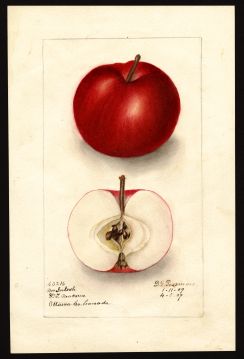 USDA Pomological Watercolor of McIntosh
 -
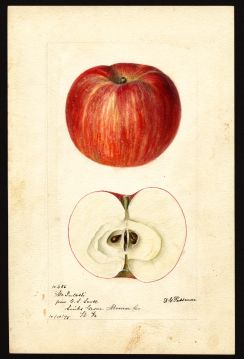 USDA Pomological Watercolor of McIntosh
 -
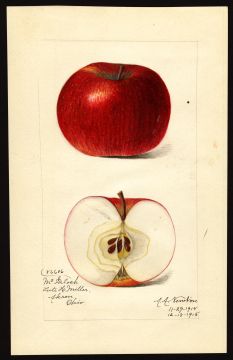 USDA Pomological Watercolor of McIntosh
 -
 USDA Pomological Watercolor of McIntosh
 -
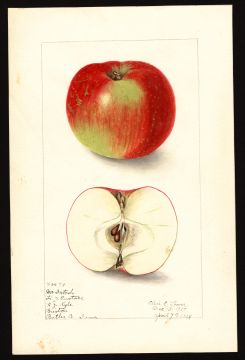 USDA Pomological Watercolor of McIntosh
 -
 USDA Pomological Watercolor of McIntosh
 -
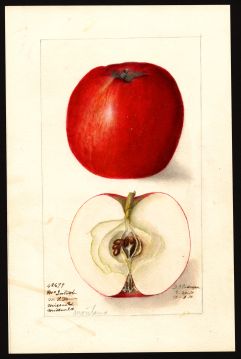 USDA Pomological Watercolor of McIntosh
 -
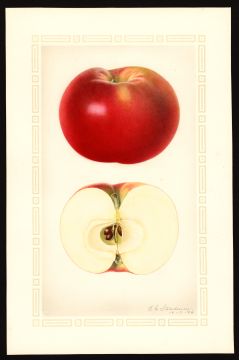 USDA Pomological Watercolor of McIntosh
 -
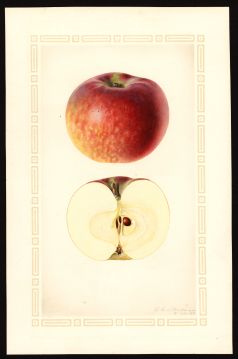 USDA Pomological Watercolor of McIntosh
 -
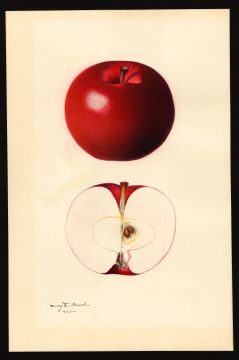 USDA Pomological Watercolor of McIntosh
 -
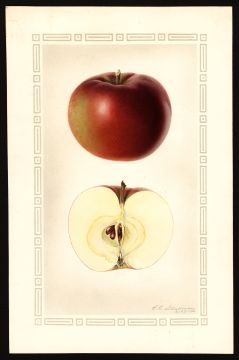 USDA Pomological Watercolor of McIntosh
 -
 USDA Pomological Watercolor of McIntosh
 -
 USDA Pomological Watercolor of McIntosh
 -
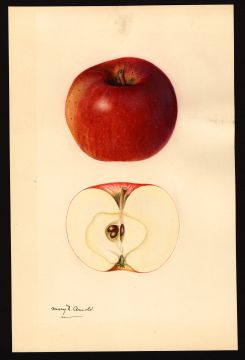 USDA Pomological Watercolor of McIntosh
 -
 USDA Pomological Watercolor of McIntosh
 -
 USDA Pomological Watercolor of McIntosh
 -
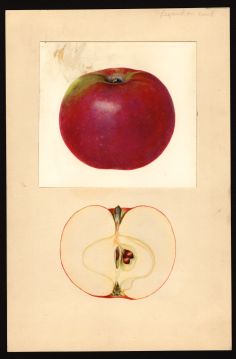 USDA Pomological Watercolor of McIntosh


U.S. Department of Agriculture Pomological Watercolor Collection. Rare and Special Collections, National Agricultural Library, Beltsville, MD 20705
Sources
- S.A. Beach, The Apples of New York Vol. 2 (1905). Public domain.
- J.L. Budd & N.E. Hansen, American Horticultural Manual, Part II: Systematic Pomology (1914). Public domain.
- H.H. Fisher, A Survey of Apple Clones in the United States (USDA ARS, 1963). Public domain.
- A.J. Downing, Fruits and Fruit Trees of America (1869). Public domain.
- N.E. Hansen, A Study of Northwestern Apples (South Dakota Ag. Exp. Station Bulletin 76, 1902). Public domain.
- U.P. Hedrick, Cyclopedia of Hardy Fruits (1922). Public domain.
- Granville Lowther (ed.), Encyclopedia of Practical Horticulture (1914). Public domain.
- John J. Thomas, The American Fruit Culturist (1903). Public domain.
- 47 historical nursery catalog references (see Variety Finder for the full list).
- Full entry with all citations: McINTOSH on the Variety Finder
Trees of this Variety in Our Collection
| Orchard | Tag | Condition | |
|---|---|---|---|
| Lithgow Springs Tree 104 | Lithgow Springs | 104 | fair |
| Lithgow Springs Tree 105 | Lithgow Springs | 105 | fair |