Blue Pearmain: Difference between revisions
Bot: Heritage variety data import |
Bot: enrich variety page from Variety Finder data (blue-pearmain-apple) |
||
| (4 intermediate revisions by the same user not shown) | |||
| Line 2: | Line 2: | ||
|name=Blue Pearmain | |name=Blue Pearmain | ||
|species=Apple | |species=Apple | ||
|at_clarno=yes | |at_clarno=yes | ||
|clarno_year=2025 | |clarno_year=2025 | ||
}} | }} | ||
[[File:USDA_Pomological_Blue_Pearmain_POM00001653.jpg|thumb|right|320px|USDA Pomological Watercolor by Newton, Amanda Almira (Fredericton, Canada). <small>Public domain. USDA National Agricultural Library.</small>]] | |||
''' | Large, skin stripes of dark, purplish red over a dull ground and appearing bluish from the white bloom. Flesh yellowish, mild, rather rich and aromatic. October to February. | ||
'''Read the full entry:''' [https://heritageapplecorps.org/varieties/blue-pearmain-apple/ Blue Pearmain on the Variety Finder] for deeper history, every book quote, and all nursery catalog references. | |||
== | == Quick Facts == | ||
* [ | {| class="wikitable" | ||
* [[ | |- | ||
| '''Type''' || Apple | |||
|- | |||
| '''Season''' || Late (Mid to late fall (September to October)) | |||
|- | |||
| '''Flavor''' || sweet, tart, rich, subacid, aromatic, mild | |||
|- | |||
| '''Flavor notes''' || Rich, mildly tart; dense, firm, slightly crisp; sweet with tart background | |||
|- | |||
| '''Uses''' || fresh eating, baking, pies, sauce, cider, preserves, cooking | |||
|- | |||
| '''Keeping quality''' || Good | |||
|- | |||
| '''Size''' || Very Large | |||
|- | |||
| '''Shape''' || Round | |||
|- | |||
| '''Skin color''' || striped red, red, yellow, purple, crimson, dark, striped, russet | |||
|- | |||
| '''Flesh''' || Yellow medium | |||
|- | |||
| '''Origin''' || Massachusetts, USA, c. 1750. New England (possibly Middlesex County, Massachusetts), USA; 1700s | |||
|} | |||
== Synonyms == | |||
Prolific Beauty | |||
== Origin and History == | |||
Blue Pearmain is an old American variety of uncertain origin. Bunyard places its origin as American with the date uncertain but known before 1800. Hedrick reports it was known in New England as early as the Revolutionary War, with its culture spreading southward to the Carolinas and westward to the Mississippi. Beach notes that on account of its hardiness it has often been planted in the home orchards of the more elevated regions of New York and New England during the last 75 years (as of 1905), and that it has probably been in cultivation for a century or more. Kenrick (1833) mentions it as common in the vicinity of Boston in the early part of the 19th century, and Hedrick notes it was first described by Kenrick in 1833. Beach reports that occasional trees are found in the oldest home orchards of New York State, but that it is rarely planted now (1905), and is not recommended for commercial planting. Hedrick notes the variety is widely grown only in New England. Beach observes that Blue Pearmain seems to have transmitted its characters little changed to a numerous progeny, and references the "Blue Pearmain group" of related varieties marked by characteristically large dots. | |||
Fisher (1963) records USDA accessions of Blue Pearmain received from G. S. Cory (Canton, NY, 1910), Sherman Nursery Co. (Charles City, IA), AES at University Park, PA, and W. W. Smith (New Hampton, 1939), held at reporting stations including Geneva NY, Cheyenne WY, Glenn Dale MD, and Pennsylvania State University. | |||
== Fruit == | |||
'''Size.''' Of the largest size (Downing); very large (Elliott, Thomas, Budd-Hansen); large to very large (Hedrick); above medium to very large (Beach); medium to large (Hedrick, in one passage); medium (Bunyard, giving 2⅔ by 2½ inches); medium-large (Fisher). Pretty uniform in size and shape (Beach, Hedrick). | |||
'''Form.''' Roundish, regularly formed, very slightly conical (Downing). Roundish or inclined to oblate, sometimes a little inclined to conic, irregular, often obscurely ribbed, sometimes distinctly furrowed from the cavity nearly to the basin (Beach; echoed by Hedrick). Roundish, slightly conical (Elliott). Roundish, inclining to oblong, slightly and obtusely conical (Thomas). Nearly regular, roundish to roundish oblong, very slightly conical (Budd-Hansen). Round, conical, regular (Bunyard). Oblong-conic, ribbed, axis sometimes oblique (Hedrick, in one passage). Round-oblate, regular shape (Fisher). Characterized by ribbed or sometimes furrowed surface (Hedrick). | |||
'''Stem.''' Short (Elliott, Hedrick, Budd-Hansen); medium length to rather short, rather thick (Beach); short, thick (Hedrick); long, thick (Hedrick, in one passage); rather short in a rather wide and deep cavity (Bunyard); three-fourths of an inch long (Thomas). | |||
'''Cavity.''' Moderately deep, obscurely furrowed, usually covered with orange-russet or greenish-russet (Beach, Hedrick). Wide, deep, obtuse, some stellate russet (Budd-Hansen). Acuminate, wide, lipped but usually symmetrical, with red-russet or greenish outspreading rays (Hedrick, in one passage). Rather wide and deep (Bunyard). | |||
'''Calyx.''' Small (Elliott); deep set (Thomas); partly open, with acute lobes (Beach, Hedrick); closed (Hedrick, in one passage); open, with segments flat convergent (Budd-Hansen); slightly open (Bunyard, referring to "eye" in a moderately wide and deep basin). | |||
'''Basin.''' Deep (Elliott); medium in depth and width, with concentric gray or russet lines, obscurely furrowed (Beach, Hedrick); often oblique, shallow and obtuse to deep and abrupt, furrowed and wrinkled (Hedrick, in one passage); shallow, smooth, some with trace of russet (Budd-Hansen); moderately wide and deep (Bunyard). | |||
'''Skin.''' Thick (Beach); thick, tough, smooth (Hedrick); rough, or "a little rough" (Beach, Hedrick). Color: stripes of dark purplish-red over a dull ground, appearing bluish from the white bloom (Downing). Striped and blotched with purplish red over a dull ground, with white bloom (Elliott). Dark purplish red in large broken stripes on lighter ground; bloom conspicuous (Thomas). Yellow, washed and mottled with red, often deepening on one side to nearly solid red, splashed and striped with deep purplish-carmine and overspread with an abundant blue bloom from which the variety takes its name (Beach, Hedrick). Pale yellow, almost wholly covered with large dark purplish splashes and stripes, mixed nearly solid red on sunny side, the heavy white bloom over dark red ground giving the fruit a bluish color (Budd-Hansen). Yellow entirely covered with dull crimson flush and broad broken stripes, heavily covered with bloom on the tree (Bunyard). Yellow, striped or covered with red, deepening to almost black, obscurely striped with darker crimson and with streaks of scarf-skin, giving the effect of dull bloom; prevailing effect dull gray-purple (Hedrick, in one passage). Red blush on yellow (Fisher). When well colored it is beautiful, though not brilliant, being overcast with a dull bluish bloom (Beach). | |||
'''Dots.''' Numerous, small, pale, mingled with others which are conspicuous, very large, gray with russet center, and often also mingled with irregular lines or flecks of dull green or russet (Beach, Hedrick). The large dots are characteristic of this variety as also of other varieties of the Blue Pearmain group (Beach). Distinct, white, russet, minute, some large, gray, with russet centres (Budd-Hansen). Numerous, gray, small, rough (Hedrick, in one passage). Large; indistinct (Thomas). | |||
'''Flesh and flavor.''' Yellowish (Downing, Elliott, Thomas, Beach, Budd-Hansen, Fisher); yellow (Hedrick, Bunyard). Mild (Downing, Beach), rather rich, aromatic, and very good (Downing). Mild sub-acid (Elliott, Thomas, Hedrick); mild subacid, decidedly and agreeably aromatic, good (Beach); mild, subacid, agreeably aromatic, good (Hedrick); rich subacid, spicy, pleasant, very good (Budd-Hansen); rich, peculiarly aromatic, good (Hedrick); subacid, aromatic, good (Fisher); tender, rather dry, highly aromatic and sweet (Bunyard). Texture: moderately firm, rather coarse, moderately juicy (Beach); firm, coarse, juicy (Hedrick); firm, tender, coarse, juicy becoming dry (Hedrick, in one passage); firm, moderately juicy (Budd-Hansen); moderately firm, juicy (Fisher); tender, rather dry (Bunyard). | |||
Beach assesses the fruit as of mild flavor and not ranking high in quality. Hedrick concurs that the quality is not sufficiently high to make the variety worthy except where hardiness is necessary. | |||
'''Core and seeds.''' Calyx tube elongated conical approaching funnel-form (Beach); elongated-conical (Hedrick); funnel-shaped (Budd-Hansen); large, wide, cone-shape (Hedrick, in one passage). Stamens basal to median (Beach); basal (Hedrick); median (Budd-Hansen, Hedrick in one passage). Core medium (Elliott); rather large, nearly axile, closed or somewhat open (Beach); large, axile, closed or open (Hedrick); large, axile, closed (Hedrick, in one passage); partly open (Budd-Hansen). Core lines clasping or, with modified calyx tube, nearly meeting (Beach); clasping (Hedrick). Carpels broad, elongated or roundish, slightly tufted (Beach); broad, elongated or round, tufted (Hedrick); long-ovate, tapering both ways, emarginate, tufted (Hedrick, in one passage). Seeds medium or rather long, acuminate, rather light brown (Beach); long, acuminate, light brown (Hedrick); often abortive, when developed of medium size, acuminate, tufted (Hedrick, in one passage). | |||
== Season == | |||
October to February (Downing, Budd-Hansen). Early winter (Elliott, Thomas). Comes into season in October; may keep till March but often begins to shrivel after January (Beach). October till March (Hedrick); October to January or February (Hedrick, in one passage). January to March (Bunyard). October–March, often later (Fisher). In common storage it does not keep late, and by January it often becomes shriveled (Beach, citing Beach and Clark 1904); the fruit does not keep well (Hedrick). | |||
== Uses == | |||
Home and local market (Beach). Home use only (Fisher). Culinary or dessert (Bunyard). Beach and Hedrick agree it is not a good market fruit and is not recommended for commercial planting; it is apt to have a high percentage of unmarketable fruit (Beach, Fisher). Bunyard considers it a hardy variety worthy of further trial, noting it does well in Western Counties. | |||
== Illustrations == | |||
<gallery mode="packed" heights="240"> | |||
File:USDA_Pomological_Blue_Pearmain_POM00001653.jpg|USDA Pomological Watercolor by Newton, Amanda Almira (Fredericton, Canada) | |||
File:USDA_Pomological_Blue_Pearmain_POM00001654.jpg|USDA Pomological Watercolor by Newton, Amanda Almira | |||
File:USDA_Pomological_Blue_Pearmain_POM00001403.jpg|USDA Pomological Watercolor by Arnold, Mary Daisy (Yakima, Yakima, Washington) | |||
File:USDA_Pomological_Blue_Pearmain_POM00001404.jpg|USDA Pomological Watercolor by Arnold, Mary Daisy (Derry, Rockingham, New Hampshire) | |||
File:USDA_Pomological_Blue_Pearmain_POM00001405.jpg|USDA Pomological Watercolor by Steadman, Royal Charles (Waterford, Oxford, Maine) | |||
File:USDA_Pomological_Blue_Pearmain_POM00001406.jpg|USDA Pomological Watercolor by Steadman, Royal Charles (Waterford, Oxford, Maine) | |||
File:Book_beach_vol1_blue-pearmain-apple.webp|S.A. Beach, The Apples of New York Vol. 1 (1905) | |||
</gallery> | |||
<small>U.S. Department of Agriculture Pomological Watercolor Collection. Rare and Special Collections, National Agricultural Library, Beltsville, MD 20705</small> | |||
== Sources == | |||
* S.A. Beach, The Apples of New York Vol. 1 (1905). Public domain. | |||
* H.H. Fisher, A Survey of Apple Clones in the United States (USDA ARS, 1963). Public domain. | |||
* J.L. Budd & N.E. Hansen, American Horticultural Manual, Part II: Systematic Pomology (1914). Public domain. | |||
* E.A. Bunyard, A Handbook of Hardy Fruits (1920). Public domain. | |||
* A.J. Downing, Fruits and Fruit Trees of America (1869). Public domain. | |||
* F.R. Elliott, The Western Fruit Book (1865). Public domain. | |||
* U.P. Hedrick, Cyclopedia of Hardy Fruits (1922). Public domain. | |||
* John J. Thomas, The American Fruit Culturist (1903). Public domain. | |||
* USDA Pomological Watercolor Collection, U.S. National Agricultural Library. | |||
* 25 historical nursery catalog references (see [https://heritageapplecorps.org/varieties/blue-pearmain-apple/ Variety Finder] for the full list). | |||
* '''Full entry with all citations:''' [https://heritageapplecorps.org/varieties/blue-pearmain-apple/ Blue Pearmain on the Variety Finder] | |||
== Trees of this Variety in Our Collection == | |||
{{#ask: [[Has variety::Blue Pearmain]] | |||
|?Has orchard=Orchard | |||
|?Has field tag=Tag | |||
|?Has condition=Condition | |||
|format=table | |||
|sort=Has orchard, Has field tag | |||
}} | |||
[[Category:Varieties]] | [[Category:Varieties]] | ||
[[Category:Apple Trees]] | [[Category:Apple Trees]] | ||
[[Category:Preserved at Clarno]] | [[Category:Preserved at Clarno]] | ||
Latest revision as of 12:01, 28 April 2026
| Blue Pearmain | |
|---|---|
| Species | Apple |
| Trees Found | 2 |
| Orchards | Cyrus,McCoin Lower |
| Preserved | Clarno Arboretum(2025) |

Large, skin stripes of dark, purplish red over a dull ground and appearing bluish from the white bloom. Flesh yellowish, mild, rather rich and aromatic. October to February. Read the full entry: Blue Pearmain on the Variety Finder for deeper history, every book quote, and all nursery catalog references.
Quick Facts
| Type | Apple |
| Season | Late (Mid to late fall (September to October)) |
| Flavor | sweet, tart, rich, subacid, aromatic, mild |
| Flavor notes | Rich, mildly tart; dense, firm, slightly crisp; sweet with tart background |
| Uses | fresh eating, baking, pies, sauce, cider, preserves, cooking |
| Keeping quality | Good |
| Size | Very Large |
| Shape | Round |
| Skin color | striped red, red, yellow, purple, crimson, dark, striped, russet |
| Flesh | Yellow medium |
| Origin | Massachusetts, USA, c. 1750. New England (possibly Middlesex County, Massachusetts), USA; 1700s |
Synonyms
Prolific Beauty
Origin and History
Blue Pearmain is an old American variety of uncertain origin. Bunyard places its origin as American with the date uncertain but known before 1800. Hedrick reports it was known in New England as early as the Revolutionary War, with its culture spreading southward to the Carolinas and westward to the Mississippi. Beach notes that on account of its hardiness it has often been planted in the home orchards of the more elevated regions of New York and New England during the last 75 years (as of 1905), and that it has probably been in cultivation for a century or more. Kenrick (1833) mentions it as common in the vicinity of Boston in the early part of the 19th century, and Hedrick notes it was first described by Kenrick in 1833. Beach reports that occasional trees are found in the oldest home orchards of New York State, but that it is rarely planted now (1905), and is not recommended for commercial planting. Hedrick notes the variety is widely grown only in New England. Beach observes that Blue Pearmain seems to have transmitted its characters little changed to a numerous progeny, and references the "Blue Pearmain group" of related varieties marked by characteristically large dots.
Fisher (1963) records USDA accessions of Blue Pearmain received from G. S. Cory (Canton, NY, 1910), Sherman Nursery Co. (Charles City, IA), AES at University Park, PA, and W. W. Smith (New Hampton, 1939), held at reporting stations including Geneva NY, Cheyenne WY, Glenn Dale MD, and Pennsylvania State University.
Fruit
Size. Of the largest size (Downing); very large (Elliott, Thomas, Budd-Hansen); large to very large (Hedrick); above medium to very large (Beach); medium to large (Hedrick, in one passage); medium (Bunyard, giving 2⅔ by 2½ inches); medium-large (Fisher). Pretty uniform in size and shape (Beach, Hedrick).
Form. Roundish, regularly formed, very slightly conical (Downing). Roundish or inclined to oblate, sometimes a little inclined to conic, irregular, often obscurely ribbed, sometimes distinctly furrowed from the cavity nearly to the basin (Beach; echoed by Hedrick). Roundish, slightly conical (Elliott). Roundish, inclining to oblong, slightly and obtusely conical (Thomas). Nearly regular, roundish to roundish oblong, very slightly conical (Budd-Hansen). Round, conical, regular (Bunyard). Oblong-conic, ribbed, axis sometimes oblique (Hedrick, in one passage). Round-oblate, regular shape (Fisher). Characterized by ribbed or sometimes furrowed surface (Hedrick).
Stem. Short (Elliott, Hedrick, Budd-Hansen); medium length to rather short, rather thick (Beach); short, thick (Hedrick); long, thick (Hedrick, in one passage); rather short in a rather wide and deep cavity (Bunyard); three-fourths of an inch long (Thomas).
Cavity. Moderately deep, obscurely furrowed, usually covered with orange-russet or greenish-russet (Beach, Hedrick). Wide, deep, obtuse, some stellate russet (Budd-Hansen). Acuminate, wide, lipped but usually symmetrical, with red-russet or greenish outspreading rays (Hedrick, in one passage). Rather wide and deep (Bunyard).
Calyx. Small (Elliott); deep set (Thomas); partly open, with acute lobes (Beach, Hedrick); closed (Hedrick, in one passage); open, with segments flat convergent (Budd-Hansen); slightly open (Bunyard, referring to "eye" in a moderately wide and deep basin).
Basin. Deep (Elliott); medium in depth and width, with concentric gray or russet lines, obscurely furrowed (Beach, Hedrick); often oblique, shallow and obtuse to deep and abrupt, furrowed and wrinkled (Hedrick, in one passage); shallow, smooth, some with trace of russet (Budd-Hansen); moderately wide and deep (Bunyard).
Skin. Thick (Beach); thick, tough, smooth (Hedrick); rough, or "a little rough" (Beach, Hedrick). Color: stripes of dark purplish-red over a dull ground, appearing bluish from the white bloom (Downing). Striped and blotched with purplish red over a dull ground, with white bloom (Elliott). Dark purplish red in large broken stripes on lighter ground; bloom conspicuous (Thomas). Yellow, washed and mottled with red, often deepening on one side to nearly solid red, splashed and striped with deep purplish-carmine and overspread with an abundant blue bloom from which the variety takes its name (Beach, Hedrick). Pale yellow, almost wholly covered with large dark purplish splashes and stripes, mixed nearly solid red on sunny side, the heavy white bloom over dark red ground giving the fruit a bluish color (Budd-Hansen). Yellow entirely covered with dull crimson flush and broad broken stripes, heavily covered with bloom on the tree (Bunyard). Yellow, striped or covered with red, deepening to almost black, obscurely striped with darker crimson and with streaks of scarf-skin, giving the effect of dull bloom; prevailing effect dull gray-purple (Hedrick, in one passage). Red blush on yellow (Fisher). When well colored it is beautiful, though not brilliant, being overcast with a dull bluish bloom (Beach).
Dots. Numerous, small, pale, mingled with others which are conspicuous, very large, gray with russet center, and often also mingled with irregular lines or flecks of dull green or russet (Beach, Hedrick). The large dots are characteristic of this variety as also of other varieties of the Blue Pearmain group (Beach). Distinct, white, russet, minute, some large, gray, with russet centres (Budd-Hansen). Numerous, gray, small, rough (Hedrick, in one passage). Large; indistinct (Thomas).
Flesh and flavor. Yellowish (Downing, Elliott, Thomas, Beach, Budd-Hansen, Fisher); yellow (Hedrick, Bunyard). Mild (Downing, Beach), rather rich, aromatic, and very good (Downing). Mild sub-acid (Elliott, Thomas, Hedrick); mild subacid, decidedly and agreeably aromatic, good (Beach); mild, subacid, agreeably aromatic, good (Hedrick); rich subacid, spicy, pleasant, very good (Budd-Hansen); rich, peculiarly aromatic, good (Hedrick); subacid, aromatic, good (Fisher); tender, rather dry, highly aromatic and sweet (Bunyard). Texture: moderately firm, rather coarse, moderately juicy (Beach); firm, coarse, juicy (Hedrick); firm, tender, coarse, juicy becoming dry (Hedrick, in one passage); firm, moderately juicy (Budd-Hansen); moderately firm, juicy (Fisher); tender, rather dry (Bunyard).
Beach assesses the fruit as of mild flavor and not ranking high in quality. Hedrick concurs that the quality is not sufficiently high to make the variety worthy except where hardiness is necessary.
Core and seeds. Calyx tube elongated conical approaching funnel-form (Beach); elongated-conical (Hedrick); funnel-shaped (Budd-Hansen); large, wide, cone-shape (Hedrick, in one passage). Stamens basal to median (Beach); basal (Hedrick); median (Budd-Hansen, Hedrick in one passage). Core medium (Elliott); rather large, nearly axile, closed or somewhat open (Beach); large, axile, closed or open (Hedrick); large, axile, closed (Hedrick, in one passage); partly open (Budd-Hansen). Core lines clasping or, with modified calyx tube, nearly meeting (Beach); clasping (Hedrick). Carpels broad, elongated or roundish, slightly tufted (Beach); broad, elongated or round, tufted (Hedrick); long-ovate, tapering both ways, emarginate, tufted (Hedrick, in one passage). Seeds medium or rather long, acuminate, rather light brown (Beach); long, acuminate, light brown (Hedrick); often abortive, when developed of medium size, acuminate, tufted (Hedrick, in one passage).
Season
October to February (Downing, Budd-Hansen). Early winter (Elliott, Thomas). Comes into season in October; may keep till March but often begins to shrivel after January (Beach). October till March (Hedrick); October to January or February (Hedrick, in one passage). January to March (Bunyard). October–March, often later (Fisher). In common storage it does not keep late, and by January it often becomes shriveled (Beach, citing Beach and Clark 1904); the fruit does not keep well (Hedrick).
Uses
Home and local market (Beach). Home use only (Fisher). Culinary or dessert (Bunyard). Beach and Hedrick agree it is not a good market fruit and is not recommended for commercial planting; it is apt to have a high percentage of unmarketable fruit (Beach, Fisher). Bunyard considers it a hardy variety worthy of further trial, noting it does well in Western Counties.
Illustrations
-
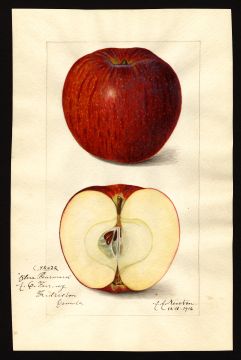 USDA Pomological Watercolor by Newton, Amanda Almira (Fredericton, Canada)
 -
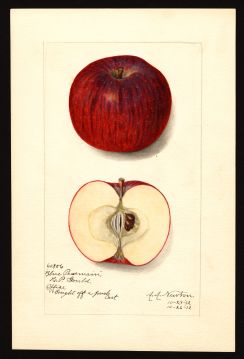 USDA Pomological Watercolor by Newton, Amanda Almira
 -
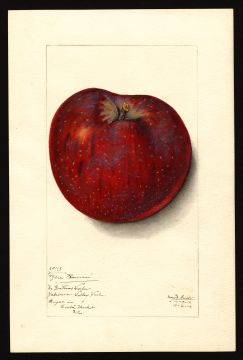 USDA Pomological Watercolor by Arnold, Mary Daisy (Yakima, Yakima, Washington)
 -
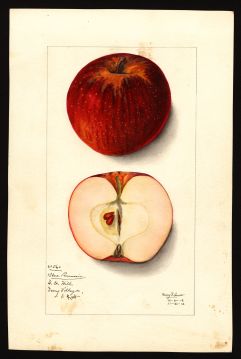 USDA Pomological Watercolor by Arnold, Mary Daisy (Derry, Rockingham, New Hampshire)
 -
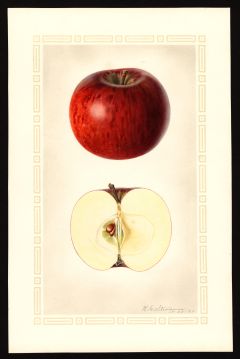 USDA Pomological Watercolor by Steadman, Royal Charles (Waterford, Oxford, Maine)
 -
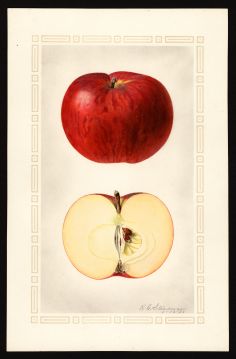 USDA Pomological Watercolor by Steadman, Royal Charles (Waterford, Oxford, Maine)
 -
S.A. Beach, The Apples of New York Vol. 1 (1905)


U.S. Department of Agriculture Pomological Watercolor Collection. Rare and Special Collections, National Agricultural Library, Beltsville, MD 20705
Sources
- S.A. Beach, The Apples of New York Vol. 1 (1905). Public domain.
- H.H. Fisher, A Survey of Apple Clones in the United States (USDA ARS, 1963). Public domain.
- J.L. Budd & N.E. Hansen, American Horticultural Manual, Part II: Systematic Pomology (1914). Public domain.
- E.A. Bunyard, A Handbook of Hardy Fruits (1920). Public domain.
- A.J. Downing, Fruits and Fruit Trees of America (1869). Public domain.
- F.R. Elliott, The Western Fruit Book (1865). Public domain.
- U.P. Hedrick, Cyclopedia of Hardy Fruits (1922). Public domain.
- John J. Thomas, The American Fruit Culturist (1903). Public domain.
- USDA Pomological Watercolor Collection, U.S. National Agricultural Library.
- 25 historical nursery catalog references (see Variety Finder for the full list).
- Full entry with all citations: Blue Pearmain on the Variety Finder
Trees of this Variety in Our Collection
| Orchard | Tag | Condition | |
|---|---|---|---|
| Cyrus Tree 15 | Cyrus | 15 | fair |
| McCoin Lower Tree 75 | McCoin Lower | 75 | fair |