Stark: Difference between revisions
Bot: Add 8 USDA Pomological Watercolor(s) (POM00003190, POM00003191, POM00003192, POM00003193, POM00003194, POM00003195, POM00003196, POM00003197) |
Bot: enrich variety page from Variety Finder data (stark-apple) |
||
| (3 intermediate revisions by the same user not shown) | |||
| Line 2: | Line 2: | ||
|name=Stark | |name=Stark | ||
|species=Apple | |species=Apple | ||
|at_clarno=yes | |at_clarno=yes | ||
|clarno_year=2025 | |clarno_year=2025 | ||
}} | }} | ||
[[File:USDA_Pomological_Stark_POM00003190.jpg|thumb|right|320px|USDA Pomological Watercolor by Newton, Amanda Almira (Landisburg, Perry, Pennsylvania). <small>Public domain. USDA National Agricultural Library.</small>]] | |||
''' | Large, oblong, partly covered with red; flavor mild, sub-acid; agreeable, resembling Janeton. Tree one of the very strongest growers, hardy and a most regular annual bearer; in our orchard has not failed in 14 years. It has also proved a very profitable market sort throughout the West, and is in great demand, even in Canada. A leading Stark orchardist in Calhoun Co., Ill., who bought Stark trees of us which are now in full bearing, lately ordered 500 Ben Davis and 500 Stark; the latter bearing twice as much as Ben Davis. | ||
'''Read the full entry:''' [https://heritageapplecorps.org/varieties/stark-apple/ Stark on the Variety Finder] for deeper history, every book quote, and all nursery catalog references. | |||
== | == Quick Facts == | ||
{| class="wikitable" | |||
|- | |||
| '''Type''' || Apple | |||
|- | |||
| '''Season''' || Late (Late fall (October)) | |||
|- | |||
| '''Flavor''' || tart, mild, subacid | |||
|- | |||
| '''Flavor notes''' || Mildly tart, pleasant flavor; firm flesh | |||
|- | |||
| '''Uses''' || fresh eating, cooking, baking, drying | |||
|- | |||
| '''Keeping quality''' || Good | |||
|- | |||
| '''Size''' || Large | |||
|- | |||
| '''Shape''' || Round | |||
|- | |||
| '''Skin color''' || striped red, red, yellow, green, russet, striped, crimson, dark | |||
|- | |||
| '''Flesh''' || Yellow crisp | |||
|- | |||
| '''Origin''' || Ohio or Indiana, USA, c. 1875. Likely Ohio or Indiana, USA; mid to late 1800s | |||
|} | |||
== | == Synonyms == | ||
<gallery mode="packed" heights=" | Robinson, Starke Apple, Yeats | ||
File:USDA_Pomological_Stark_POM00003190.jpg| | |||
File:USDA_Pomological_Stark_POM00003191.jpg| | == Fruit == | ||
File:USDA_Pomological_Stark_POM00003192.jpg| | '''Size:''' Large, sometimes very large, quite uniform in size and shape (Beach; Hedrick; Downing; Lowther; Central Experimental Farm; Thomas). | ||
File:USDA_Pomological_Stark_POM00003194.jpg| | '''Form:''' Roundish, inclining to conic, sometimes a little elongated, and sometimes slightly oblique (Downing). Roundish inclined to conic, varying to slightly oblate or to roundish ovate; sides sometimes unequal (Beach; Hedrick). Roundish conical (Lowther). Oblong, tapering to the eye (Central Experimental Farm). Well-turned in shape (Hedrick). | ||
File: | |||
File:USDA_Pomological_Stark_POM00003196.jpg| | '''Stem:''' Short to medium in length, moderately stout (Beach); short, stout (Hedrick); short, rather stout (Downing). | ||
File:USDA_Pomological_Stark_POM00003197.jpg| | |||
'''Cavity:''' Medium in size, acuminate or approaching acute, moderately deep, rather wide to moderately narrow, sometimes gently furrowed, occasionally lipped, sometimes russeted and with outspreading russet (Beach). Hedrick describes the cavity as deep and wide (otherwise matching Beach in being acuminate, sometimes furrowed, occasionally lipped, sometimes russeted with outspreading russet). Downing simply gives a medium cavity. | |||
'''Calyx:''' Closed (Downing); medium to rather large, closed or partly open (Beach); large, closed or partly open (Hedrick). | |||
'''Basin:''' Rather large, slightly corrugated (Downing); shallow and obtuse to medium in depth and somewhat abrupt, rather wide, slightly wrinkled (Beach); shallow, obtuse, wide, wrinkled (Hedrick). | |||
'''Skin:''' Greenish yellow, shaded, splashed, and striped with light and dark red nearly over the whole surface, and thickly sprinkled with light and brown dots, a portion of them areole dots (Downing). Smooth or slightly roughened with russet dots; pale green becoming yellow more or less blushed and mottled with red and rather indistinctly striped with darker red; prevailing effect dull green and red, but in highly colored specimens fairly bright red (Beach). Pale yellow more or less blushed and mottled with red and indistinctly striped with darker red; prevailing effect dull green and red, in highly-colored specimens bright red (Hedrick). Greenish yellow, nearly covered with purple red and sprinkled with brown dots (Central Experimental Farm). Yellow-red (Lowther); striped (Thomas). The skin is thick and tough, making the fruit stand handling well and desirable for distant shipment (Beach; Hedrick). It is often dull and not attractive, sometimes having but very little red color, yet under favorable conditions it is nearly covered with red, and in the spring when the contrasting yellow tints are fully developed it becomes quite attractive (Beach). | |||
'''Flesh/Flavor:''' Yellowish, a little coarse, moderately juicy, mild subacid; good (Downing). Yellowish, firm, moderately fine to rather coarse, breaking, rather tender, juicy, sprightly, mild subacid, not high in flavor; fair to good, or nearly good, in quality (Beach). Yellow, firm, fine, breaking, tender, juicy, sprightly, mild subacid; fair to good (Hedrick). Yellowish, crisp, a little coarse, moderately juicy, mildly sub-acid, quality good (Central Experimental Farm). Coarse, mild sub-acid, good (Thomas). Quality good (Lowther). Has a mild flavor and ranks only medium in quality (Beach); not good enough in quality for a dessert fruit, though well liked for culinary purposes and prime favorites for drying (Hedrick). | |||
'''Calyx tube:''' Rather wide, truncate cone-shape with fleshy pistil point projecting into the base, or approaching funnel-form (Beach); wide, truncate cone-shape with fleshy pistil point projecting into the base (Hedrick). | |||
'''Stamens:''' Median or below (Beach); median (Hedrick). | |||
'''Core/Seeds:''' Core small (Downing; Hedrick); medium to rather small, axile (Beach); cells uniform, symmetrical, closed or partly open; core lines meeting or slightly clasping (Beach), core-lines meeting (Hedrick). Carpels thin, tender, flat, broadly roundish to obcordate, emarginate, mucronate, tufted (Beach; Hedrick). Seeds few, long, acute, tufted (Beach; Hedrick). | |||
== Season == | |||
January to May (Downing; Central Experimental Farm); January to June at Geneva, NY in ordinary storage, with May as the usual commercial limit (Beach); November to April (Hedrick); winter (Lowther). Valuable as a keeper (Thomas); a long keeper (Downing); the fruits keep well (Beach; Hedrick). | |||
== Uses == | |||
Family use (Lowther). Well liked for baking and evaporating (Beach); well liked for culinary purposes and prime favorites for drying (Hedrick). Often sells in the general market at remunerative prices and is regarded by some as a good apple for export trade (Beach). The firm flesh and thick, tough skin make the crop desirable for distant shipment (Beach; Hedrick). Not good enough in quality for a dessert fruit (Hedrick). | |||
== Illustrations == | |||
<gallery mode="packed" heights="240"> | |||
File:USDA_Pomological_Stark_POM00003190.jpg|USDA Pomological Watercolor by Newton, Amanda Almira (Landisburg, Perry, Pennsylvania) | |||
File:USDA_Pomological_Stark_POM00003191.jpg|USDA Pomological Watercolor by Newton, Amanda Almira (Sunbury, Northumberland, Pennsylvania) | |||
File:USDA_Pomological_Stark_POM00003192.jpg|USDA Pomological Watercolor by Newton, Amanda Almira (Elysburg, Northumberland, Pennsylvania) | |||
File:USDA_Pomological_Stark_POM00003194.jpg|USDA Pomological Watercolor by Newton, Amanda Almira (Wenatchee, Chelan, Washington) | |||
File:USDA_Pomological_Stark_POM00003193.jpg|USDA Pomological Watercolor by Arnold, Mary Daisy (Ontario, Washington, Pennsylvania) | |||
File:USDA_Pomological_Stark_POM00003196.jpg|USDA Pomological Watercolor by Arnold, Mary Daisy | |||
File:USDA_Pomological_Stark_POM00003197.jpg|USDA Pomological Watercolor by Arnold, Mary Daisy (Fennville, Allegan, Michigan) | |||
File:USDA_Pomological_Stark_POM00003195.jpg|USDA Pomological Watercolor by Steadman, Royal Charles (Newark, New Castle, Delaware) | |||
</gallery> | </gallery> | ||
<small>U.S. Department of Agriculture Pomological Watercolor Collection. Rare and Special Collections, National Agricultural Library, Beltsville, MD 20705</small> | <small>U.S. Department of Agriculture Pomological Watercolor Collection. Rare and Special Collections, National Agricultural Library, Beltsville, MD 20705</small> | ||
== Sources == | |||
* S.A. Beach, The Apples of New York Vol. 1 (1905). Public domain. | |||
* A.J. Downing, Fruits and Fruit Trees of America (1869). Public domain. | |||
* Granville Lowther (ed.), Encyclopedia of Practical Horticulture (1914). Public domain. | |||
* U.P. Hedrick, Cyclopedia of Hardy Fruits (1922). Public domain. | |||
* John J. Thomas, The American Fruit Culturist (1903). Public domain. | |||
* USDA Pomological Watercolor Collection, U.S. National Agricultural Library. | |||
* 33 historical nursery catalog references (see [https://heritageapplecorps.org/varieties/stark-apple/ Variety Finder] for the full list). | |||
* '''Full entry with all citations:''' [https://heritageapplecorps.org/varieties/stark-apple/ Stark on the Variety Finder] | |||
== Trees of this Variety in Our Collection == | |||
{{#ask: [[Has variety::Stark]] | |||
|?Has orchard=Orchard | |||
|?Has field tag=Tag | |||
|?Has condition=Condition | |||
|format=table | |||
|sort=Has orchard, Has field tag | |||
}} | |||
[[Category:Varieties]] | [[Category:Varieties]] | ||
[[Category:Apple Trees]] | [[Category:Apple Trees]] | ||
[[Category:Preserved at Clarno]] | [[Category:Preserved at Clarno]] | ||
Latest revision as of 13:27, 28 April 2026
| Stark | |
|---|---|
| Species | Apple |
| Trees Found | 1 |
| Orchards | Osborn Springs |
| Preserved | Clarno Arboretum(2025) |

Large, oblong, partly covered with red; flavor mild, sub-acid; agreeable, resembling Janeton. Tree one of the very strongest growers, hardy and a most regular annual bearer; in our orchard has not failed in 14 years. It has also proved a very profitable market sort throughout the West, and is in great demand, even in Canada. A leading Stark orchardist in Calhoun Co., Ill., who bought Stark trees of us which are now in full bearing, lately ordered 500 Ben Davis and 500 Stark; the latter bearing twice as much as Ben Davis. Read the full entry: Stark on the Variety Finder for deeper history, every book quote, and all nursery catalog references.
Quick Facts
| Type | Apple |
| Season | Late (Late fall (October)) |
| Flavor | tart, mild, subacid |
| Flavor notes | Mildly tart, pleasant flavor; firm flesh |
| Uses | fresh eating, cooking, baking, drying |
| Keeping quality | Good |
| Size | Large |
| Shape | Round |
| Skin color | striped red, red, yellow, green, russet, striped, crimson, dark |
| Flesh | Yellow crisp |
| Origin | Ohio or Indiana, USA, c. 1875. Likely Ohio or Indiana, USA; mid to late 1800s |
Synonyms
Robinson, Starke Apple, Yeats
Fruit
Size: Large, sometimes very large, quite uniform in size and shape (Beach; Hedrick; Downing; Lowther; Central Experimental Farm; Thomas).
Form: Roundish, inclining to conic, sometimes a little elongated, and sometimes slightly oblique (Downing). Roundish inclined to conic, varying to slightly oblate or to roundish ovate; sides sometimes unequal (Beach; Hedrick). Roundish conical (Lowther). Oblong, tapering to the eye (Central Experimental Farm). Well-turned in shape (Hedrick).
Stem: Short to medium in length, moderately stout (Beach); short, stout (Hedrick); short, rather stout (Downing).
Cavity: Medium in size, acuminate or approaching acute, moderately deep, rather wide to moderately narrow, sometimes gently furrowed, occasionally lipped, sometimes russeted and with outspreading russet (Beach). Hedrick describes the cavity as deep and wide (otherwise matching Beach in being acuminate, sometimes furrowed, occasionally lipped, sometimes russeted with outspreading russet). Downing simply gives a medium cavity.
Calyx: Closed (Downing); medium to rather large, closed or partly open (Beach); large, closed or partly open (Hedrick).
Basin: Rather large, slightly corrugated (Downing); shallow and obtuse to medium in depth and somewhat abrupt, rather wide, slightly wrinkled (Beach); shallow, obtuse, wide, wrinkled (Hedrick).
Skin: Greenish yellow, shaded, splashed, and striped with light and dark red nearly over the whole surface, and thickly sprinkled with light and brown dots, a portion of them areole dots (Downing). Smooth or slightly roughened with russet dots; pale green becoming yellow more or less blushed and mottled with red and rather indistinctly striped with darker red; prevailing effect dull green and red, but in highly colored specimens fairly bright red (Beach). Pale yellow more or less blushed and mottled with red and indistinctly striped with darker red; prevailing effect dull green and red, in highly-colored specimens bright red (Hedrick). Greenish yellow, nearly covered with purple red and sprinkled with brown dots (Central Experimental Farm). Yellow-red (Lowther); striped (Thomas). The skin is thick and tough, making the fruit stand handling well and desirable for distant shipment (Beach; Hedrick). It is often dull and not attractive, sometimes having but very little red color, yet under favorable conditions it is nearly covered with red, and in the spring when the contrasting yellow tints are fully developed it becomes quite attractive (Beach).
Flesh/Flavor: Yellowish, a little coarse, moderately juicy, mild subacid; good (Downing). Yellowish, firm, moderately fine to rather coarse, breaking, rather tender, juicy, sprightly, mild subacid, not high in flavor; fair to good, or nearly good, in quality (Beach). Yellow, firm, fine, breaking, tender, juicy, sprightly, mild subacid; fair to good (Hedrick). Yellowish, crisp, a little coarse, moderately juicy, mildly sub-acid, quality good (Central Experimental Farm). Coarse, mild sub-acid, good (Thomas). Quality good (Lowther). Has a mild flavor and ranks only medium in quality (Beach); not good enough in quality for a dessert fruit, though well liked for culinary purposes and prime favorites for drying (Hedrick).
Calyx tube: Rather wide, truncate cone-shape with fleshy pistil point projecting into the base, or approaching funnel-form (Beach); wide, truncate cone-shape with fleshy pistil point projecting into the base (Hedrick).
Stamens: Median or below (Beach); median (Hedrick).
Core/Seeds: Core small (Downing; Hedrick); medium to rather small, axile (Beach); cells uniform, symmetrical, closed or partly open; core lines meeting or slightly clasping (Beach), core-lines meeting (Hedrick). Carpels thin, tender, flat, broadly roundish to obcordate, emarginate, mucronate, tufted (Beach; Hedrick). Seeds few, long, acute, tufted (Beach; Hedrick).
Season
January to May (Downing; Central Experimental Farm); January to June at Geneva, NY in ordinary storage, with May as the usual commercial limit (Beach); November to April (Hedrick); winter (Lowther). Valuable as a keeper (Thomas); a long keeper (Downing); the fruits keep well (Beach; Hedrick).
Uses
Family use (Lowther). Well liked for baking and evaporating (Beach); well liked for culinary purposes and prime favorites for drying (Hedrick). Often sells in the general market at remunerative prices and is regarded by some as a good apple for export trade (Beach). The firm flesh and thick, tough skin make the crop desirable for distant shipment (Beach; Hedrick). Not good enough in quality for a dessert fruit (Hedrick).
Illustrations
-
 USDA Pomological Watercolor by Newton, Amanda Almira (Landisburg, Perry, Pennsylvania)
 -
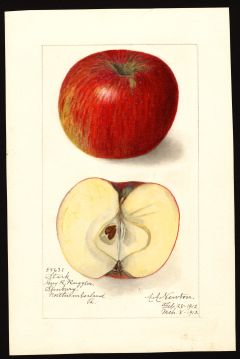 USDA Pomological Watercolor by Newton, Amanda Almira (Sunbury, Northumberland, Pennsylvania)
 -
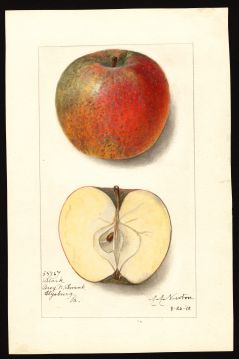 USDA Pomological Watercolor by Newton, Amanda Almira (Elysburg, Northumberland, Pennsylvania)
 -
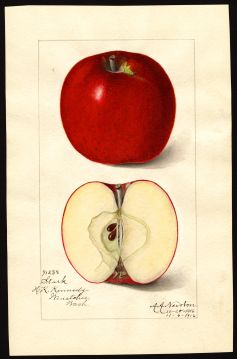 USDA Pomological Watercolor by Newton, Amanda Almira (Wenatchee, Chelan, Washington)
 -
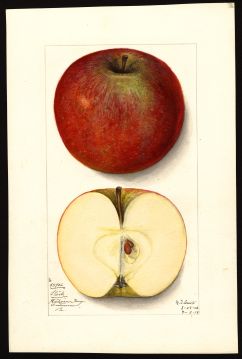 USDA Pomological Watercolor by Arnold, Mary Daisy (Ontario, Washington, Pennsylvania)
 -
 USDA Pomological Watercolor by Arnold, Mary Daisy
 -
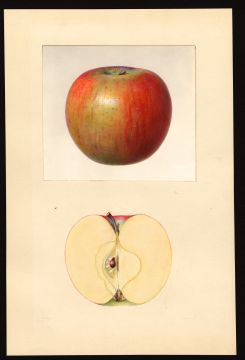 USDA Pomological Watercolor by Arnold, Mary Daisy (Fennville, Allegan, Michigan)
 -
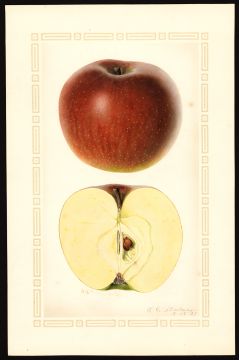 USDA Pomological Watercolor by Steadman, Royal Charles (Newark, New Castle, Delaware)


U.S. Department of Agriculture Pomological Watercolor Collection. Rare and Special Collections, National Agricultural Library, Beltsville, MD 20705
Sources
- S.A. Beach, The Apples of New York Vol. 1 (1905). Public domain.
- A.J. Downing, Fruits and Fruit Trees of America (1869). Public domain.
- Granville Lowther (ed.), Encyclopedia of Practical Horticulture (1914). Public domain.
- U.P. Hedrick, Cyclopedia of Hardy Fruits (1922). Public domain.
- John J. Thomas, The American Fruit Culturist (1903). Public domain.
- USDA Pomological Watercolor Collection, U.S. National Agricultural Library.
- 33 historical nursery catalog references (see Variety Finder for the full list).
- Full entry with all citations: Stark on the Variety Finder
Trees of this Variety in Our Collection
| Orchard | Tag | Condition | |
|---|---|---|---|
| Osborn Springs Tree 113 | Osborn Springs | 113 | good |