White Winter Pearmain: Difference between revisions
Bot: enrich variety page from Variety Finder data (white-winter-pearmain-apple) |
Bot: remove 1 issue-marked watercolor(s) (injury/disease illustrations) |
||
| Line 78: | Line 78: | ||
File:USDA_Pomological_White_Winter_Pearmain_POM00004134.jpg|USDA Pomological Watercolor by Heiges, Bertha (Coeur d'Alene, Kootenai, Idaho) | File:USDA_Pomological_White_Winter_Pearmain_POM00004134.jpg|USDA Pomological Watercolor by Heiges, Bertha (Coeur d'Alene, Kootenai, Idaho) | ||
File:USDA_Pomological_White_Winter_Pearmain_POM00000047.jpg|USDA Pomological Watercolor by Steadman, Royal Charles (Corvallis, Benton, Oregon) | File:USDA_Pomological_White_Winter_Pearmain_POM00000047.jpg|USDA Pomological Watercolor by Steadman, Royal Charles (Corvallis, Benton, Oregon) | ||
</gallery> | </gallery> | ||
Latest revision as of 01:26, 18 July 2026
| White Winter Pearmain | |
|---|---|
| Species | Apple |
| Trees Found | 2 |
| Orchards | McCoin Upper |
| Preserved | Clarno Arboretum(2025) |

Large, roundish, oblong, conic; pale yellow with high flavor. The original tree has never failed to produce from a moderate set to a full crop. It is not only a beauty but all right for size, quality and productiveness, qualities rarely combined in one variety. Season, December to March. Read the full entry: White Winter Pearmain on the Variety Finder for deeper history, every book quote, and all nursery catalog references.
Quick Facts
| Type | Apple |
| Season | Late (Late fall to winter (October to November)) |
| Flavor | sweet, aromatic, honeyed, subacid, mild |
| Flavor notes | Honeyed, tropical notes; sweet, sprightly; tender, fine-grained, crisp flesh; aromatic |
| Uses | fresh eating, pies, sauce, cider, cooking |
| Keeping quality | Excellent |
| Size | Above Medium |
| Shape | Conic |
| Skin color | yellow, green, blushed, red |
| Flesh | Yellow crisp |
| Origin | eastern United States, USA, c. 1790. Unknown, likely eastern United States; documented before 1850, possibly late 1700s to early 1800s |
Synonyms
Campbellite, Michael Henry, Michael Henry Pippin, WHITE PEARMAIN, White Pearmain, Winter Harvey
Origin and History
Origin unknown; thought to be an old Eastern variety whose name was lost when it traveled west, though it has never been definitively identified. Warder records that the fruit was brought to Indiana by some of the early pomologists "in the days of saddle-bag transportation." In a lot of grafts, two varieties lost their labels and were propagated and fruited without name; being considered Pearmain-shaped, they were called respectively Red and White Winter Pearmains. The former proved to be the Esopus Spitzenberg; the latter has never been identified, though it is believed to be an old eastern variety. Downing suggested it might be the Winter Harvey, a description of which Warder had not seen. Hedrick reiterates that it was "one of the highly prized possessions of the pioneers of Ohio and Indiana," brought as grafts during the saddle-bag era, and is "thought to be an old sort renamed, but what it is no one knows."
For a time the variety was confounded with the Michael Henry Pippin, an old New Jersey apple. Elliott, in his first edition (1854), made White Pearmain and White Winter Pearmain synonyms of Michael Henry Pippin because all specimens he had examined matched that variety; on later testing on his own grounds he became confident of its distinctness, and retained it under the name by which it was generally known. Warder likewise notes the early confusion and affirms the two are very distinct. In 1858 the American Pomological Society catalogued it as White Winter Pearmain; since 1897 it has been listed by the Society as White Pearmain, though Beach observes "it is very doubtful whether this change will be generally accepted by fruit growers and fruit dealers." Downing also records the name "Campbellite" for this variety.
It is an old favorite dessert apple in portions of the Middle West from Ohio to Kansas, and Elliott reports that "in Oregon it is one of the most desirable of apples." Beach notes it succeeds better in those regions than in New York, where it has been little grown and is now seldom or never planted. Budd-Hansen's specimen illustrated was "a fine specimen from the Pacific slope, in Washington, shown at the Pan-American Exposition, 1901." Hedrick adds that its cultivation is largely confined to Ohio and Indiana, though it has been somewhat planted in the Far West, and notes the apples are "not particularly attractive in appearance, neither shape nor color appealing to the eye."
Fruit
Size. Medium to large, or "below medium to nearly large" (Beach); above medium (Elliott); rather large (Thomas); above medium to large (Budd-Hansen); medium to large (Hedrick). Uniform in size and shape.
Form. Conical, regular, sometimes obscurely angular (Warder); roundish oblong conic, somewhat oblique (Downing); roundish ovate or roundish approaching oblong conic, varying to roundish conic, somewhat ribbed, pretty symmetrical (Beach); oblong conical, angular or oblique (Elliott); conical, angular or ribbed (Thomas); roundish oblong conic, somewhat oblique and ribbed toward the base (Budd-Hansen); round-oblate, round or oblong-conic, ribbed, symmetrical (Hedrick).
Stem. Medium to long, often knobby and clubbed (Warder); short (Downing, Elliott, Thomas); medium to long, often fleshy or knobbed at branch end (Budd-Hansen); medium to long (Beach, Hedrick).
Cavity. Acute, wavy, brown (Warder); deep, nearly closed (Downing); deep (Elliott); rather small to above medium, acute, deep, moderately narrow to broad, somewhat furrowed, sometimes russeted (Beach); deep, regular, obtuse, with faint trace of russet (Budd-Hansen); small, acute, deep, narrow, furrowed, sometimes russeted (Hedrick).
Calyx. Medium, closed (Warder); nearly closed (Elliott); medium to large, usually closed, lobes long, acute (Beach); open, with segments long, divergent (Budd-Hansen); large, usually closed, lobes long, acute (Hedrick). Downing notes "Segments long." Calyx tube long, conical (Beach, Hedrick); tube funnel-shaped, stamens median (Budd-Hansen).
Basin. Abrupt, regular or shallow and folded (Warder); uneven (Downing, Budd-Hansen); uneven, surrounded by five prominences, continued in obscure angles along its sides (Elliott); small to medium, oblique, shallow and obtuse to medium in depth and rather abrupt, medium in width, often distinctly furrowed, wrinkled, pubescent (Beach); shallow, uneven, or ribbed (Budd-Hansen); small, oblique, shallow, obtuse, often distinctly furrowed, wrinkled, pubescent (Hedrick).
Skin. Smooth, yellow, often bronzy (Warder); pale yellow, with a slight blush or warm cheek, thickly sprinkled with minute brown dots (Downing); pale yellow, with slight blush cheek and minute brown dots (Elliott); light yellowish green, with a brownish red cheek (Thomas); clear pale yellow, with faint bronze blush or warm cheek (Budd-Hansen); tough, smooth, slightly waxen, pale yellow, or at first greenish, with a shade of brownish-red (Beach); tough, smooth, waxen, pale yellow, with a shade of brownish-red (Hedrick). Dots scattered, small, dark (Warder); minute brown (Downing, Elliott); distinct, numerous, minute, russet (Budd-Hansen); numerous, pale or russet, often submerged, usually larger and much elongated about the cavity (Beach, Hedrick).
Flesh / Flavor. Yellow, fine grained, tender, crisp, juicy; flavor mild sub-acid, very rich; quality best (Warder). Yellowish, tender, crisp, juicy, very pleasant subacid; very good (Downing). Yellowish, tender, crisp, juicy, pleasant, very mild sub-acid; "very good" (Elliott). Whitish, fine-grained, with a mild sub-acid, rich, fine flavor (Thomas). Yellowish, tender, juicy, crisp, spicy, very pleasant subacid, excellent to best (Budd-Hansen). Slightly tinged with yellow, firm, fine-grained, crisp, tender, juicy, mild subacid, sprightly, very pleasantly aromatic, very good to best (Beach). Yellow, firm, fine-grained, crisp, tender, juicy, mild subacid, sprightly, pleasantly aromatic; good to best (Hedrick). Hedrick notes the apples are "a little too mild for culinary uses."
Core / Seeds. Core regular, closed, slightly clasping the eye; seeds few, pointed, pale or yellow (Warder). Core medium to rather large; cells closed or partly open; core lines somewhat clasping; carpels rather flat, broad or roundish-cordate, emarginate, mucronate, tufted; seeds light brown, medium to large, rather wide, plump, obtuse to acute, tufted (Beach). Core closed; cells round, slit; tube funnel-shaped; stamens median; seeds plump (Budd-Hansen). Core medium to large; cells closed or partly open; core-lines clasping; carpels flat, broad or round-cordate, emarginate, mucronate, tufted; seeds light brown, large, wide, plump, obtuse, tufted (Hedrick).
Season
December to March (Warder, Beach, Hedrick); January to April (Downing, Elliott); December to April (Budd-Hansen); winter (Lowther). Beach notes the fruit is "often scabby on rich limestone soils and on old trees" (under fruit), affecting handsomeness in some seasons.
Uses
Table, kitchen, market (Warder). Both kitchen and market (Lowther). A dessert apple (Beach). Hedrick remarks it is "a little too mild for culinary uses," implying its strength is as a dessert fruit.
Illustrations
-
 USDA Pomological Watercolor by Newton, Amanda Almira (Watsonville, Santa Cruz, California)
 -
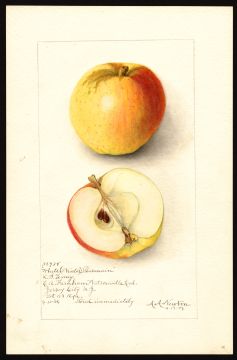 USDA Pomological Watercolor by Newton, Amanda Almira (Watsonville, Santa Cruz, California)
 -
 USDA Pomological Watercolor by Newton, Amanda Almira (Milton-Freewater, Umatilla, Oregon)
 -
 USDA Pomological Watercolor by Heiges, Bertha (Coeur d'Alene, Kootenai, Idaho)
 -
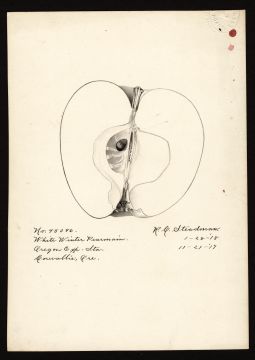 USDA Pomological Watercolor by Steadman, Royal Charles (Corvallis, Benton, Oregon)


U.S. Department of Agriculture Pomological Watercolor Collection. Rare and Special Collections, National Agricultural Library, Beltsville, MD 20705
Sources
- John A. Warder, American Pomology: Apples (1867). Public domain.
- A.J. Downing, Fruits and Fruit Trees of America (1869). Public domain.
- S.A. Beach, The Apples of New York Vol. 1 (1905). Public domain.
- U.P. Hedrick, Cyclopedia of Hardy Fruits (1922). Public domain.
- F.R. Elliott, The Western Fruit Book (1865). Public domain.
- Granville Lowther (ed.), Encyclopedia of Practical Horticulture (1914). Public domain.
- John J. Thomas, The American Fruit Culturist (1903). Public domain.
- J.L. Budd & N.E. Hansen, American Horticultural Manual, Part II: Systematic Pomology (1914). Public domain.
- USDA Pomological Watercolor Collection, U.S. National Agricultural Library.
- 41 historical nursery catalog references (see Variety Finder for the full list).
- Full entry with all citations: White Winter Pearmain on the Variety Finder
Trees of this Variety in Our Collection
| Orchard | Tag | Condition | |
|---|---|---|---|
| McCoin Upper Tree 40 | McCoin Upper | 40 | poor |
| McCoin Upper Tree 41 | McCoin Upper | 41 | poor |