Baldwin
| Baldwin | |
|---|---|
| Species | Apple |
| Trees Found | 7 |
| Orchards | Lithgow Springs,McCoin Lower,McCoin Upper |
| Preserved | Clarno Arboretum(2025) |

Large, roundish, narrowing a little to the eye; skin yellow in the shade, but nearly covered and striped with red and orange in the sun; flesh crisp, juicy and subacid, rich; tree a vigorous grower and bears abundantly; succeeds well in Western Maryland and the mountains of Virginia, but drops its fruit too early in or near the tidewater section. October to January, later in the mountains. Read the full entry: Baldwin on the Variety Finder for deeper history, every book quote, and all nursery catalog references.
Quick Facts
| Type | Apple |
| Season | Late (Late fall (October to November)) |
| Flavor | sweet, vinous, subacid, aromatic, rich |
| Flavor notes | Mild acidity with vinous sweetness; light rose-like aroma; crunchy, juicy flesh |
| Uses | fresh eating, cider, pies, baking, cooking, drying, preserves |
| Keeping quality | Excellent |
| Size | Above Medium |
| Shape | Round |
| Skin color | striped red, red, yellow, green, orange, crimson, russet, striped, blushed, dark |
| Flesh | Yellow crisp |
| Origin | Massachusetts, USA, c. 1740. Wilmington, Massachusetts, USA; discovered around 1740 as a chance seedling on John Ball's farm |
Synonyms
Baldwin Rosenapfel, Baldwin's Rother Pippin, Butters, Calville Butter, Felch, Late Baldwin, Pecker, Red Baldwin, Red Baldwin Pippin, Steele's Red Winter, Woodpecker
Origin and History
The Baldwin originated about 1740 as a chance seedling on the farm of John Ball in Wilmington, Middlesex County, Massachusetts (about three miles southeast of Lowell, near Lowell). Ball had purchased the then-uncultivated farm around 1740, and not long after, the variety came up in a lane leading from the house to the barn. For about 40 years its cultivation was confined to the immediate neighborhood. The farm eventually came into the possession of a Mr. Butters, who gave the apple the name Woodpecker because the tree was frequented by woodpeckers; it was long known locally as the Woodpecker, Pecker, or Butters. Deacon Samuel Thompson, a surveyor of Woburn, brought it to the attention of Col. Baldwin of the same town, who at once perceived its excellence, propagated it, and more widely introduced it in Eastern Massachusetts as early as 1784; from his interest it came to be called the Baldwin. In 1817 the original tree was still alive but it perished between 1817 and 1832; a monument to the Baldwin apple now marks the location.
Coxe (1817) makes no mention of it. Thacher's American Orchardist (Boston, 1832) gives it brief but favorable mention. Floy's American edition of Lindley's Guide to the Orchard (New York, 1833) does not mention it, but the appendix to the 1846 edition describes it and notes it is "well known, highly esteemed, and extensively cultivated" in New England. Kenrick's New American Orchardist (Boston, 1833) called it the most popular apple in the vicinity of Boston, raised in large quantities for the market. Hovey (1852) reported orchards near Boston producing about a thousand barrels per bearing year, with as many as fifteen hundred barrels sent to the East Indies in a single season. Prior to 1850 the Baldwin was little known in New York state, but with the extension of commercial orcharding it rapidly came into supremacy among the commercial apples of New York. Downing groups its flavor and general characteristics with the Esopus Spitzenberg family. The Fisher (1963) USDA survey records numerous indexed clonal entries from Maine, Geneva NY (D. S. T. Smith Co., 1897), Kelly Bros. Nursery (Dansville, NY, 1952; station number 147), Willis Nursery (Ottawa, Kansas; chance seedling; station number 4341323), and additional entries from experiment stations in Connecticut, Michigan, Illinois, and elsewhere.
Fruit
Size: Large, sometimes very large; usually above medium; pretty uniform in size. Hovey gives about two and a half inches deep and three broad. Warder calls it large.
Form: Roundish inclined to conic, varying to roundish oblong; often faintly ribbed or somewhat irregular but symmetrical and fairly uniform in shape. Downing and Elliott describe it as roundish, narrowing a little to the eye/calyx. Hovey: roundish, largest about the middle, narrowing little to the eye. Thomas: rather large, roundish, with more or less of a rounded taper towards the apex. Warder describes it as frequently round, sometimes almost conical, but generally inclined to be flattened, classed by measurement as oblate; large specimens in southern latitudes are very apt to be unequal and lop-sided, with axis inclined.
Stem: Medium to long; usually about three-fourths of an inch (Downing, Elliott, Thomas give half to three-fourths inch), rather slender for so large a fruit (Downing, Thomas, Elliott), though Warder calls it sufficiently stout, often curved or inclined. Hovey: rather slender, curved, and obliquely inserted.
Cavity: Acute, medium to rather deep, rather broad; often somewhat furrowed, sometimes compressed, sometimes lipped; often russeted with outspreading rays of russet or deep green. Downing: even, moderately deep. Warder: wide, regular or wavy, generally brown. Elliott: deep. Hovey: regular and moderately deep, blotched with russet around the stem, sometimes extending in irregular tracings over the base of the fruit.
Calyx / Eye: Calyx small to rather large; closed or somewhat open; lobes long, acute to acuminate. Calyx tube conical, rather short and wide with projection of fleshy pistil point into its base. Stamens basal. Hovey: segments of the calyx long and woolly. Downing: closed. Warder: eye large and open, from the shortness of the calyx, on which account the variety is considered very subject to the attacks of the codling-moth.
Basin: Abrupt, narrow to moderately wide; often distinctly furrowed; slightly corrugated; the plaited or folded marks are quite characteristic (Warder). Downing: rather narrow, plaited. Elliott: rather narrow, plaited. Thomas: narrow, slightly plaited. Hovey: rather deep and slightly plaited or furrowed (calling the basin a "hollow"). Warder: deep, often abrupt and narrow, generally waved, folded or plaited.
Skin: Tough, smooth, light yellow or greenish, blushed and mottled with bright red, indistinctly striped with deep carmine; the prevailing effect is bright red. Lowther adds: sometimes approaching a deep red. Flecks of russet, or even broken russet lines, may occasionally be seen on the base of the fruit. Downing: yellow in the shade, but nearly covered and striped with crimson, red, and orange in the sun, dotted with a few russet dots, and with radiating streaks of russet about the stalk. Hovey: fair, smooth, glossy, bright yellow in the shade, but nearly covered with deep orange red approaching scarlet, indistinctly striped with crimson. Warder: rich yellow where shaded, exposed parts quite covered with deep red so as to conceal the ground color and obscure stripes of deeper red; frequently marked with veined russet overlying or excluding the red. The skin is firm and thick, allowing the fruit to stand handling and shipping well, a key reason it is the standard for both home and export markets.
Dots: Gray or whitish, depressed; small and numerous toward the basin, more scattering, conspicuous, large, irregular, or elongated toward the cavity. Warder: minute, yellow, or gray where the red prevails. Hovey: prominent grayish specks, thickest near the crown.
Flesh / Flavor: Yellowish (Downing: yellowish white; Hovey: yellowish; Lowther: yellow), firm, moderately coarse, crisp, rather tender, juicy to very juicy, agreeably subacid, sprightly, somewhat aromatic; good to very good. Downing characterizes the flavor as "that agreeable mingling of the saccharine and acid which constitutes a rich, high flavor. Very good." Hovey: juice abundant, sugary, with a delicious admixture of acid, rich, brisk, and high-flavored. Thomas: rich, sub-acid flavor. Warder: yellow, breaking, frequently coarse-grained, juicy, sub-acid, rich; some northern specimens are fine-grained and almost first quality, while those from the South are coarse, poor, and scarcely second-rate for table use though good for cooking. Hedrick: quality, while not of the best, is good. Beach notes "Baldwin Spot", brown flecks in the flesh, a physiological defect more apt to appear in overgrown than in medium-sized fruit, not caused by insects or fungi, with no known remedy.
Core / Seeds: Core medium or below, nearly axile, closed or partly open; core lines meeting. Carpels roundish ovate, emarginate, somewhat tufted. Warder: core medium, regular, closed, meeting, sometimes clasping the eye. Hovey: core medium size, very close. Elliott: core small, compact; capsules ovate hollow. Seeds variable, often abortive; when normally developed they are large, long, acute, and dark brown. Warder: numerous, long, angular, imperfect. Hovey: rather large and pointed, but mostly abortive. Elliott: long ovate, pyriform.
Season
A winter apple. November to March or April in common storage; to May or later in cold storage (Beach). Hovey: ripe in December, keeps in excellent condition till May or June. Downing: ripe November to March, in perfection in January. Hedrick: November to March or April. Warder: October to January, occasionally keeping later. Elliott: December to March. Thomas: ripens through winter. Lowther: March or April; November to December in the Northwest; later in cold storage. Beach and Downing both note that when grown in southern latitudes Baldwin becomes a fall or early winter sort and loses sprightliness; conversely, summer-ripening varieties originating north are improved when grown south.
Uses
Well adapted for general market, dessert, and culinary uses. Pre-eminently the leading variety in the commercial orchards of New York, New England, certain regions in Southern Canada, the southern peninsula of Michigan, and on the clay soils of Northern Ohio; grown more or less from Colorado to Washington; does fairly well in the Pacific Northwest but cannot compete there with the Northeastern states (Lowther). One of the leading apples used for export trade and one of the principal varieties handled in cold storage. Yields a pretty uniform grade of fruit with a low percentage of culls when kept free of injurious insects and fungous diseases. Baldwins unsuitable for barreling supply a large part of the evaporator stock in New York state and are used to some extent by canneries. In the South and Southwest it is undesirable because it ripens too early to be a good winter variety and does not attain as high quality. Considered very subject to codling-moth attack on account of its short calyx and open eye (Warder).
Illustrations
-
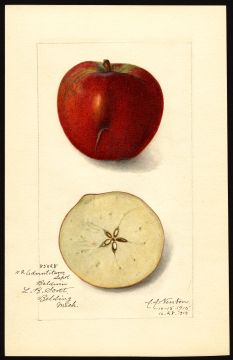 USDA Pomological Watercolor by Newton, Amanda Almira (Belding, Ionia, Michigan)
 -
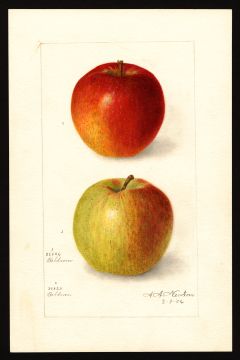 USDA Pomological Watercolor by Newton, Amanda Almira (New York)
 -
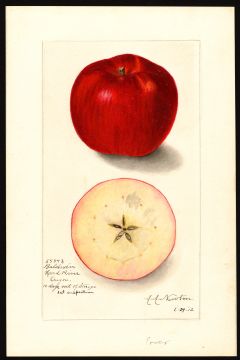 USDA Pomological Watercolor by Newton, Amanda Almira (Hood River, Hood River, Oregon)
 -
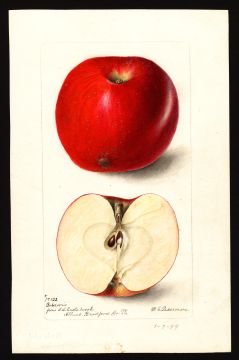 USDA Pomological Watercolor by Passmore, Deborah Griscom (Athens, Bradford, Pennsylvania)
 -
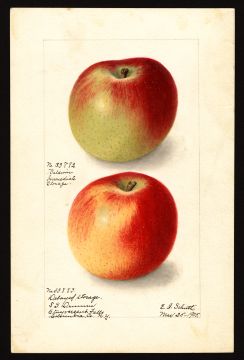 USDA Pomological Watercolor by Schutt, Ellen Isham (Stuyvesant Falls, Columbia, New York)
 -
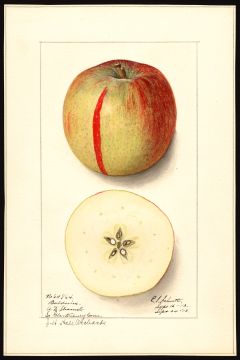 USDA Pomological Watercolor by Schutt, Ellen Isham (Seymour, New Haven, Connecticut)
 -
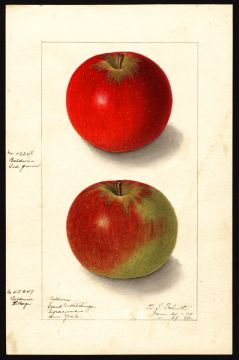 USDA Pomological Watercolor by Schutt, Ellen Isham (Syracuse, Onondaga, New York)
 -
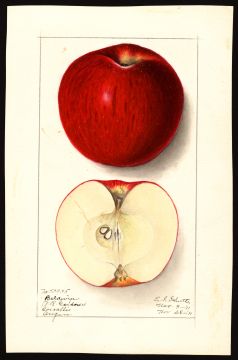 USDA Pomological Watercolor by Schutt, Ellen Isham (Corvallis, Benton, Oregon)
 -
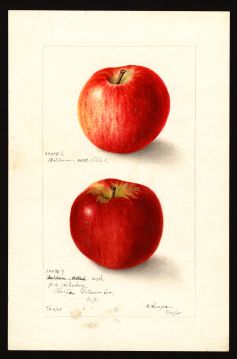 USDA Pomological Watercolor by Heiges, Bertha (Phelps, Ontario, New York)
 -
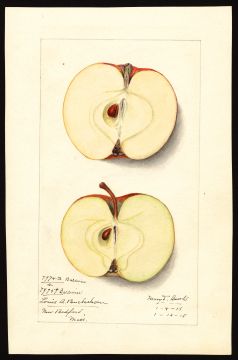 USDA Pomological Watercolor by Arnold, Mary Daisy (New Bedford, Bristol, Massachusetts)
 -
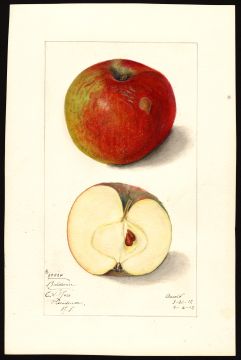 USDA Pomological Watercolor by Arnold, Mary Daisy (Providence, Providence, Rhode Island)
 -
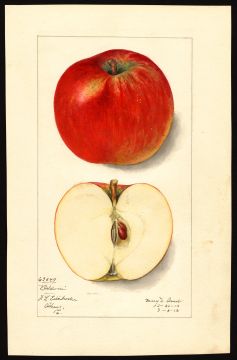 USDA Pomological Watercolor by Arnold, Mary Daisy (Athens, Bradford, Pennsylvania)
 -
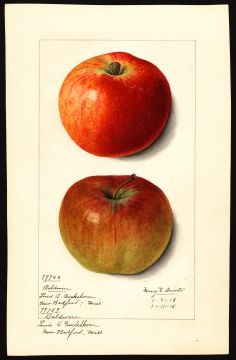 USDA Pomological Watercolor by Arnold, Mary Daisy (New Bedford, Bristol, Massachusetts)
 -
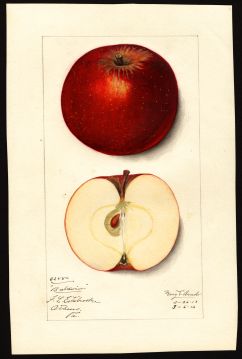 USDA Pomological Watercolor by Arnold, Mary Daisy (Athens, Bradford, Pennsylvania)
 -
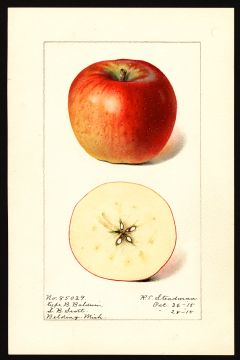 USDA Pomological Watercolor by Steadman, Royal Charles (Belding, Ionia, Michigan)
 -
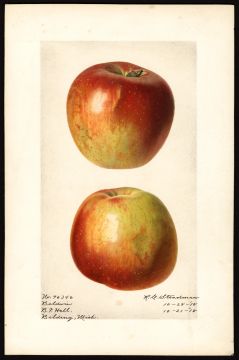 USDA Pomological Watercolor by Steadman, Royal Charles (Belding, Ionia, Michigan)
 -
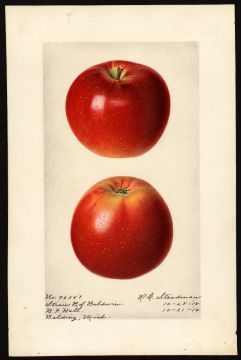 USDA Pomological Watercolor by Steadman, Royal Charles (Belding, Ionia, Michigan)
 -
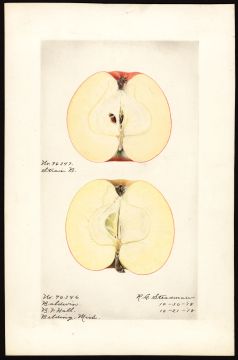 USDA Pomological Watercolor by Steadman, Royal Charles (Belding, Ionia, Michigan)
 -
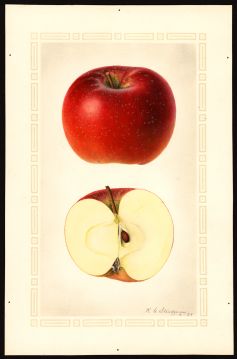 USDA Pomological Watercolor by Steadman, Royal Charles (Arlington, Virginia)
 -
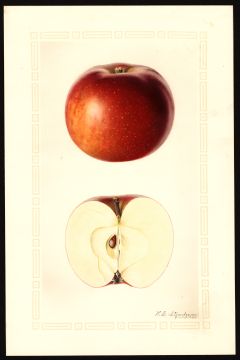 USDA Pomological Watercolor by Steadman, Royal Charles (Amherst, Hampshire, Massachusetts)
 -
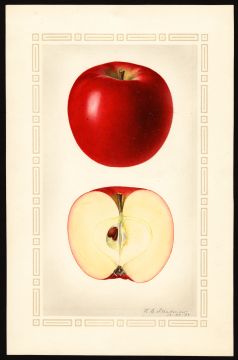 USDA Pomological Watercolor by Steadman, Royal Charles (Amherst, Hampshire, Massachusetts)
 -
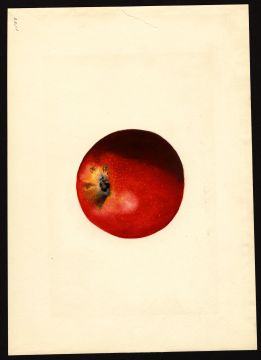 USDA Pomological Watercolor by Shull, James Marion (Wayne, New York)
 -
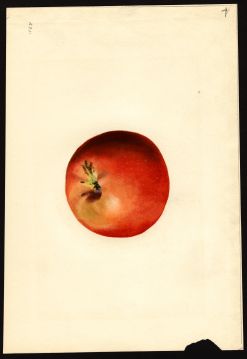 USDA Pomological Watercolor by Shull, James Marion (Wayne, New York)
 -
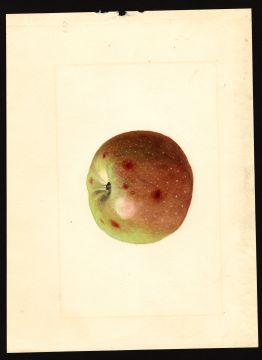 USDA Pomological Watercolor by Shull, James Marion (Winchester, Virginia)
 -
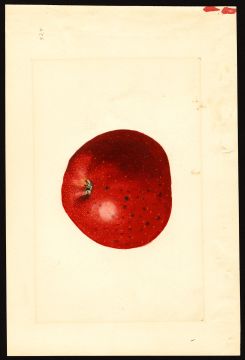 USDA Pomological Watercolor by Shull, James Marion (Pleasant Valley, El Dorado, California)
 -
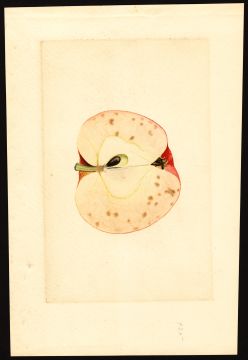 USDA Pomological Watercolor by Shull, James Marion (Pleasant Valley, El Dorado, California)
 -
S.A. Beach, The Apples of New York Vol. 1 (1905)
-
John A. Warder, American Pomology: Apples (1867)
-
A.J. Downing, Fruits and Fruit Trees of America (1869)


U.S. Department of Agriculture Pomological Watercolor Collection. Rare and Special Collections, National Agricultural Library, Beltsville, MD 20705
USDA Bulletin 56 Notes
USDA name: Baldwin
USDA citations: NEF'26
- The syn. Mahaska probably erroneous.
Sources
- S.A. Beach, The Apples of New York Vol. 1 (1905). Public domain.
- John A. Warder, American Pomology: Apples (1867). Public domain.
- A.J. Downing, Fruits and Fruit Trees of America (1869). Public domain.
- H.H. Fisher, A Survey of Apple Clones in the United States (USDA ARS, 1963). Public domain.
- F.R. Elliott, The Western Fruit Book (1865). Public domain.
- Granville Lowther (ed.), Encyclopedia of Practical Horticulture (1914). Public domain.
- U.P. Hedrick, Cyclopedia of Hardy Fruits (1922). Public domain.
- John J. Thomas, The American Fruit Culturist (1903). Public domain.
- C.M. Hovey, The Fruits of America (1852). Public domain.
- USDA Pomological Watercolor Collection, U.S. National Agricultural Library.
- 85 historical nursery catalog references (see Variety Finder for the full list).
- Full entry with all citations: Baldwin on the Variety Finder