Gravenstein
| Gravenstein | |
|---|---|
| Species | Apple |
| Trees Found | 2 |
| Orchards | El Rancho,Grandview |
| Preserved | Clarno Arboretum({{{clarno_year}}}) |

Streaked and splashed deep red; large, handsome, excellent quality. Especially profitable in the apple-growing sections on the Pacific Coast. The Gravenstein group is one of the most widely planted apple we have ever known and if we think of it that this season we propagated 100,000. NCS Read the full entry: Gravenstein on the Variety Finder for deeper history, every book quote, and all nursery catalog references.
Quick Facts
| Type | Apple |
| Season | Early (Early (late July to late August)) |
| Flavor | sweet, aromatic, subacid, rich |
| Flavor notes | Sweet-sharp balance; clean, crisp; very aromatic |
| Uses | fresh eating, cooking, sauce, cider, drying |
| Keeping quality | Poor |
| Size | Large |
| Shape | Round |
| Skin color | striped red, yellow, green, red, orange, striped, crimson, blushed, white |
| Flesh | Yellow tender |
| Origin | Schleswig-Holstein, Germany, c. 1650. Disputed; likely Italy or southern Germany, brought to Graefenstein Castle, Schleswig-Holstein (now Denmark) in the 17th century |
Synonyms
Banks, Blumen Calvill, Blumen-Calvill, Calleville Grafensteiner, Calville Grafensteiner, Calville de Gravenstein, Diel's Sommer König, Diel's Sommerkonig, Early Congress, German, Graefenstein, Graefensteiner, Grafen-Apfel, Grafenapfel, Grafensteiner, Grave Slige, Grave Slije, Grave Slue, Gravensteiner, Gravenstine, Harryman, King of Pippins, Ohio Nonpareil, Paradies, Paradies A, Paradies Apfel, Pomme Graefenstein, Prinsessin-Apfel, Prinzessin A, Prinzessin Apfel, Ripp Apfel, Ripp. A, Sabine, Sabine of the Flemings, Sommer König, Stroemling, Strohmer, Stromling, Tom Harryman
Origin and History
Gravenstein is an old German (or more broadly North European) apple, considered one of the finest of northern Europe in both appearance and quality. The most-cited origin story, given by Hovey in 1851 and repeated by Beach (1905) and Lowther (1914), is that it was originally found in the Duke of Augustinberg's garden at Gravenstein, in Holstein, with the original tree growing there in the middle of the eighteenth century (c. 1750). A second account holds that it took its name from being found in the garden of the castle of Grafenstein, in Sleswick (Schleswig); Diel reports a further suggestion that it was introduced from Italy. Bunyard (1920) gives the introduction date as "about 1760." Warder (1867) and Budd-Hansen (1914) likewise give Gravenstein, Holstein as the origin. Hovey notes that the variety is undoubtedly of similar origin to the Red Astrachan and Duchess of Oldenburg, sharing the peculiar habit of growth, form of foliage, and texture of fruit that distinguish the German apples.
The variety became common throughout Germany and Sweden and was received from there into the English collections (Hovey gives "English collections"; Lowther's 1914 reprint reads "English colonies"). It was described in the Transactions of the London Horticultural Society in 1822 (Hovey, Beach), and Forsyth lists it in 1824 (Beach). Hovey infers that it reached American gardens some time after 1822, since neither Coxe nor Thacher describe it. Captain DeWolfe stated in 1857 that he imported it from Denmark in May 1826; however, a letter from Judge Buel of Albany dated October 11, 1820, published in the New England Farmer, called attention to the importation of Gravenstein and other German apples, trees of which he had presented to members of the Massachusetts Horticultural Society, so Hovey concludes Gravenstein was imported to the vicinity of Albany probably prior to 1826. Hedrick (1922) writes that it "has been in America probably a hundred years or more." After these early importations the variety was gradually disseminated through New York state and the rest of the country, though in most localities grown only to a limited extent. By Beach's time (1905), commercial cultivation was gradually increasing in some sections of New York, particularly portions of the Hudson valley, where growers found it desirable for both domestic and foreign markets. Fisher (1963) records U.S. clonal holdings at experiment stations in New Jersey, Pennsylvania, New York (Geneva), Washington (Moxee, Prosser, Wenatchee), Oregon (Corvallis), and Maryland (Glenn Dale); one accession was received from Ellwanger & Barry, Rochester, N.Y. in 1888 (probably from Germany), another from Milton Nursery, N.Y. in 1941, and PI No. 249923 from New Zealand in 1958.
Fruit
Size
Large to above medium, fairly uniform in size but not in shape (Beach, Hedrick, Lowther). Bunyard gives it as "medium, 3 by 2¼." Hovey: "Large, about three inches broad, and two and a half deep." Thomas: "Rather large." Central Experimental Farm: "above medium size, a little flattened." Most sources simply say "large" (Warder, Downing, Budd-Hansen, Fisher, Rivers).
Form
Sources broadly agree on a roundish to oblate, somewhat irregular, angular, broad-based form. Warder: "globular-oblate, angular." Downing: "rather flattened, and a little one-sided or angular, broadest at the base." Beach and Hedrick: "oblate to roundish, somewhat irregular, broad at the base, slightly angular about the basin"; Hedrick adds "oblate or round." Budd-Hansen: "varying from roundish oblong to slightly oblate, angular on the sides, the ribs extending from base to calyx, broadest at the base." Hovey: "Form, roundish, irregular, angular on the sides, broadest at the base and narrowing to the crown, which is large, ribbed, and slightly depressed." Elliott: "roundish flattened, a little irregular, somewhat ribbed, on surface undulating." Thomas: "roundish, slightly oblate, obtusely and obscurely ribbed, surface a little wavy." Bunyard: "rounded square, irregular." Fisher: "oblate to round, somewhat irregular."
Stem / Stalk
Short to medium, thick or stout (Beach, Hedrick, Budd-Hansen). Downing: "quite short and strong, deeply set." Warder: "short." Hovey: "very short, less than half an inch long, moderately stout, and deeply inserted." Elliott: "short." Thomas: "three-quarters of an inch long." Bunyard: "short, thick in a large deep cavity."
Cavity
Beach and Hedrick: "rather large, acute to acuminate, moderately deep to deep, rather narrow to broad, irregularly russeted." Warder: "deep, regular." Budd-Hansen: "acute, deep, angular, with trace of stellate russet." Hovey: "medium sized, somewhat uneven." Elliott: "open, deep." Thomas: "rather deep." Bunyard: "large deep." Hedrick repeats: "acute, deep, narrow to broad, irregularly russeted."
Calyx / Eye
Beach and Hedrick: "Calyx large, open or sometimes closed; lobes large, long, very broad, acute." Downing: "Calyx large, closed... Segments long, irregular, recurved." Warder: "Eye small, closed." Budd-Hansen: "calyx closed; segments long, leafy, large, irregular, slightly reflexed." Hovey: "Eye, large, open, and moderately sunk... segments of the calyx large, broad, somewhat reflexed and woolly." Elliott: "calyx, with open half reflexed segments." Thomas: "calyx large." Bunyard: "Eye, closed in a deep ribbed basin." So sources disagree about whether the eye is open or closed: Warder, Downing, Budd-Hansen, and Bunyard call it closed; Hovey and Elliott call it open; Beach and Hedrick allow both.
Basin
Beach and Hedrick: "irregular, medium in depth to deep, medium to wide, obtuse to somewhat abrupt, wrinkled"; Hedrick condenses to "wide, obtuse to abrupt, wrinkled." Downing: "wide, deep, rather irregular." Warder: "medium, regular." Budd-Hansen: "angular, rather irregular, ribbed." Hovey: "large, open and furrowed." Elliott: "rather deep, irregular, ribbed." Thomas: "deep, narrow." Bunyard: "deep ribbed."
Skin
Beach, Hedrick, and Lowther: "thin, tender, slightly rough" (Hedrick: "rough"), greenish-yellow to orange-yellow overlaid with broken stripes of light and dark red; dots few, small, light; prevailing effect yellow striped. Warder: "smooth, yellow, partially covered with mixed and splashed scarlet; Dots rare." Downing: "greenish yellow at first, but becoming yellow, and beautifully dashed and pencilled, and marbled with light and deep red and orange." Budd-Hansen: "bright yellow, beautifully striped, splashed, marbled, and dotted with light and deep bright red and orange on sunny side, polished, becoming unctuous at maturity; dots very obscure, few, gray, minute." Hovey: "fair, smooth, with a greenish yellow ground, of a waxen hue, distinctly streaked and pencilled with pale red, and lightly splashed with crimson, deepest on the sunny side." Elliott: "at first pale greenish, yellow ground, becoming rich yellow, beautifully striped, and splashed with bright red; exposed to sun, red prevails, and becomes of a dark hue, beautiful, few faint light green dots." Central Experimental Farm: "clear yellow, streaked and splashed with orange and red." Thomas: "striped and splashed with bright red on a yellow ground." Fisher: "thin, green-yellow with broken stripes light and dark red."
Flesh and Flavor
Beach: "yellowish, firm, moderately fine, crisp, moderately tender, juicy, sprightly subacid, aromatic, very good to best." Hedrick (essentially identical): "yellow, firm, fine, crisp, tender, juicy, sprightly subacid, aromatic; very good to best." Warder: "yellow, fine grained, breaking, juicy; Flavor sub-acid, aromatic; Quality best." Downing: "tender and crisp, with a high-flavored, somewhat aromatic taste. Very good." Budd-Hansen: "yellow, with yellow veinings, tender, juicy, crisp, sprightly subacid, high-flavored, aromatic, excellent." Hovey: "yellowish white, rather coarse, crisp and very tender: Juice, abundant, rich, subacid, sprightly and high flavored." Elliott: "yellowish, crisp, tender, sub-acid, with a peculiar aromatic taste." Thomas: "tender, juicy, very rich, sub-acid or rather acid, high flavored." Central Experimental Farm: "tender, crisp, juicy and of high flavour, quality very good." Bunyard: "crisp, yellowish-white, extremely juicy, of most distinct flavour... fragrant aroma and digestible flesh." Fisher: "yellow, firm, crisp, juicy, subacid, aromatic, very good to best." Hedrick (1922) summarizes the American assessment: "all lovers of fruits value Gravenstein for its crisp, tender, sprightly, juicy, richly-flavored, aromatic apples." Hovey notes the characteristic "refreshing admixture of sweet and acid."
Note on flesh texture: most sources call it tender and crisp; Hovey describes it as "rather coarse" but "crisp and very tender," while Beach calls it "moderately fine"; Hedrick "fine."
Core and Seeds
Beach and Hedrick: "Core medium in size, strongly abaxile; cells open; core lines clasping the funnel cylinder. Carpels broadly ovate (broad-ovate), emarginate. Seeds medium to large, medium in width, rather long, plump, acute to acuminate, medium brown" (Hedrick: "seeds large, long, plump, acute, brown"). Beach also gives "Calyx tube large, conical to funnel-shape. Stamens median." Warder: "Core regular, globular, or pointed toward the eye, closed, clasping; Seeds small, pointed." Budd-Hansen: "Core open, large; cells roomy, elliptical or round, abaxile; tube conical or funnel-shaped; stamens basal." Hovey: "Core, rather small, closed: Seeds, medium size." Elliott: "core, large, capsules open, hollow; seeds, ovate pyriform, reddish brown." Sources disagree on core size (Beach/Hedrick "medium"; Budd-Hansen and Elliott "large"; Hovey "rather small"; Warder "regular") and on whether cells are open or closed (Beach/Hedrick/Budd-Hansen/Elliott "open"; Warder/Hovey "closed"). Stamen position also differs (Beach/Hedrick "median"; Budd-Hansen "basal").
Season
Late September till early November (Beach, Hedrick, Fisher). Warder: "August, September." Downing: "September and October." Hovey: "Ripe in September and keeps till December." Elliott: "fit for cooking in August, and eating in September and October." Thomas: "Mid-autumn." Budd-Hansen: "September, October." Central Experimental Farm: "September and October." Rivers: "Sept.–Nov." Bunyard: "October to December." Lowther: "from the last of August to the first of November, depending on the latitude and altitude in which it is grown."
The crop ripens continuously over a period of several weeks and should have two or three pickings (Beach), or "two, three, or perhaps four pickings" (Lowther). Beach: beginning in the latter half of September, it continues in season till early November; when properly handled a considerable portion may remain apparently sound much later, but the color fades and quality and flavor deteriorate. As compared with other varieties of its class it stands up well in good dry cold storage. Hedrick notes that in Nova Scotia "it becomes a winter apple."
Commercial faults (Beach): "There is apt to be considerable loss from the dropping of the fruit before it is properly colored and there is also a rather high percentage of low grade or unmarketable fruit."
Uses
Dual-purpose, table/dessert and culinary/cooking/market. Warder: "table and kitchen." Downing: "A valuable apple for market or cooking, succeeding admirably wherever grown." Beach: "For culinary purposes it is perhaps unexcelled by any variety of its season." Lowther: "good for dessert and has no superior for culinary purposes." Bunyard: "Dessert or culinary... A good dessert apple. Its fragrant aroma and digestible flesh make it deserving of wider cultivation." Hedrick: "a valuable commercial fruit, where it succeeds, by reason of early bearing, productiveness, and good shipping qualities." Fisher: "a dual purpose apple." Often sells at comparatively (or "for") high prices in the markets (Beach, Lowther). Hovey notes it comes in at a season when fine varieties are scarce, succeeding the Porter and supplying the table throughout October.
Illustrations
-
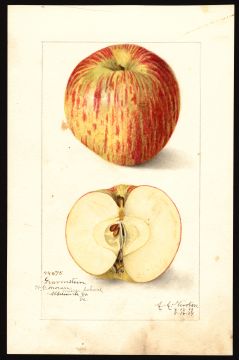 USDA Pomological Watercolor by Newton, Amanda Almira (Albermarle, Virginia)
 -
 USDA Pomological Watercolor by Newton, Amanda Almira (Truro, Canada)
 -
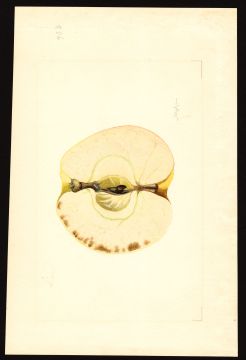 USDA Pomological Watercolor by Schutt, Ellen Isham
 -
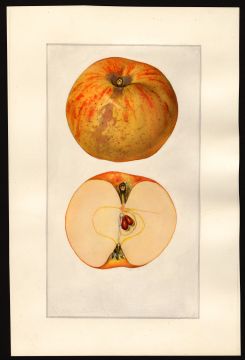 USDA Pomological Watercolor by Arnold, Mary Daisy (Arlington, Virginia)
 -
 USDA Pomological Watercolor by Arnold, Mary Daisy (Arlington, Virginia)
 -
 USDA Pomological Watercolor by Lower, Elsie E. (Missoula, Missoula, Montana)
 -
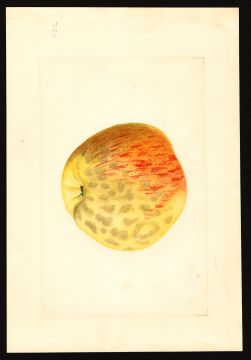 USDA Pomological Watercolor by Shull, James Marion
 -
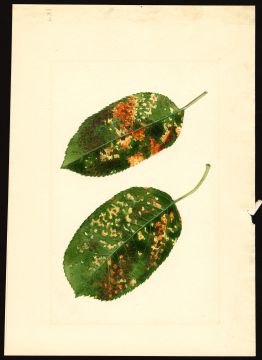 USDA Pomological Watercolor by Shull, James Marion (Kentville, Canada)


U.S. Department of Agriculture Pomological Watercolor Collection. Rare and Special Collections, National Agricultural Library, Beltsville, MD 20705
Sources
- S.A. Beach, The Apples of New York Vol. 2 (1905). Public domain.
- John A. Warder, American Pomology: Apples (1867). Public domain.
- J.L. Budd & N.E. Hansen, American Horticultural Manual, Part II: Systematic Pomology (1914). Public domain.
- E.A. Bunyard, A Handbook of Hardy Fruits (1920). Public domain.
- A.J. Downing, Fruits and Fruit Trees of America (1869). Public domain.
- Granville Lowther (ed.), Encyclopedia of Practical Horticulture (1914). Public domain.
- H.H. Fisher, A Survey of Apple Clones in the United States (USDA ARS, 1963). Public domain.
- U.P. Hedrick, Cyclopedia of Hardy Fruits (1922). Public domain.
- F.R. Elliott, The Western Fruit Book (1865). Public domain.
- John J. Thomas, The American Fruit Culturist (1903). Public domain.
- C.M. Hovey, The Fruits of America (1852). Public domain.
- USDA Pomological Watercolor Collection, U.S. National Agricultural Library.
- 94 historical nursery catalog references (see Variety Finder for the full list).
- Full entry with all citations: Gravenstein on the Variety Finder
Trees of this Variety in Our Collection
| Orchard | Tag | Condition | |
|---|---|---|---|
| El Rancho Tree 3 | El Rancho | 3 | |
| Grandview Tree 1 | Grandview | 1 |