Jonathan
| Jonathan | |
|---|---|
| Species | Apple |
| Trees Found | 0 |
| Orchards | |
| Preserved | Clarno Arboretum({{{clarno_year}}}) |

(King Philip) A beautiful, brilliant, dark red apple of very high flavor and excellent quality; tender, spicy, rich and juicy; an A-1 family sort and unusually profitable when planted commercially. A seedling of Spitzenburg but of much wider adaptability; originated in New York. In the West, Jonathan is the most popular of the older standard varieties and is heavily planted as a filler in orchards of Newtown Pippin and Spitzenburg. CS Read the full entry: Jonathan on the Variety Finder for deeper history, every book quote, and all nursery catalog references.
Quick Facts
| Type | Apple |
| Season | Mid (Mid-fall (early October)) |
| Flavor | sweet tart, aromatic, spicy, mild, subacid |
| Flavor notes | Sweet-tart balance with spicy, aromatic qualities; crisp, juicy flesh |
| Uses | fresh eating, baking, pies, cider, cooking |
| Keeping quality | Excellent |
| Size | Medium |
| Shape | Round |
| Skin color | striped red, red, yellow, striped, crimson, dark, blushed, orange, pink, russet |
| Flesh | White juicy |
| Origin | Ulster County, New York, USA, c. 1826. Woodstock, Ulster County, New York, USA; discovered 1826 as an Esopus Spitzenburg seedling on the farm of Philip Rick |
Synonyms
Esopus Spitzenberg (New), Johnathan, King Philip, New Spitzenberg, Philip Rick, Ulster Seedling, Wine, Winesap
Origin and History
Jonathan originated on the farm of Philip Rick at Woodstock, Ulster County, New York (Kingston, N.Y. is the locality given by several sources), with Hedrick dating its origin to about 1800. The first published account is that of Judge J. Buel of Albany in 1826, in his article "Observations on the utility of a Descriptive Catalogue of Garden and Orchard Fruit," addressed to the New York Horticultural Society, where he listed it as "Esopus Spitzenberg (New)" with the synonym "Ulster Seedling." In 1829 Judge Buel sent specimens to the Massachusetts Horticultural Society with the statement that it was "An Esopus Seedling and sometimes called the New Spitzenberg." According to Downing the original tree was still alive in 1845; Stark Bros. (1910) reports the original tree had been growing for over 100 years and was still bearing abundantly. The name Jonathan was assigned by Judge Buel in honor of Jonathan Hasbrouck, by whom Buel's attention was first called to the variety. Buel's first description was based on information from Judge Buell. The variety belongs to the Esopus Spitzenburg class and is by some considered to be a seedling of that variety; it excels its parent in hardiness, productiveness, health and vigor and is adapted to a wider range of territory, but the fruit is not so large nor does it keep as well as Esopus Spitzenburg. Jonathan was at first disseminated under various names, all soon superseded by "Jonathan." It has been widely disseminated throughout the apple-growing regions of New York but in none is it grown extensively; it is extensively planted farther west and south, where in many localities it ranks next to Ben Davis in commercial importance. Stark Bros. (1910) calls it the leader of all reds in demand and a profit-maker in all parts of the United States. Hansen (1902) and Budd-Hansen (1914) consider Jonathan and Grimes Golden the two best varieties for dessert use in the West. Warder (1867) notes its excellence has caused it to be called particularly "a gentleman's apple, though quite acceptable to the farmers' boys."
USDA ARS (Fisher, 1963) records multiple accessions: one received from Ulster Co., N.Y. held at Kansas State University; additional accessions held jointly at MiB, University of Connecticut, Pennsylvania State University, MiC, Oklahoma State University, and University of Illinois; an accession (station number 189) at University of Vermont; an accession from the Maine Apple Tree Pool at University of Maine; an accession received from Ellwanger & Barry, Rochester, N.Y. in 1888 held at the Geneva, New York station; an accession received from Milton Nurs., N.Y. in 1941 at Oregon State University; an accession from Alvin Marr, Entiat, Wash. (station numbers AP-H-25 and M-723) held at Prosser, Washington and Moxee Quarantine Station, Moxee, Washington; an accession from Inter-State Nurs., Hamburg, Iowa at Iowa State University; an accession from Stark Bros. Nurs. & Greening Nurs. at the Ohio Agricultural Experiment Station, Wooster (described as an Esopus seedling, fruit small-medium, oblong, deep red, flavor good); and an accession from Sherman Nurs. Co., Charles City, Iowa (station number A4985) held at the U.S. Horticultural Field Station, Cheyenne, Wyoming. The Fisher entry also includes a heading "Jonathan Sports."
Fruit
Size: Medium, rarely large; sometimes medium to rather small (Beach; Hedrick gives "small, rarely large"). As grown in New York, ordinarily rather small with a comparatively high percentage of uneven and irregular fruit; in the valleys of the Ohio, Mississippi and Missouri and in irrigated mountain districts farther west it attains better size (Beach). Pretty uniform in shape and size.
Form: Roundish conic to roundish ovate, often somewhat truncate, regular; round or oblong, conic, truncated (Warder); roundish, conical, regular (Elliott); round-ovate or approaching truncate-conical (Thomas); roundish oblong, somewhat conical, truncated, regular (Hansen; Budd-Hansen); round-conic, smoothly and regularly turned (Hedrick).
Stem: Medium to long, rather slender (Beach; Hedrick); long, slender (Warder; Hansen; Budd-Hansen); rather long, slender (Elliott); slender (Thomas).
Cavity: Acute to acuminate, deep to very deep, wide, symmetrical, sometimes slightly furrowed (Beach); acute, deep, regular, reddish brown (Warder); open, wide (Elliott); acute, deep, regular, with stellate russet (Hansen; Budd-Hansen); acute, deep to very deep, abrupt, narrow (Hedrick, note Hedrick says narrow whereas Beach says wide).
Calyx: Small, closed (Beach; Elliott; Hansen; Budd-Hansen; Warder gives "Eye small, closed, green"); segments connivent (Hansen; Budd-Hansen). Calyx tube rather small, funnel-shape or sometimes conical (Beach); funnel-shape (Hedrick); conical (Hansen; Budd-Hansen). Stamens basal to median (Beach; Hansen; Budd-Hansen); basal (Hedrick).
Basin: Deep to very deep, very abrupt, wide to moderately narrow (Beach); deep, regular, russet-veined (Warder); deep, smooth, very abrupt, rather wide (Hansen; Budd-Hansen); very distinct, rather deep (Thomas). Elliott (1865) gives a conflicting "shallow, slightly furrowed."
Skin: Thin, tough, smooth, pale bright yellow overlaid with lively red, striped with carmine (Beach; Lowther; Hedrick). When well colored the fruit is almost completely covered with red which deepens to purplish on the sunny side and often shows a beautiful contrasting bit of clear pale yellow about the cavity where a twig or leaf lay in contact with the skin; less highly colored fruit has more of a striped appearance particularly toward the basin (Beach; echoed by Hedrick). Warder gives "very smooth, waxy yellow, wholly covered brilliant dark red, mixed and striped." Elliott: "light yellow ground, mostly overspread, streaked, or stained with rich light red." Thomas: "nearly covered with brilliant stripes of clear red on a pale yellow ground." Hansen and Budd-Hansen: "very smooth, clear light yellow, almost or wholly covered with solid brilliant dark red on sunny side, on shaded side mixed and striped with lighter red." Stark Bros. (1910): "deep red, almost black color on sunny side." Lowther adds that in the irrigated regions it often takes on a deep or dark red color. Prevailing effect attractive lively deep red.
Dots: Minute, usually inconspicuous (Beach; Hedrick); minute, russet-veined (Warder); few minute white dots (Elliott); distinct, many, minute, whitish (Hansen; Budd-Hansen).
Flesh / Flavor: Whitish or somewhat yellow, sometimes with a tinge of red, firm, moderately fine, crisp, tender, juicy, very aromatic, sprightly subacid, very good to best (Beach; Lowther; Hedrick gives flesh yellow with tinge of red, firm, fine, crisp, tender, juicy, very aromatic, sprightly subacid, very good to best). Warder: "whitish yellow, tender, breaking, very juicy; Flavor sub-acid, aromatic, equal to Spitzenberg; Quality best." Elliott: "yellowish white, tender, juicy, slightly acid unless fully matured, when it is sub-acid, sprightly." Thomas: "white, very juicy, spicy, sub-acid, moderately rich." Hansen: "white, very tender, juicy, spicy, aromatic, sprightly subacid, best." Budd-Hansen: "white, very tender and juicy, spicy, aromatic, sprightly subacid, quality best." Stark Bros.: "fine-grained, very crisp and juicy ... sub-acid flavor, slightly vinous." Hedrick further describes the flavor as "not especially rich in flavor, but peculiarly sprightly and refreshing, having a distinct and most pleasing aroma."
Core / Seeds: Core medium or below, axile or nearly so; cells symmetrical but often not uniformly developed, usually closed, sometimes open; core lines clasp the funnel cylinder; carpels rather concave, roundish to roundish cordate, emarginate, smooth (Beach; Hedrick gives "core small, axile"). Warder: "Core medium, roundish-oval, regular, closed, scarcely clasping the eye." Hansen / Budd-Hansen: "Core closed, scarcely clasping; cells obovate." Thomas mentions "core, medium" only briefly via Elliott; Elliott gives "core, medium." Seeds rather large, long, acute to acuminate, dark, numerous (Beach; Hedrick gives "large, long, acute, dark, numerous"); plump, long, pointed (Hansen; Budd-Hansen); numerous, large, angular (Warder); full, abundant, dark brown (Elliott).
Season
November to January or later (Beach); December, January (Warder); December to February (Elliott); November to January, longer in cold storage, with the greatest demand at Christmas (Hedrick); December to March north, late fall and early winter in the south (Hansen); December to March East, late fall and early winter in the South (Budd-Hansen); keeps through winter (Thomas). Lowther: season from September to first of November for picking and marketing depending on the section grown, but may be held in storage until January and February if grown in the colder higher altitudes, Colorado Jonathans seen in Texas markets in prime condition in February, but when grown in the Ozarks could not be marketed later than December. Beach notes that the season is about the same as that of Tompkins King: it may be kept through the winter, but when held in ordinary storage later than January dark spots are liable to develop in the skin and seriously injure the appearance of the fruit; handled this way its commercial limit is December or early January, while in cold storage its commercial limit varies from January to March or sometimes later. Hedrick echoes the dark-spot problem in either common or cold storage. Stark Bros. (1910) cites the long-bearing original tree as proof of the fruit's keeping qualities. Fisher (1963) records "Nov. to Feb." for the Ellwanger & Barry accession at Geneva.
Uses
Dessert, cooking, etc. (Warder); a very superior dessert fruit, good for all purposes (Warder); excellent quality for either dessert or culinary use (Beach; Lowther). One of the most desirable varieties for the fancy trade at the holiday season (Beach). Considered, with Grimes Golden, one of the two best varieties for dessert use in the West (Hansen; Budd-Hansen). Not recommended for general commercial planting in New York but in some places under good management it has proved a profitable variety (Beach); a popular market variety in many sections, both East and West (Thomas); Jonathan leads all reds in demand and is a profit-maker in all parts of the United States (Stark Bros., 1910). Grown best in parts of the Middle West and the Pacific Coast states (Hedrick).
Illustrations
-
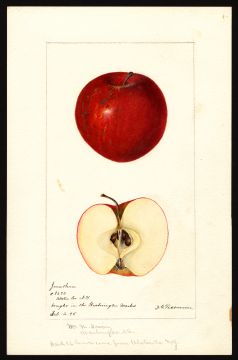 USDA Pomological Watercolor by Passmore, Deborah Griscom (Ulster, New York)
 -
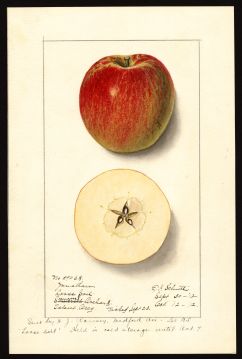 USDA Pomological Watercolor by Schutt, Ellen Isham (Talent, Jackson, Oregon)
 -
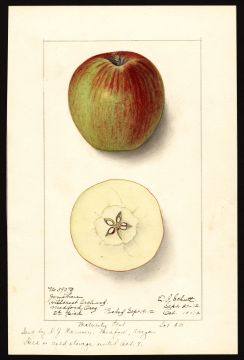 USDA Pomological Watercolor by Schutt, Ellen Isham (Medford, Jackson, Oregon)
 -
 USDA Pomological Watercolor by Schutt, Ellen Isham (Medford, Jackson, Oregon)
 -
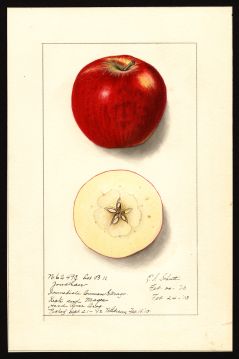 USDA Pomological Watercolor by Schutt, Ellen Isham (Hood River, Hood River, Oregon)
 -
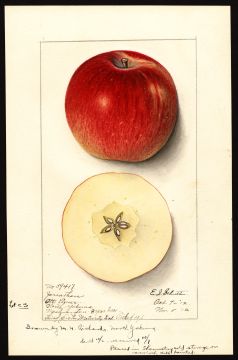 USDA Pomological Watercolor by Schutt, Ellen Isham (Yakima, Yakima, Washington)
 -
 USDA Pomological Watercolor by Schutt, Ellen Isham (Medford, Jackson, Oregon)
 -
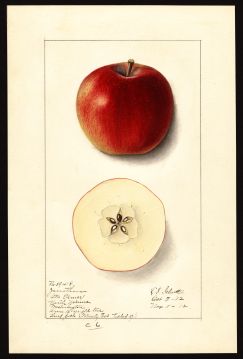 USDA Pomological Watercolor by Schutt, Ellen Isham (Yakima, Yakima, Washington)
 -
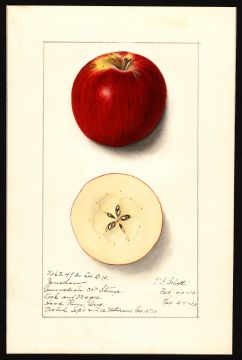 USDA Pomological Watercolor by Schutt, Ellen Isham (Hood River, Hood River, Oregon)
 -
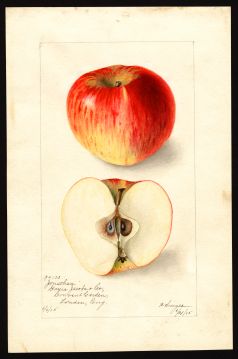 USDA Pomological Watercolor by Heiges, Bertha (London, United Kingdom)
 -
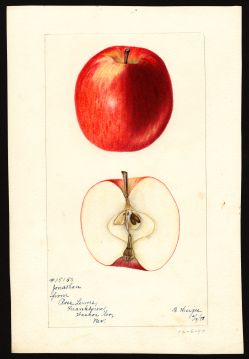 USDA Pomological Watercolor by Heiges, Bertha (Franktown, Washoe, Nevada)
 -
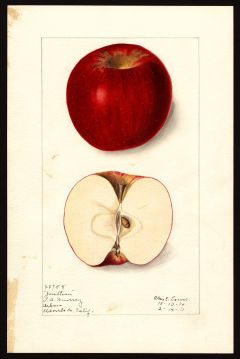 USDA Pomological Watercolor by Lower, Elsie E. (El Dorado, California)
 -
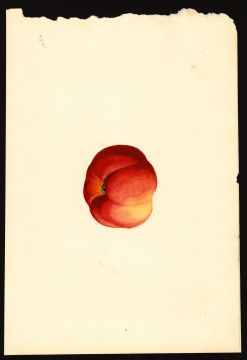 USDA Pomological Watercolor by Shull, James Marion (Boise, Ada, Idaho)


U.S. Department of Agriculture Pomological Watercolor Collection. Rare and Special Collections, National Agricultural Library, Beltsville, MD 20705
Sources
- S.A. Beach, The Apples of New York Vol. 1 (1905). Public domain.
- Granville Lowther (ed.), Encyclopedia of Practical Horticulture (1914). Public domain.
- John A. Warder, American Pomology: Apples (1867). Public domain.
- H.H. Fisher, A Survey of Apple Clones in the United States (USDA ARS, 1963). Public domain.
- N.E. Hansen, A Study of Northwestern Apples (South Dakota Ag. Exp. Station Bulletin 76, 1902). Public domain.
- J.L. Budd & N.E. Hansen, American Horticultural Manual, Part II: Systematic Pomology (1914). Public domain.
- F.R. Elliott, The Western Fruit Book (1865). Public domain.
- U.P. Hedrick, Cyclopedia of Hardy Fruits (1922). Public domain.
- John J. Thomas, The American Fruit Culturist (1903). Public domain.
- USDA Pomological Watercolor Collection, U.S. National Agricultural Library.
- 76 historical nursery catalog references (see Variety Finder for the full list).
- Full entry with all citations: Jonathan on the Variety Finder