Monmouth Pippin
| Monmouth Pippin | |
|---|---|
| Species | Apple |
| Trees Found | 2 |
| Orchards | Cyrus,Osborn Springs |
| Preserved | Clarno Arboretum(2025) |

Large, greenish yellow, with a fine large red cheek; juicy, tender and good; trees erect, vigorous and productive. Keeps well till March or April. Read the full entry: Monmouth Pippin on the Variety Finder for deeper history, every book quote, and all nursery catalog references.
Quick Facts
| Type | Apple |
| Season | Late (Late fall (October to November)) |
| Flavor | sweet tart, tart, subacid, aromatic, mild |
| Flavor notes | Mildly sweet-tart; crisp, firm flesh |
| Uses | fresh eating, cooking, cider |
| Keeping quality | Good |
| Size | Large |
| Shape | Oblate |
| Skin color | red, green, yellow, blushed, pink, russet, dark, orange |
| Flesh | Yellow juicy |
| Origin | New Jersey, USA, c. 1810. Monmouth County, New Jersey, USA; early 1800s |
Synonyms
MONMOUTH, Monmouth, Red Cheek, Red Cheek Pippin, Red Cheeked Pippin, Red-cheeked Pippin
Fruit
Size: Above medium to large; rather large (Warder, Thomas); large (Downing, Elliott, Lowther, Hedrick).
Form: Oblate to roundish, somewhat inclined to conic, flattened at the base, somewhat irregular, often obscurely ribbed (or obscurely five-angled per Downing); sides often unequal (Beach, Hedrick). Warder describes it as roundish or flattened, regular. Downing notes slight flattening at base and crown. Elliott: roundish flattened, sometimes roundish conical. Thomas: roundish-oblate. Lowther: flat.
Stem: Short to medium, rather thick (Beach, Hedrick); short, thick (Warder); rather short (Downing, Elliott).
Cavity: Moderately large to large, acute to sometimes acuminate, deep, rather broad, somewhat furrowed or compressed, smooth or russeted, sometimes with outspreading russet rays (Beach, Hedrick). Warder describes the cavity as wide, regular or wavy, brown. Downing: large, slightly russeted. Elliott: deep, regular.
Calyx: Large, leafy, pubescent, open or partly closed; lobes often reflexed and separated at the base (Beach, Hedrick). Warder: eye large, closed. Downing: partially closed. Elliott: medium, segments woolly and often nearly closed.
Basin: Large, rather wide and deep, abrupt, often distinctly furrowed and wrinkled (Beach, Hedrick); deep, abrupt, and corrugated (Downing); wide, abrupt, deep, much plaited (Elliott). Warder differs, calling the basin shallow, regular.
Skin: Moderately thin, tough, smooth toward the base, the upper half often roughened with russet dots or with capillary russet lines which become concentric toward the calyx (Beach, Hedrick). Ground color lively green marbled with yellow, becoming pale yellow as the season advances, faintly shaded with red, or in highly colored specimens blushed with lively pinkish-red (Beach); green marbled with yellow or pale yellow blushed with lively red (Hedrick). Warder: greenish yellow, blushed and marbled. Downing: pale yellow, with a beautiful warm cheek, and numerous russet dots. Elliott: pale greenish yellow, with blush-red cheeks, small, raised, rough, brown specks, with a shade of light green suffused around them underneath the skin. Thomas: light greenish yellow, with a fine red cheek. Lowther: yellow-red.
Dots: Variable, rather numerous, usually greenish and areolar with brown russet point, often elongated about the cavity (Beach, Hedrick). Warder describes dots as minute, green. Downing: numerous russet dots.
Flesh/Flavor: Decidedly tinged with yellow, firm, moderately coarse, somewhat crisp, tender, juicy, brisk subacid but becoming mild, aromatic; good to very good (Beach; Hedrick: yellow, firm, coarse, crisp, tender, juicy, brisk subacid, becoming mild, aromatic, good to very good). Downing: juicy, fine, brisk, aromatic subacid; very good to best. Elliott: yellowish white, rather coarse-grained, breaking tender, moderately juicy, sub-acid, with considerable aroma, or perfume. Thomas: crisp, juicy, mild sub-acid, with a good rich flavor. Warder differs sharply: white, breaking, fine-grained, juicy; flavor acid; quality good for cooking only. Lowther rates quality very good and use as both kitchen and market.
Calyx tube: Large, wide, conical or urn-shape with fleshy pistil point projecting into the base. Stamens median to basal (Beach); stamens median (Hedrick).
Core/Seeds: Core rather small, slightly abaxile with hollow cylinder in the axis; cells usually symmetrical and closed; core lines meeting or somewhat clasping. Carpels roundish or inclined to roundish obcordate, mucronate, slightly tufted. Seeds few, long, somewhat acute, somewhat tufted (Beach; Hedrick: round-obcordate, mucronate, tufted; seeds few, long, acute, tufted). Warder differs: core medium, closed, clasping; seeds numerous, pointed, brown. Elliott: core small, compact; seeds oblong ovate, abundant.
Season
November to March (Downing); November to February (Hedrick); December to February (Warder); December to February, and often till April (Elliott); winter, keeping through winter (Thomas, Lowther). Beach reports keeping quality varies much in different years at the New York Station: sometimes it may be held in good condition through the winter or into the spring, but more often its commercial limit in ordinary storage hardly extends beyond November. When stored in good condition its season in cold storage may extend till June. In ordinary storage the percentage of loss often becomes high early in the winter, but sometimes not before March.
Uses
Lowther reports use as both kitchen and market. Warder rates quality as good for cooking only. Beach considers it a good apple for the home orchard, not recommended for general commercial planting but probably profitable in favorable localities. Hedrick notes the crop runs more to low-grade fruit than Rhode Island Greening.
Illustrations
-
 USDA Pomological Watercolor of Monmouth Pippin
 -
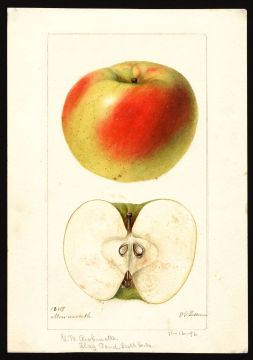 USDA Pomological Watercolor of Monmouth Pippin
 -
 USDA Pomological Watercolor of Monmouth Pippin
 -
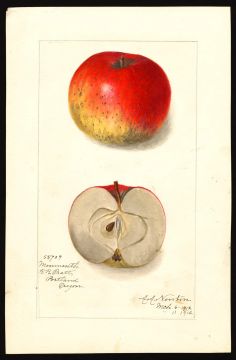 USDA Pomological Watercolor of Monmouth Pippin
 -
 USDA Pomological Watercolor of Monmouth Pippin


U.S. Department of Agriculture Pomological Watercolor Collection. Rare and Special Collections, National Agricultural Library, Beltsville, MD 20705
Sources
- John A. Warder, American Pomology: Apples (1867). Public domain.
- S.A. Beach, The Apples of New York Vol. 1 (1905). Public domain.
- U.P. Hedrick, Cyclopedia of Hardy Fruits (1922). Public domain.
- A.J. Downing, Fruits and Fruit Trees of America (1869). Public domain.
- F.R. Elliott, The Western Fruit Book (1865). Public domain.
- John J. Thomas, The American Fruit Culturist (1903). Public domain.
- Granville Lowther (ed.), Encyclopedia of Practical Horticulture (1914). Public domain.
- USDA Pomological Watercolor Collection, U.S. National Agricultural Library.
- 21 historical nursery catalog references (see Variety Finder for the full list).
- Full entry with all citations: Monmouth Pippin on the Variety Finder
Trees of this Variety in Our Collection
| Orchard | Tag | Condition | |
|---|---|---|---|
| Cyrus Tree 21 | Cyrus | 21 | fair |
| Osborn Springs Tree 111 | Osborn Springs | 111 | good |