Admirable
Apple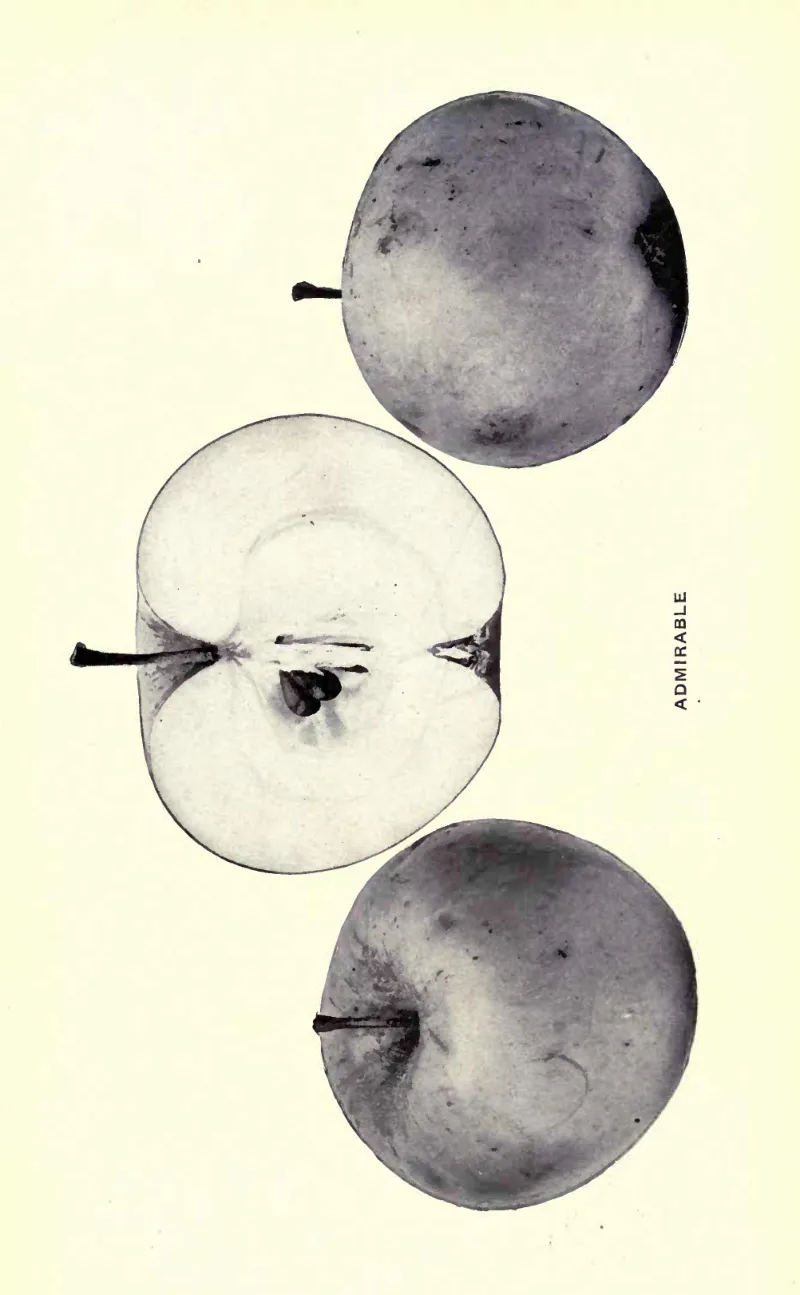
Admirable
Origin / History
Raised about 1850 by Mr. Small, a nurseryman, of Colnbrook, near Slough (Bunyard). Beach, citing Leroy and Hogg, says the variety originated in England. Known in the older literature as Small's Admirable. Hogg describes it as an immense bearer, adapted for dwarf culture (so given by Downing and Beach). Beach says that in England it is regarded as an excellent kitchen and dessert apple. Beach does not recommend it for cultivation in New York.
Tree
Tree dwarfish, compact (Bunyard), with short, stout, slow-growing branches. Form rather flat, spreading and somewhat drooping. Twigs short, somewhat curved, stout to rather slender; internodes short to above medium. Bark dark brown tinged with olive-green, lightly streaked with scarf-skin; pubescent. Lenticels numerous, small to medium, oval, slightly raised. Buds deeply set in bark, medium to small, broad, plump, obtuse to somewhat acute, appressed or free, pubescent. Leaf large, long, little upfolded, twisted, doubly crenate (Bunyard). Very fertile (Bunyard). Hogg: an immense bearer, well adapted for dwarf culture. As tested at the New York Station the tree has been an annual cropper and very productive, often yielding full crops.
Fruit
Size: Medium to above medium; Bunyard gives 2½ by 2¼. Quite uniform in size and shape for any particular crop, but varies under different conditions from below medium to above (Beach).
Form: Round to roundish ovate or oblate conic to roundish conic, rather flattened; pretty regular but sometimes indistinctly ribbed (Beach).
Stem: Medium to long, slender, pubescent (Beach); short (Bunyard).
Cavity: Acute, moderately deep to deep, broad, smooth or thinly russeted (Beach); rather wide (Bunyard).
Calyx: Closed or open; lobes reflexed (Beach). Eye small, fast closed (Bunyard). Calyx tube rather narrow, elongated funnel-form. Stamens median (Beach).
Basin: Moderately shallow, rather narrow, sometimes abrupt, somewhat furrowed and wrinkled (Beach); very shallow, with a few beads at base (Bunyard).
Skin: Pale green or green to yellow, attractive lemon-yellow at best, sometimes with brownish blush; pale yellow, greasy (Bunyard). Beach: "not particularly attractive".
Dots: Numerous, small, light or russet (Beach); large, russet (Bunyard).
Flesh and flavor: Flesh whitish to nearly white (Beach; Bunyard), yellowish (Downing); firm, crisp, moderately coarse, quite juicy. Subacid, mild subacid, "not very acid" (Bunyard); very aromatic (Beach). Beach rates it good to very good in well grown fruit and "very good for dessert use" at its best, but as grown at the New York Station usually "but fair to good" in quality, the fruit very apt to show imperfect spots in the flesh, evidently due to some physiological defect.
Core and seeds: Core rather large, somewhat abaxile; cells open; core lines clasping. Carpels long, obovate. Seeds rather large, long, plump, pointed, medium brown.
Season
October to January (Beach). Ordinary season November and December (Downing; Beach). A portion of the fruit may sometimes be kept through the winter (Beach). Bunyard gives "till February", and says it keeps much later than Hogg states, doubting that Hogg describes the right variety.
Uses
Excellent kitchen and dessert apple in England (Beach, after Hogg). Culinary (Bunyard). Very good for dessert use at its best (Beach).
Subtypes / Variants
Not described in source.
Other
Not described in source.
Book Sources
Described in 3 period pomological works
- Beach, The Apples of New York Vol. 2 (1905)
- Bunyard, A Handbook of Hardy Fruits (1920) — listed as Small's Admirable
- Downing, Fruits and Fruit Trees of America (1900) — listed as Small's Admirable
Nursery Catalog Sources
Found in 2 catalogs (1900–1911) from England
- Central Experimental Farm , Dominion Department of Agriculture, Agassiz, British Columbia (under test; Bulletin No. 3, Second Series) — 1900 — listed as Small's Admirable
- James Veitch & Sons , Ltd., Royal Exotic Nursery, Chelsea, London (also Coombe Wood, Langley, and Feltham) , England — 1911 — listed as Small's Admirable
View original book sources (3)
— A.J. Downing, The Fruits and Fruit Trees of America (1900)Small's Admirable.
This is described by Hogg as an immense bearer, and adapted for dwarf culture.
Fruit above medium, roundish ovate, flattened, lemon yellow. Flesh firm, yellowish, crisp, subacid. November, December.
— S.A. Beach, The Apples of New York, Vol. 2 (1905)ADMIRABLE.
References. 1. Downing, 1869:354. 2. Leroy, 1873:813. fig. 3. Hogg, 1884:214. 4. N. Y. Sta. An. Rpt., 8:339, 348. 1889. 5. Beach, Ib., 11:589, 595, 1892. 6. Beach and Clark, N. Y. Sta. Bul., 248:110. 1904.
Synonyms. Admirable (6). Small's Admirable (1, 2, 3, 4, 5). Small Admirable (6).
Fruit green or yellow, not particularly attractive. At its best it is very good for dessert use, but as grown at this Station it usually ranks but fair to good in quality and the fruit is very apt to show imperfect spots in the flesh which are evidently due to some physiological defect. In England it is regarded as an excellent kitchen and dessert apple and the tree is said to be an immense bearer and well adapted for dwarf culture (3). So far as tested at this Station the tree has been an annual cropper and very productive, often yielding full crops. A portion of the fruit may sometimes be kept through the winter, but ordinarily the season for this variety is November and December (6). Not recommended for cultivation in New York.
Historical. This variety originated in England (2, 3).
Tree.
Tree dwarfish with short, stout, slow-growing branches. Form rather flat, spreading and somewhat drooping. Twigs short, somewhat curved, stout to rather slender; internodes short to above medium. Bark dark brown tinged with olive-green, lightly streaked with scarf-skin; pubescent. Lenticels numerous, small to medium, oval, slightly raised. Buds deeply set in bark, medium to small, broad, plump, obtuse to somewhat acute, appressed or free, pubescent.
Fruit.
Fruit quite uniform in size and shape for any particular crop but varies under different conditions from below medium to above. Form oblate conic to roundish conic, pretty regular but sometimes indistinctly ribbed. Stem medium to long, slender, pubescent. Cavity acute, moderately deep to deep, broad, smooth or thinly russeted. Calyx closed or open; lobes reflexed. Basin moderately shallow, rather narrow, sometimes abrupt, somewhat furrowed and wrinkled. Skin varies from pale green to attractive lemon-yellow, sometimes with brownish blush. Dots numerous, small, light or russet. Calyx tube rather narrow, elongated funnel-form. Stamens median. Core rather large, somewhat abaxile; cells open; core lines clasping. Carpels long, obovate. Seeds rather large, long, plump, pointed, medium brown. Flesh whitish, firm, moderately coarse, crisp, quite juicy, mild subacid, very aromatic, good to very good in quality in well grown fruit. Season October to January.
— E.A. Bunyard, A Handbook of Hardy Fruits (1920)SMALL'S ADMIRABLE. Her. Pom., 73. Culinary, till February, round, rather flattened, medium, 2½ by 2¼. Colour, pale yellow, greasy, dotted with large russet dots. Flesh, firm, crisp, juicy, not very acid, nearly white. Eye, small, fast closed, in a very shallow basin which has a few beads at base. Stem, short, in a rather wide cavity. Growth, dwarf and compact; very fertile. Leaf, large, long, little upfolded, twisted, doubly crenate. Origin, raised about 1850, by Mr. Small, a nurseryman, of Colnbrook, near Slough. I think it doubtful if Hogg describes the right variety as it keeps much later than he states.