Akin
Apple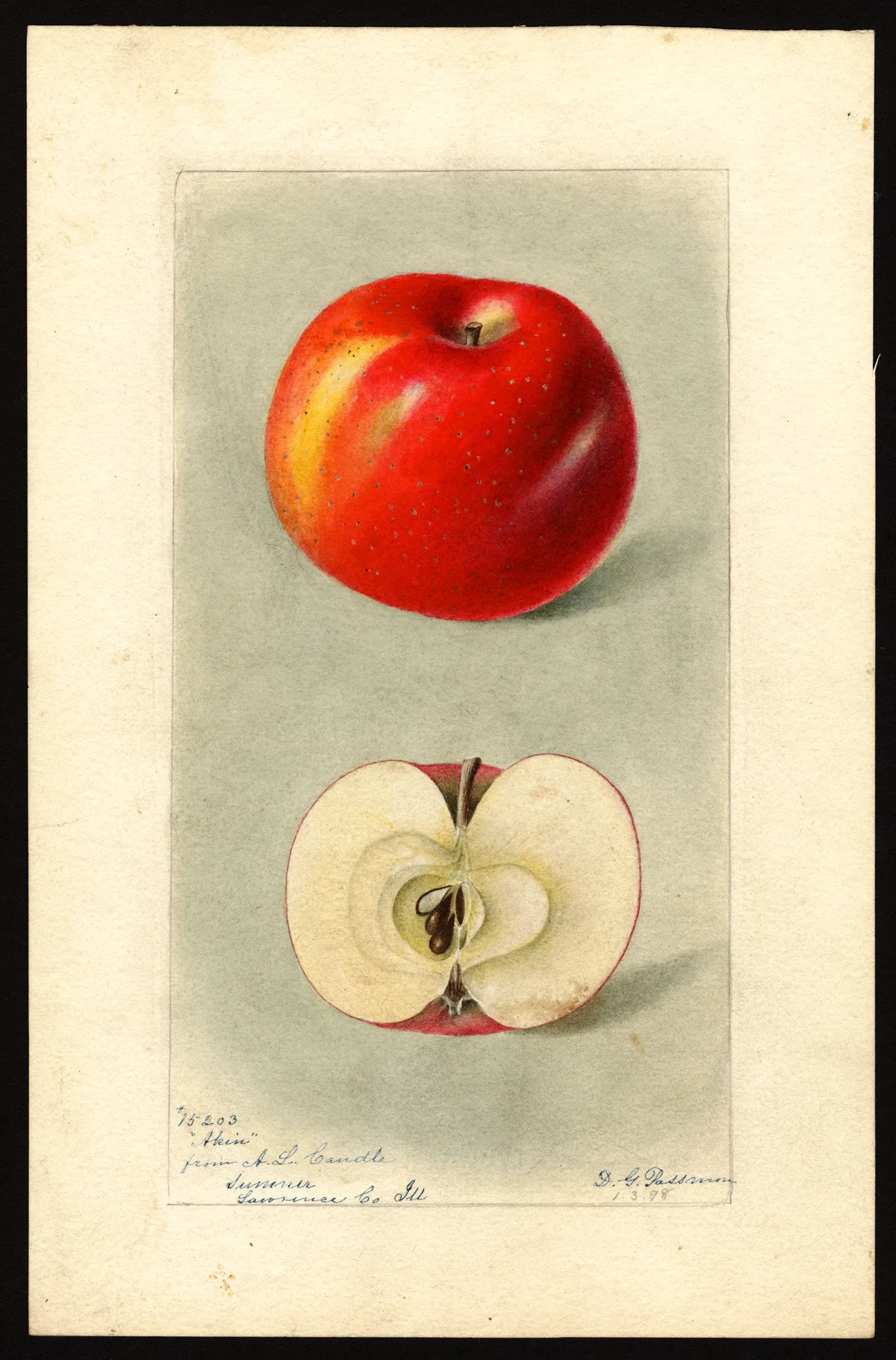
USDA Pomological Watercolor Collection
Akin
Origin and History
The Akin variety originated from seed brought from Tennessee and planted in 1831 near Lawrenceville, Illinois, on the farm now owned by W. J. Akin. The original tree was first propagated for sale in 1868. In December 1890, Mr. Akin exhibited the variety at the Cairo meeting of the Illinois State Horticultural Society, where it received first premium recognition both as a "Seedling" and as a "New Variety good enough to be recommended." The variety has since been fruited in several states across the Middle West and the winter apple districts of the Allegheny Mountain region, with particular promise for growers seeking varieties well-adapted to the fancy trade in larger cities.
Tree Characteristics
Tree upright, becoming somewhat spreading, with dense, medium-sized growth and moderate vigor. Branches long and moderately stout. Twigs long, straight, and stocky with thick tips; internodes short to medium in length. Bark olive-green varying to dull purplish-brown, largely covered with gray pubescence that becomes thicker and heavier toward the tips. Lenticels numerous, conspicuous, oblong or roundish in form, and raised. Buds medium-sized, obtuse, broad, appressed, and quite pubescent. Leaves large and broad.
Fruit Characteristics
Size and Form: Usually medium or above, sometimes large. Form oblate to roundish oblate, often irregular with slight ribbing; sides sometimes unequal. Fairly uniform in size and shape overall.
Stem: Medium to long, slender.
Cavity: Obtuse, broad, rather shallow to deep, often distinctly furrowed, not often russeted.
Calyx: Small to medium, usually closed. Calyx tube conical, sometimes approaching funnel-form.
Basin: Medium in width and depth, usually somewhat abrupt, somewhat furrowed and corrugated.
Skin: Tough, smooth, rather attractive yellow, blushed and striped with bright deep red; in well-colored specimens almost completely red. Dots small, whitish or with russet point, sometimes conspicuous in contrast with the dark red skin. Prevailing effect is attractive bright red with contrasting clear yellow or greenish-yellow.
Core and Seeds: Core abaxile, medium, open or partly closed; core lines meeting. Carpels elliptical or approaching roundish obcordate, slightly emarginate. Seeds moderately dark brown, long, rather narrow, acute, and numerous.
Flesh and Flavor: Whitish, slightly tinged with yellow, rather crisp, moderately coarse, moderately tender, very juicy, sprightly subacid, aromatic. Quality good to very good for dessert.
Season and Storage
Season January to June. In ordinary storage, the fruit keeps well till midwinter; in cold storage, it keeps till March or later.
Uses and Cultivation Notes
When well-developed, the Akin is a beautiful, dark red winter apple of pretty good quality, appearing specially adapted for fancy trade and for dessert use. Though not sufficiently tested to determine its full value for cultivation in New York, it promises to be hardy, healthy, and reliably productive. It seems best suited to more southern localities, though it has usually developed well at Geneva, though in occasional seasons its fruit has not attained good color there. With ordinary care, the fruit does not average much above medium size. The variety is worthy of testing for commercial purposes and is particularly suited to the needs of the fancy trade in larger cities. It succeeds well in the Middle West and in the winter apple districts of the Allegheny Mountain region, and is worthy of thorough test on rich, warm soils in the northern apple districts from New York westward.
Book Sources
Described in 1 period pomological work
Nursery Catalog Sources
Found in 14 catalogs (1894–1918) from Indiana, Missouri, Oregon, Washington
- Knox Nurseries (H.M. Simpson Co. , Proprietors), Vincennes , Indiana — 1894
- Stark Bros. Nurseries & Orchards Co. , Louisiana , Missouri — 1896
- Stark Bros. Nurseries & Orchards Co. , Louisiana , Missouri — 1898
- Washington Nursery Co. , Toppenish , Washington — 1901
- The Dalles Nurseries (R.H. Weber) , The Dalles , Oregon — 1906
- Stark Bros. Nurseries & Orchards Co. , Louisiana , Missouri — 1906
- Washington Nursery Company , Toppenish , Washington — 1909
- Stark Bros. Nurseries & Orchards Co. , Louisiana , Missouri — 1910
- Stark Bros. Nurseries & Orchards Co. , Louisiana , Missouri — 1911
- Stark Bros. Nurseries & Orchards Co. , Louisiana , Missouri — 1912
- Pacific Nursery Company , Portland , Oregon — 1912
- Washington Nursery Company , Toppenish , Washington — 1912
- Vineland Nurseries Company , Clarkston , Washington — 1912
- Stark Bros. Nurseries & Orchards Co. , Louisiana , Missouri — 1918
View original book sources (1)
— S.A. Beach, The Apples of New York, Vol. 1 (1905)AKIN.
REFERENCES. 1. Bailey, An. Hort., 1892:234. 2. Riehl, Am. Pom. Soc. Rpt., 1897:137. 3. Taylor, U. S. Dept. Agr. Yr. Bk., 1903:268. col. pl. 4. Ill. State Hort. Soc. Rpt., 1890.
SYNONYMS.¹ Akin Red, Akin Seedling, Akin's Seedling, Aikin's Red, Aiken, Aken—not "Aiken's Winter" of Downing which is a crab of Minnesota origin. (3). Akin's Red. (4).
When the Akin is well developed it is a beautiful, dark red, winter apple of pretty good quality. It appears to be specially adapted for fancy trade and for dessert use. Although it has not been sufficiently tested to determine its value for cultivation in New York, it promises to be hardy, healthy and reliably productive. It seems to be best suited to more southern localities, but it has usually developed well at Geneva, although in occasional seasons its fruit has not attained good color here. With ordinary care the fruit does not average much above medium size. In ordinary storage it keeps well till midwinter and in cold storage till March or later. It is sufficiently promising to be worthy of testing for commercial purposes.
Historical. Taylor gives an excellent account of the origin of the Akin (3) from which it appears that the original tree was grown from seed brought from Tennessee and planted in 1831 near Lawrenceville, Ill., on the farm now owned by W. J. Akin. It was first propagated for sale in 1868. Mr. Akin exhibited it in December, 1890, at the Cairo meeting of the Illinois State Horticultural Society, where it was awarded first premium both as a "Seedling" and a "New Variety good enough to be recommended." Taylor says (3), "It has now been fruited in several states, and is one of the most promising of the recently introduced sorts for the apple growers who desire a variety well adapted to the needs of the fancy trade in the larger cities. It succeeds well in the Middle West and in the winter apple districts of the Allegheny Mountain region, and is worthy of thorough test on rich, warm soils in the northern apple districts from New York westward."
TREE.
Tree upright, becoming somewhat spreading, dense, medium in size, moderately vigorous. Branches long, moderately stout. Twigs long, straight, stocky, with thick tips; internodes short to medium in length. Bark olive-green varying to dull purplish-brown, largely covered with a gray pubescence that becomes thicker and heavier towards the tips. Lenticels numerous, conspicuous, oblong or roundish, raised. Buds medium size, obtuse, broad appressed, quite pubescent. Leaves large, broad.
¹ Numbers in parentheses designate authors or publications cited in the preceding list. This plan is followed with all of the formal descriptions given in this report.
FRUIT.
Fruit usually medium or above, sometimes large. Form oblate to roundish oblate, often irregular, slightly ribbed, sides sometimes unequal. Fairly uniform in size and shape. Stem medium to long, slender. Cavity obtuse, broad, rather shallow to deep, often distinctly furrowed, not often russeted. Calyx small to medium, usually closed. Basin medium in width and depth, usually somewhat abrupt, somewhat furrowed and corrugated. Skin tough, smooth, rather attractive yellow, blushed and striped with bright deep red; in well colored specimens almost completely red. Dots small, whitish or with russet point, sometimes conspicuous in contrast with the dark red skin. Prevailing effect attractive bright red with contrasting clear yellow or greenish-yellow. Calyx tube conical, sometimes approaching funnel-form. Stamens median. Core abaxile, medium, open or partly closed; core lines meeting. Carpels elliptical or approaching roundish obcordate, slightly emarginate. Seeds moderately dark brown, long, rather narrow, acute, numerous. Flesh whitish, slightly tinged with yellow, rather crisp, moderately coarse, moderately tender, very juicy, sprightly subacid, aromatic, good to very good for dessert.
Season January to June.