ALTHORP CRASANNE
Pear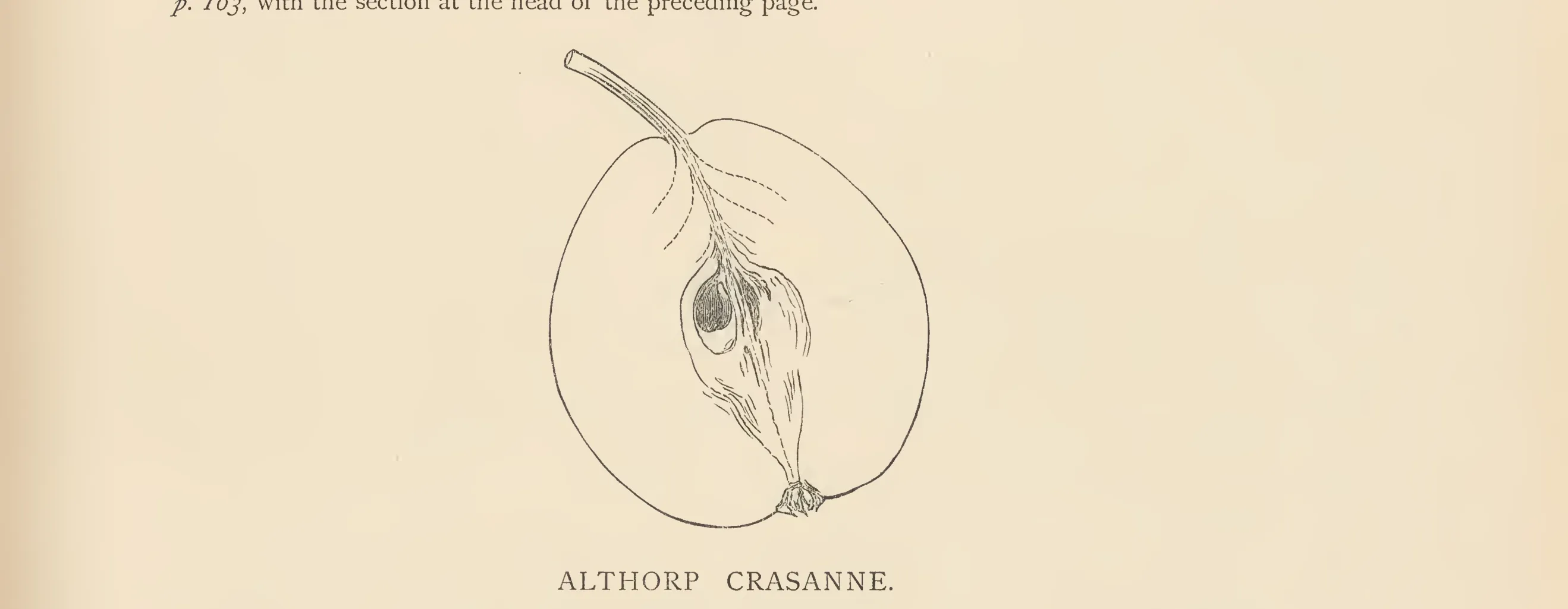
ALTHORP CRASANNE
Origin/History
ALTHORP CRASANNE was raised by Mr. Thomas Andrew Knight, and the seedling first bore fruit in 1830. Knight considered it one of the hardiest of his seedlings. Writing in 1836, Knight noted that "the original tree has borne well in all the last six years, and I believe it to be greatly more hardy than any of the Belgic varieties, and not less hardy than the Swan's Egg." The variety was bred in comparison to the Crasanne, which it was thought to improve upon: "it possesses all the richness of the Crasanne with less grittiness, being perfectly melting." Knight himself described the distinguishing character of its flavour thus: "its rose-water flavour will please where musk offends." Mr. Thompson, superintendent of the Royal Horticultural Society's garden, writing of this pear in 1836 (Trans. Hort. Soc. Vol. II, 2nd Series, p. 119) after it had been grown to greater perfection, considered that ALTHORP CRASANNE would bear competition with the first of the introduced varieties, and called it one of the very best pears.
Tree
The tree is hardy, vigorous, and an excellent bearer. It succeeds best as a standard, and is found to produce fruit of a superior quality even in soils that are unfavourable to the growth of pears generally. Knight believed it to be as hardy as the Swan's Egg Pear and greater in hardiness than any of the Belgic varieties. Bunyard records growth as vigorous and fertility as regular.
Fruit
Size
The Herefordshire Pomona describes the fruit as rather above medium size, measuring two inches and three quarters wide and two inches and a half high. Bunyard gives the size as medium. Thompson's 1836 observations note that specimens grown on a wall are very large and obovate, while fruit from standards is large. The discrepancy likely reflects both training method and degree of cultural perfection.
Form
Roundish obovate, widest in the middle, and tapering gradually to the apex, which is somewhat flattened but rounding towards the stalk (Herefordshire Pomona, main description). Thompson (1836) describes wall-grown specimens as obovate, and standard-grown fruit as large and roundish-obovate. The variety first appeared fully equal to the Crasanne in size and approaches it in its globular shape. Bunyard describes the form as round, tapering to stem, even.
Stem
The Herefordshire Pomona main description gives the stalk as an inch and a half long, slender, curved, and not deeply inserted. Thompson's 1836 observations present a more complex picture depending on training method: from wall-grown specimens the stalk is usually less than an inch and a half in length, or sometimes considerably shorter, and is thicker than that of the Crasanne; from standards the stalk differs markedly, being only half an inch or an inch in length — notably shorter than in the Crasanne, which runs to one and a half or two inches. Bunyard describes the stem as moderate, curved, rather slender, and continued (i.e., running into the fruit without an abrupt shoulder change).
Cavity
Not deeply inserted (Herefordshire Pomona). No further cavity description provided in sources.
Calyx and Basin
The Herefordshire Pomona main description gives the eye as rather large and open, placed in a shallow and slightly plaited basin. Thompson (1836) provides more differentiated observations: in wall-grown fruit the eye occupies a moderately deep depression with the segments of the calyx somewhat collapsing; in standard-grown fruit the eye is in a tolerably even-formed hollow, open, with the segments of the calyx forming tubercles and inclining to collapse. Bunyard describes the eye as rather large, open, in a shallow basin.
Skin
The Herefordshire Pomona main description gives the skin as pale green with a slight tinge of brown on the side exposed to the sun, and covered with minute russety dots. Thompson's 1836 observations record variation by training method: wall-grown fruit had skin of yellowish green with a faint brownish blush next the sun, and some russet near the stalk; standard-grown fruit had skin of greenish brown, interspersed with a russet-grey, not unlike the Crasanne in colour. The texture of the skin is described as the same colour and texture as the Crasanne (Herefordshire Pomona, additional entry). Bunyard describes the skin as rough and the colour as greenish yellow covered with fine russet.
Flesh and Flavor
White, buttery, and juicy, with a rich and slightly perfumed flavour (Herefordshire Pomona, main description). The variety's defining character is its rose-water flavour, which Knight distinguished from the musky note of the Crasanne. Thompson (1836) describes wall-grown flesh as white, melting, and buttery, with very little grit, rich and excellent, but noted that it was not equal to those from standards in point of high flavour; standard-grown flesh was described as buttery, rich, and very high flavoured. The flesh is described in the additional Herefordshire Pomona entry as less gritty than the Crasanne, and perfectly melting, possessing all the richness of the Crasanne with less grittiness. Bunyard records the flesh as white, melting, juicy, and pleasantly flavoured.
Core and Seeds
Not described in sources.
Season
October and November. Thompson (1836) specifies the end of October and November.
Uses
Dessert pear of the finest quality. ALTHORP CRASANNE is described in the Herefordshire Pomona as, in Knight's own estimation, the better of the two varieties when compared with the Crasanne; Thompson considered it one of the very best pears, capable of bearing competition with the first of the introduced varieties.
Subtypes/Variants
Thompson's 1836 observations explicitly distinguish between fruit grown on a wall and fruit grown as a standard. Wall-grown specimens are very large, obovate, with a moderately deep eye depression, a stalk of less than one and a half inches (sometimes considerably shorter) and thicker than in the Crasanne, and skin of yellowish green with a faint brownish blush next the sun and some russet near the stalk; the flesh, though white, melting, buttery, and with very little grit, was judged not equal to standard-grown fruit in high flavour. Standard-grown fruit is large, roundish-obovate, with the eye in a tolerably even hollow and open, the calyx segments forming tubercles inclining to collapse, the stalk only half an inch to one inch in length, the skin greenish brown interspersed with russet-grey, and the flesh buttery, rich, and very high flavoured. The contrast in stalk length between wall and standard is thus substantial and may be a useful identification marker when training method is known.
Other
The Herefordshire Pomona notes a coloured figure in Vol. II, 2nd Series, p. 119. Bunyard's entry cites the reference as Her. Pom. I., 4. The Herefordshire Pomona's additional entry observes that ALTHORP CRASANNE "has much the appearance of the Crasanne," with skin of the same colour and texture, and recommends comparison with that variety when identifying the fruit.
Book Sources
Described in 2 period pomological works
View original book sources (2)
— Woolhope Naturalists Field Club, The Herefordshire Pomona (1885)ALTHORP CRASANNE.
This well-known pear was produced by Mr. Thomas Andrew Knight, and the seedling first bore fruit in 1830.
Description.—Fruit; rather above the medium size, two inches and three quarters wide, and two inches and a half high, roundish obovate, widest in the middle, and tapering gradually to the apex, which is somewhat flattened, but rounding towards the stalk. Skin; pale green with a slight tinge of brown on the side exposed to the sun, and covered with minute russety dots. Eye; rather large and open, placed in a shallow and slightly plaited basin. Stalk; an inch and a half long, slender, curved, and not deeply inserted. Flesh; white, buttery and juicy, with a rich and slightly perfumed flavour.
The Althorpe Crasanne is a dessert pear of the finest quality. "It possesses all the richness of the Crasanne with less grittiness, being perfectly melting." (See Introduction, p. 42.) Mr. Knight thought it the better of the two, "its rose-water flavour will please where musk offends."
Season, October and November.
The tree is hardy, vigorous, and an excellent bearer. It succeeds best as a standard, and is found to produce fruit of a superior quality even in soils that are unfavourable to the growth of pears generally. Mr. Knight believed it to be as hardy as the Swan's Egg Pear.
[Additional entry in this volume: "Althorp Crasanne Pear", pp. 89–90]
Althorp Crasanne Pear—(with Coloured Figure in Vol. II. 2nd Series. p. 119.)
This has much the appearance of the Crasanne. The Skin is of the same colour and texture ; the flesh is less gritty, and the flavour good. The best description that can be given of it is, that it possesses all the richness of the Crasanne, with less grittiness, being perfectly melting. Season November.
Mr. Thompson, superintendent of the Royal Horticultural Society's garden, writing again of this Pear in 1836, (Trans. Hort. Soc. Vol. II, 2nd Series, p. 119) after it had been grown to greater perfection, says the Althorp Crasanne will bear competition with the first of the introduced varieties, and says it is one of the very best Pears. Specimens grown on a wall, he says, are very large and obovate ; the eye is a moderately deep depression with the segments of the calyx somewhat collapsing; the stalk usually less than an inch and a half in length, or sometimes considerably shorter, thicker than that of the Crasanne. The skin was yellowish green with a faint brownish blush next the sun, and some russet near the stalk. The flesh was white, melting, and buttery, with very little grit, rich and excellent, but not equal to those from standards in point of high flavour. From a standard the fruit was large, roundish-obovate, the eye was in a tolerably even-formed hollow, and open, with the segments of the calyx forming tubercles, inclining to collapse. The skin was greenish brown, interspersed with a russet-grey, not unlike the Crasanne in colour ; but the stalk differs much being only half an inch, or an inch in length, whereas in the Crasanne it is one and a half, or two inches long. The flesh is buttery, rich, and very high flavoured. Season the end of October and November.
Remarks.— This variety first appeared in 1830, and fully equalled the Crasanne in size. It approaches it also in its globular shape. As a dessert pear, the Althorp Crasanne is, to my taste, the best; and its rose-water flavour will please where musk offends. Writing in 1836 Mr. Knight adds, "the original tree has borne well in all the last six years, and I believe it to be greatly more hardy than any of the Belgic varieties, and not less hardy than the Swan's Egg."
— E.A. Bunyard, A Handbook of Hardy Fruits (1920)ALTHORP CRASANNE. Her. Pom. I., 4. Dessert, October to November, medium, round, tapering to stem, even. Skin, rough. Colour, greenish, yellow covered with fine russet. Flesh, white, melting, juicy and pleasantly flavoured. Eye, rather large, open, in a shallow basin. Stem, moderate, curved, rather slender, continued. Growth, vigorous; fertility, regular. Origin, raised by T. A. Knight, and first fruited in 1830. This was considered by Knight to be one of the hardiest of his seedlings and to succeed in soils unfavourable to the majority of Pears.