America
Pear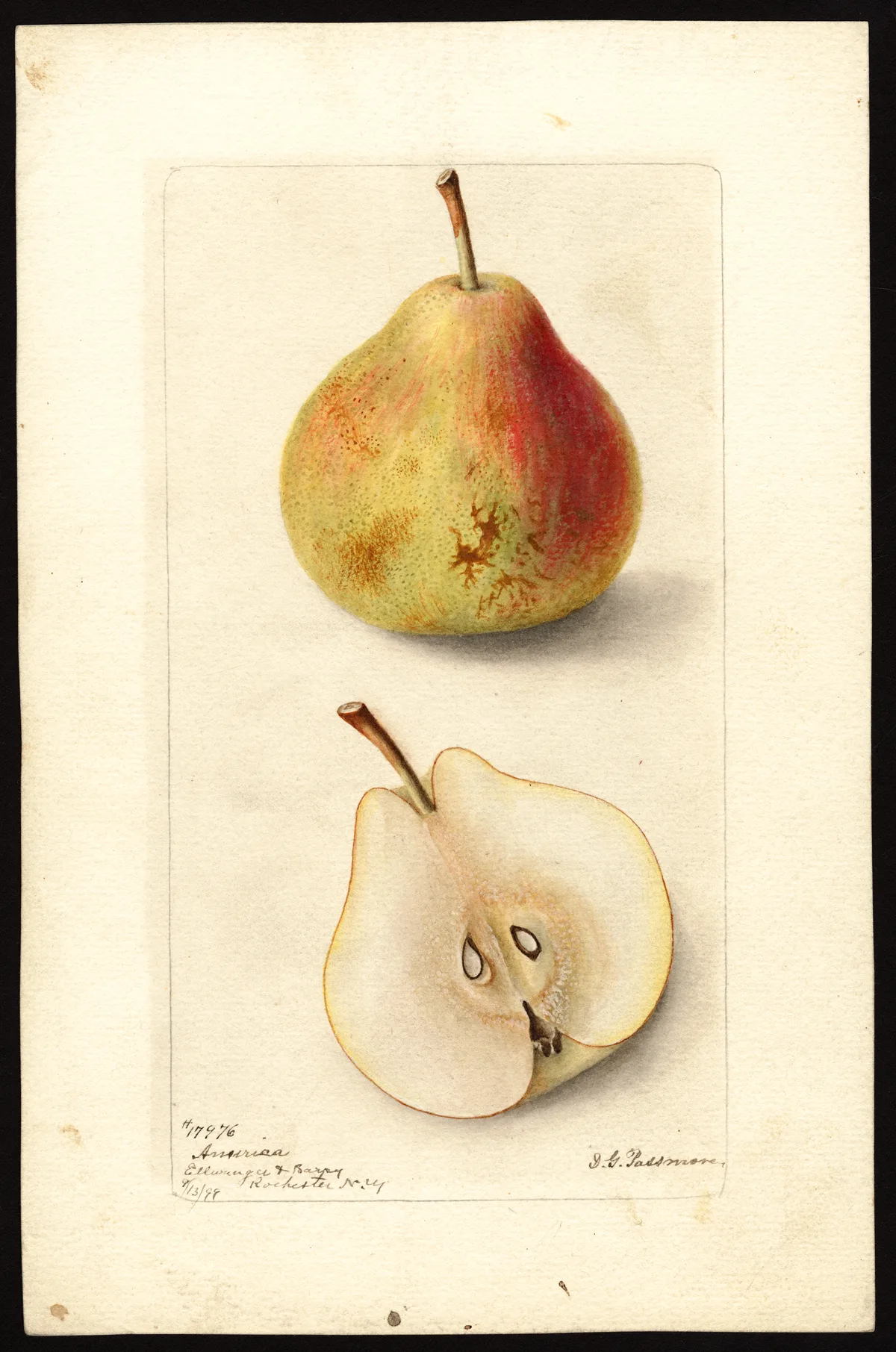
USDA Pomological Watercolor Collection
America (Pear)
Origin/History
An American pear originated with Francis Dana of Boston, Massachusetts. It was said of Dana, an indefatigable pomologist, that he saved the seed of all good pears he ate, and that from these he produced sixteen new, good varieties, of which America was one. In 1859 it was considered an important acquisition because it ripens in the early part of winter, when the number of choice varieties is limited.
Tree
Described by Downing as a strong, vigorous grower. Not further described in sources.
Fruit
Size and Form: Sources differ on size: Downing describes the fruit as medium to large; Hedrick describes it as very large. Downing gives the form as roundish oblate obtuse pyriform. Hedrick describes it as globular-ovate, somewhat angular, with an uneven surface. Hedrick characterizes it as a handsome pear.
Stem: Long (Downing).
Cavity: Small (Downing).
Calyx: Open (Downing).
Basin: Not described in source.
Skin: Sources agree on a russet-marked yellow ground, with some variation in description. Downing gives the color as yellow, with traces, dots, and patches of russet. Hedrick describes it as dull greenish-yellow, much clouded with dull russet and sprinkled heavily with large russet dots.
Flesh and Flavor: Sources agree closely. Downing gives the flesh as whitish; Hedrick as yellowish-white. Both describe it as rather coarse and semi-melting (Downing: "half melting"). Both agree it is sugary and pleasant. Hedrick adds that the flesh is buttery, rich in flavor, and has a refreshing aroma.
Core/Seeds: Not described in source.
Season
Downing places the season in November and December. Hedrick gives December, noting the variety keeps well.
Uses
Not described in source.
Subtypes/Variants
Not described in source.
Other
Not described in source.
Book Sources
Described in 2 period pomological works
Nursery Catalog Sources
Found in 6 catalogs (1890–1909) from Maryland, Massachusetts, New Jersey, Pennsylvania
- William H. Moon Co. , Morrisville, Bucks County , Pennsylvania — 1890
- Rogers Nursery Co. , Moorestown , New Jersey — 1893
- Reading Nursery , Jacob W. Manning, Proprietor, Reading , Massachusetts — 1898
- Brown Brothers Co. , Continental Nurseries, Rochester, NY (also operated from Toronto, Canada) — 1899
- Brown Brothers Co. , Continental Nurseries, Rochester, NY (also operated from Toronto, Canada) — 1901
- Wm. J. Corse (successor to Robert Sinclair / Sinclair Nurseries) , Baltimore , Maryland — 1909
View original book sources (2)
— A.J. Downing, The Fruits and Fruit Trees of America (1900)America.
An American Pear, originated with Francis Dana, Boston, Mass. Tree a strong vigorous grower.
Fruit medium to large, roundish oblate obtuse pyriform. Skin yellow, with traces, dots, and patches of russet. Stalk long, in a small cavity. Calyx open. Flesh whitish, a little coarse, half melting, sweet, sugary, pleasant. Good. November, December.
— U.P. Hedrick, The Pears of New York (1921)America. 1. Mag. Hort. 25:205, fig. 12. 1859. 2. Downing Fr. Trees Am. 658. 1869.
It was said of Francis Dana, the indefatigable pomologist of Boston, that he saved the seed of all good pears that he ate, and that from these he produced sixteen new, good varieties of which America was one. It is a handsome pear and in 1859 was considered an important acquisition because it ripens in the early part of the winter when the number of choice varieties is limited. Fruit very large, globular-ovate, somewhat angular, with an uneven surface, dull greenish-yellow, much clouded with dull russet, and sprinkled heavily with large russet dots; flesh yellowish-white, rather coarse, semi-melting, sugary, buttery, pleasant, rich in flavor and having a refreshing aroma; good; keeps well; Dec.