Ananas de Courtrai
Pear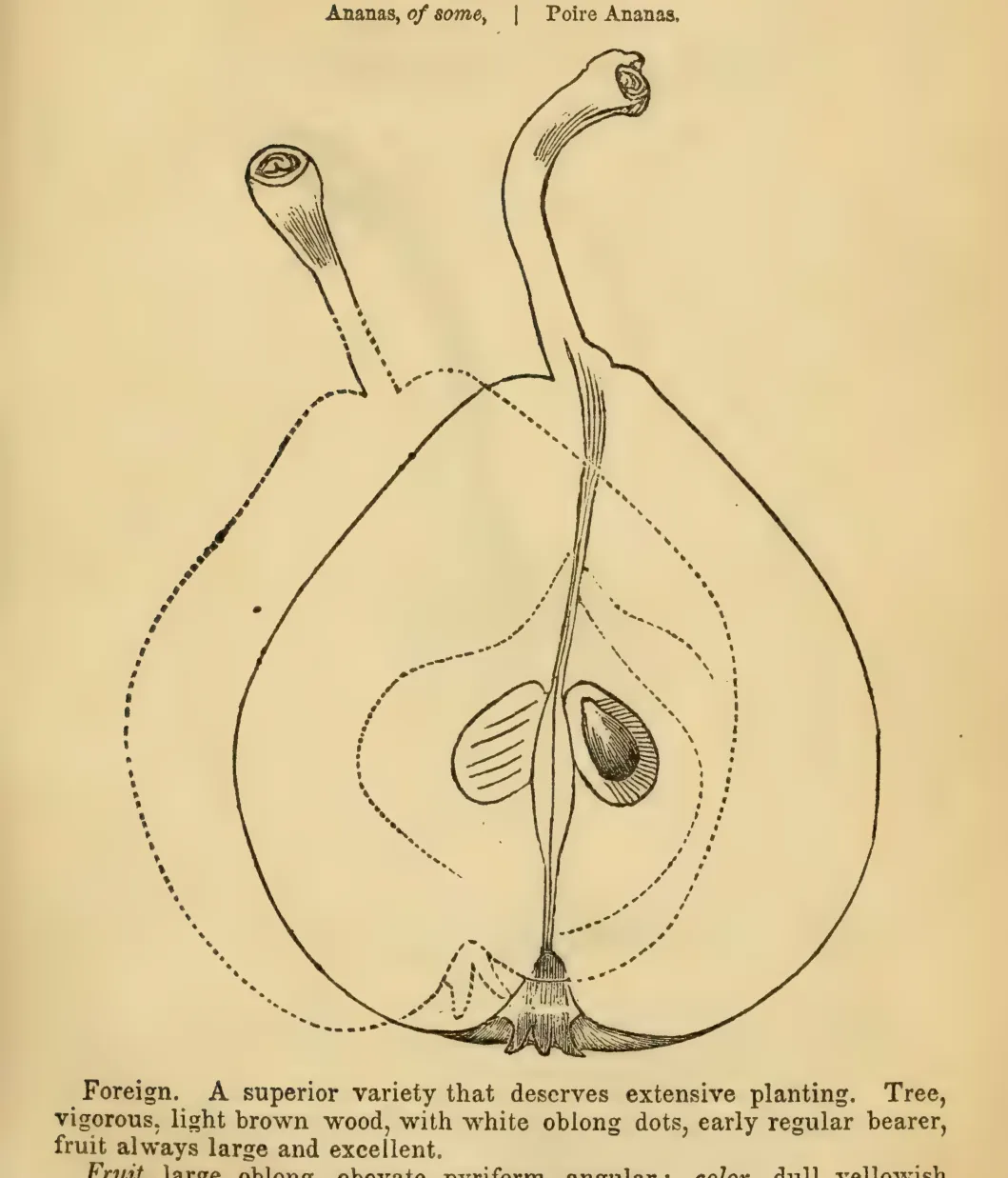
Ananas de Courtrai
Origin / History
Per Hedrick, the origin of Ananas de Courtrai is unknown, but it is believed to have been a chance seedling raised at Courtrai, Flanders. M. Six, who established himself in that town in the business of a gardener about the year 1784, found it already extensively grown there. Hedrick cites the earliest published description from the Annales de Pomologie Belge 2:13 (1854), with later figures in Leroy's Dictionnaire de Pomologie 1:124 (1867) and Mas's Pomologie Générale 1:79, fig. 40 (1872).
There is considerable historical confusion between Ananas de Courtrai and Ananas d'Été. Downing writes that what he received as Ananas de Courtrai from three or four sources, both in America and Europe, proved on bearing to be Ananas d'Été; because "there is said to be a distinct Ananas de Courtrai," he inserts Leroy's description as the authority for the true variety. Downing's broader discussion treats Ananas, Ananas d'Été, and Ananas de Courtrai as having proved identical in his trials (with Henry the Fourth being a distinct pear), and gives the older name as De Bouchet, later renamed Ananas. Both Elliott and Budd & Hansen attribute the parent stock to Holland; the form known as Ananas d'Été is described by Downing as "an old variety, from Holland."
Tree
General habit (Ananas de Courtrai, per Elliott citing An. Pom.): Tree very vigorous and productive, takes readily to any form.
General habit (under the conflated Ananas d'Été, per Elliott): Tree vigorous, an early and regular bearer; fruit always large and excellent.
Young shoots and buds (per Downing, Ananas d'Été): Young shoots strong, of a rich reddish-yellowish brown, with prominent sharp-pointed buds and oblong white specks (lenticels). Elliott describes the wood as light brown with white oblong dots. Thomas describes growth as somewhat irregular, with brownish-purple shoots.
Fruit
Size
Large (Elliott, Downing, Hedrick). Budd & Hansen describe the conflated Ananas d'Été as medium to large; Thomas as rather large.
Form
Sources describe the form variously, reflecting both genuine variability and the historical confusion of the two varieties:
- Ananas de Courtrai (Elliott, citing An. Pom.): Turbinate, pyriform.
- Ananas de Courtrai (Downing, citing Leroy): Pyriform, slightly obtuse, surface uneven.
- Ananas de Courtrai (Hedrick): Pyramidal, often inclining to oval.
- Ananas d'Été (Elliott): Oblong, obovate pyriform, angular. Elliott notes this form "varies much," and that his figures are from specimens taken from the same tree.
- Ananas d'Été (Downing): Rather large, pyriform, or occasionally obtuse at the stalk.
- Ananas d'Été (Thomas): Obtuse-pyriform.
- Ananas d'Été (Budd & Hansen): Obtuse pyriform.
Stem / Stalk
On the conflated Ananas d'Été, Elliott describes the stem as largest at the base, where it joins the fruit, and with a lip on one side. Downing describes the stalk as an inch and a quarter long, inserted sometimes in a blunt cavity, sometimes without depression, by the side of a lip. Thomas describes the stalk as stout and fleshy. Budd & Hansen give the stem as stout, one and one-quarter inches long, inserted in a shallow cavity beside a lip. Not described for Ananas de Courtrai specifically.
Cavity
Described only for the conflated Ananas d'Été: sometimes a blunt cavity, sometimes no depression, with a lip beside the stalk (Downing); shallow cavity beside a lip (Budd & Hansen).
Calyx
Described only for the conflated Ananas d'Été: open, with short divisions (Elliott, Downing).
Basin
Described for Ananas d'Été: shallow, open (Elliott); shallow (Downing, Budd & Hansen); small (Thomas). Not separately described for Ananas de Courtrai.
Skin
- Ananas de Courtrai (Elliott, citing An. Pom.): Citron-yellow at maturity, beautifully colored on the sunny side.
- Ananas de Courtrai (Downing, citing Leroy): Pale yellow, with a warm brown red cheek in the sun, more or less marbled, with some dots and patches of russet brown.
- Ananas de Courtrai (Hedrick): Bright yellow changing to lemon-yellow, much dotted and splashed with light-colored russet.
- Ananas d'Été (Elliott): Dull yellowish green, with much rough brown russet marbling.
- Ananas d'Été (Downing): Pale yellow, with a little brown on one side, and much covered with large, rough, brown russet dots.
- Ananas d'Été (Thomas): Smooth, clear yellow, with numerous small dots, often with a blush.
- Ananas d'Été (Budd & Hansen): Yellow, usually blushed; dots small, numerous.
Flesh and Flavor
- Ananas de Courtrai (Elliott, citing An. Pom.): White, firm, buttery, melting, sweet and juicy, pleasantly perfumed, but not musky.
- Ananas de Courtrai (Downing, citing Leroy): White, fine, juicy, mild, sweet, musky, with a delicate perfume. Quality "very good."
- Ananas de Courtrai (Hedrick): White, fine, juicy, well perfumed, and with a flavor suggestive of cinnamon and musk. Very good.
Sources directly conflict on the musky character: Elliott (via An. Pom.) explicitly says the perfume is pleasant "but not musky," while Downing (via Leroy) calls it musky and Hedrick describes a flavor suggestive of cinnamon and musk.
For the conflated Ananas d'Été, descriptions agree on white, fine-grained, buttery, and melting flesh: whitish, fine-grained, buttery, melting, sweet, perfumed (Elliott); fine-grained, buttery, melting, with a sweet, perfumed, and high flavor, very good (Downing); fine-grained, buttery, melting, sweet and very good (Thomas); fine-grained, buttery, melting, with subacid perfumed flavor, very good (Budd & Hansen).
Core and Seeds
Described only for the conflated Ananas d'Été (per Elliott): core compact, capsules small; seeds long ovate. Not described for Ananas de Courtrai specifically.
Season
- Ananas de Courtrai: Ripens at the end of August (Elliott, citing An. Pom.); last of August and early September (Downing, citing Leroy); August and September (Hedrick).
- Ananas d'Été: Last August and early September (Elliott); September and October (Downing); early autumn (Thomas, Budd & Hansen).
Uses
Elliott calls Ananas d'Été "a superior variety that deserves extensive planting." Downing calls it "one of our best late summer or early autumn Pears." Quality is rated "very good" by Downing, Thomas, and Budd & Hansen on Ananas d'Été, and "very good" by Downing (citing Leroy) and Hedrick on Ananas de Courtrai.
Subtypes / Variants
Not described in source, beyond the historical confusion between Ananas de Courtrai and Ananas d'Été noted above under Origin / History. Elliott notes of the conflated Ananas d'Été that "this variety varies much in form," with figures taken from specimens from the same tree.
Other
Downing observes that he received trees and grafts of Ananas de Courtrai from many sources, in both Europe and America, and on bearing they consistently proved to be Ananas d'Été — the basis for his conclusion that the names are commonly conflated in commerce, even though a distinct Ananas de Courtrai (as described by Leroy) is said to exist.
Book Sources
Described in 5 period pomological works
- Downing, Fruits and Fruit Trees of America (1900)
- Hedrick, The Pears of New York (1921)
- Elliott, The Western Fruit Book (1865) — listed as Ananas D'Ete
- Budd & Hansen, Systematic Pomology (1914) — listed as Ananas d'Ete
- Thomas, The American Fruit Culturist (1903) — listed as Ananas d'Été
View original book sources (5)
— F.R. Elliott, The Western Fruit Book (1865)Ananas D'Ete.
Ananas, of some, | Poire Ananas.
Foreign. A superior variety that deserves extensive planting. Tree, vigorous, light brown wood, with white oblong dots, early regular bearer, fruit always large and excellent.
Fruit, large, oblong, obovate pyriform, angular; color, dull yellowish green, with much rough brown russet marbling; stem, largest at base, or where it joins the fruit, and with a lip one side; calyx, open, short divisions; basin, shallow, open; core, compact, capsules small; seeds, long ovate; flesh, whitish, fine-grained, buttery, melting, sweet, perfumed Last August and early September. This variety varies much in form. Our figures are from specimens from same tree.
[Additional entry in this volume: "Ananas de Courtrai", pp. 363–363]
Ananas de Courtrai.
Foreign. Tree, very vigorous and productive, takes readily any form ; turbinate, pyriform ; skin, citron-yellow at maturity, beautifully colored on the sunny side ; flesh, white, firm, buttery, melting, sweet and juicy, pleasantly perfumed, but not musky. Ripens at the end of August. (An. Pom.)
— A.J. Downing, The Fruits and Fruit Trees of America (1900)Ananas de Courtrai. Ananas de Courtray. What we have received as Ananas de Courtrai from three or four sources, both here and in Europe, have proved to be Ananas d'Ete ; and as there is said to be a distinct Ananas de Courtrai, we insert Leroy's description. Fruit large, pyriform, slightly obtuse, surface uneven. Skin pale yellow, with a warm brown red cheek in the sun, more or less marbled, some dots and patches of russet brown. Flesh white, fine, juicy, mild, sweet, musky, delicate perfume. Very good. Last of August and early in September.
[Additional entry in this volume: "Ananas or Ananas d'Été Pear", pp. 1289–1290]
Ananas or Ananas d'Été Pear.
There is much confusion in regard to the pears Ananas, Ananas d'Été, Ananas de Courtrai, and Henry the Fourth. The three first having proved identical with me, and the latter distinct, I have received trees and grafts of Ananas de Courtrai from many sources, both in Europe and this country, and when in bearing have proved to be Ananas d'Été. From all I can learn of its history, it is a very old variety, and was first called De Bouchet, but was afterward named Ananas, which is still retained, with the synonyms annexed:
Ananas. De Bouchet. Pouchet. Ananas d'Été. Comperette. Ananas de Courtrai. Beurré Ananas. Summer Pine Apple. Ananas Française. Favori Musqué. Favori Musqué du Conseiller, V. M. Henry IV., incorrectly.
The Henry the Fourth pear has but two synonyms, viz., Henry Quatre and Jacquin, and as we received it from Europe, and as it is generally known in this country, is a small pear of very good quality; but André Leroy, in his Dictionnaire de Pomologie, describes Henry the Fourth as a large pear of second quality; which of the two is correct, I am unable to decide.
[Additional entry in this volume: "Ananas d'Ete", pp. 683–683]
Ananas d'Ete.
Ananas (of Manning and of Leroy). Ananas Francais. Du Bouchet. Summer Pine-apple. Favori Musque.
An old variety, from Holland, which here is one of our best late summer or early autumn Pears. Tree very vigorous. Young shoots strong, of a rich reddish-yellowish brown, with prominent sharp-pointed buds, and oblong white specks.
Fruit rather large, pyriform, or occasionally obtuse at the stalk. Skin pale yellow, with a little brown on one side, and much covered with large, rough, brown russet dots. Stalk an inch and a quarter long, inserted sometimes in a blunt cavity, sometimes without depression, by the side of a lip. Calyx open, with short divisions. Basin shallow. Flesh fine-grained, buttery, and melting, with a sweet, perfumed, and high flavor. Very good. September and October.
— John J. Thomas, The American Fruit Culturist (1903)Ananas d'Été. Rather large, obtuse-pyriform; skin smooth, clear yellow, with numerous small dots, often with a blush; stalk stout and fleshy; basin small; flesh fine-grained, buttery, and melting, sweet and very good. Early autumn. Growth somewhat irregular, shoots brownish-purple. Holland.
— J.L. Budd & N.E. Hansen, American Horticultural Manual, Part II: Systematic Pomology (1914)Ananas d'Ete. — Medium to large, obtuse pyriform; color yellow, usually blushed; dots small, numerous; stem stout, one and one-quarter inches long, and inserted in shallow cavity beside a lip; basin shallow. Flesh fine-grained, buttery, melting, with subacid perfumed flavor, very good. Season, early autumn. Holland.
— U.P. Hedrick, The Pears of New York (1921)Ananas de Courtrai. 1. Ann. Pom. Belge 2:13, fig. 1854. 2. Leroy Dict. Pom. 1:124, fig. 1867. Ananas de Courtray. 3. Mas Pom. Gen. 1:79, fig. 40. 1872. The origin of this variety is unknown, but it is believed to have been a chance seedling raised at Courtrai, Flanders, as M. Six, who established himself in that town in the business of a gardener about the year 1784, found it already extensively grown there. Fruit large, pyramidal and often inclining to oval, bright yellow changing to lemon-yellow and much dotted and splashed with light-colored russet; flesh white, fine, juicy, well perfumed and with a flavor suggestive of cinnamon and musk; very good; Aug. and Sept.