Andrews
Apple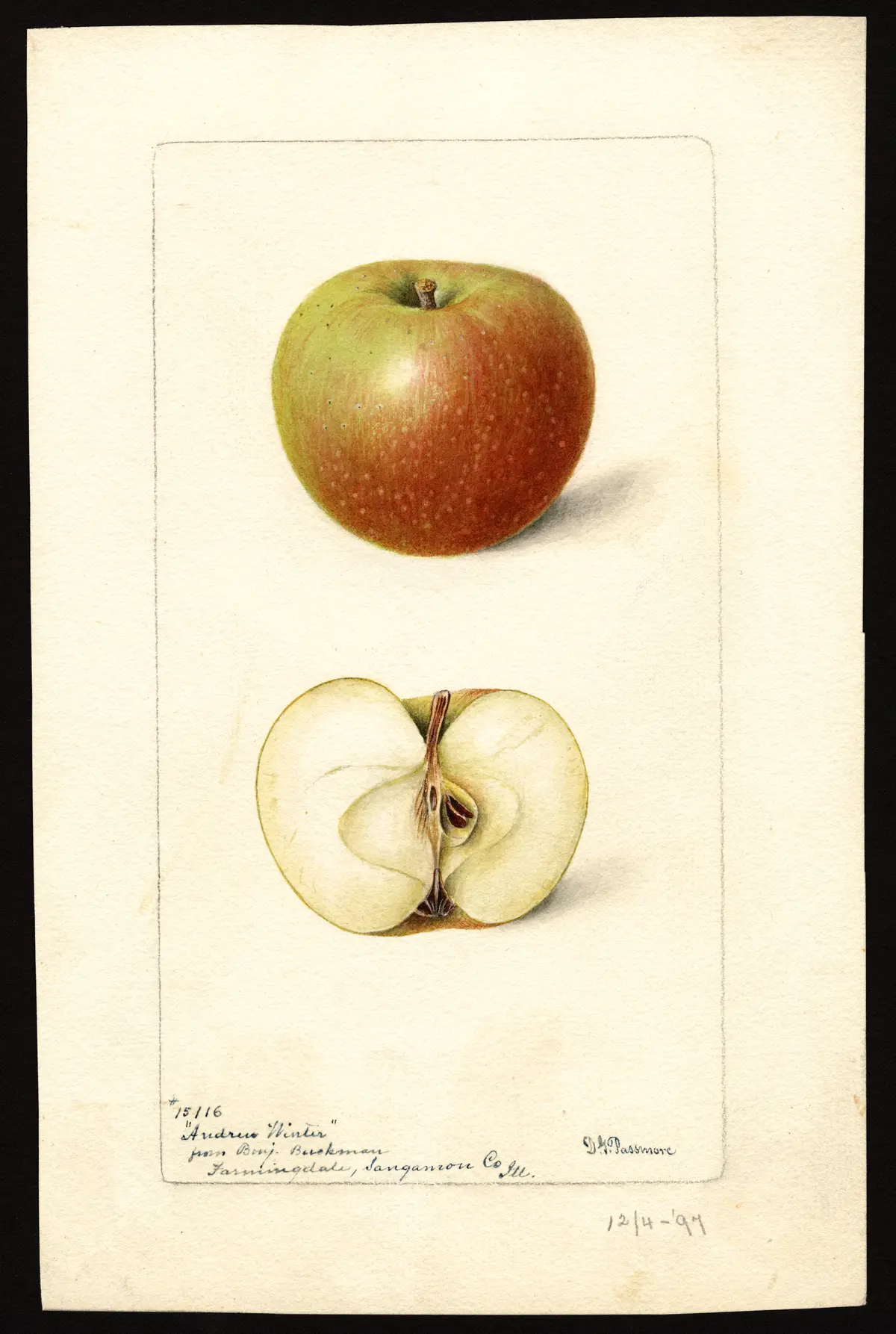
USDA Pomological Watercolor Collection
Andrews
Origin/History
First reported in Beach and Close's 1896 New York Station annual report. Not listed in Bailey's American Horticulturist (1892). Documented in Beach and Clark's 1904 New York Station bulletin.
Tree
Tree vigorous, with an upright-spreading form that is rather dense. Branches small and crooked. Twigs medium size, curved, and stout, with medium to rather long internodes. Bark clear brownish-red mingled with olive-green, partly covered with streaked scarf-skin; quite pubescent. Lenticels numerous, medium to below medium size, oblong in form. Buds medium size, plump, acute, appressed, and pubescent. Leaves medium size and broad.
Fruit
Size and Form: Small. Roundish conic to oblong conic, often unsymmetrical with sides often compressed.
Stem: Short and thick, often inserted obliquely.
Cavity: Acute, moderately shallow to rather deep, furrowed or compressed, sometimes lipped; usually smooth.
Calyx: Small and closed. Calyx tube narrow, elongated, cone-shaped or funnel-formed. Stamens median to marginal.
Basin: Abrupt, medium in width and depth, distinctly furrowed.
Skin: Tough and somewhat waxy. Ground color dull yellowish-green, partly overlaid with a dull, rather dark red bearing narrow, indistinct carmine stripes. Dots numerous, pale, and rather conspicuous.
Flesh and Flavor: Greenish-white, firm, moderately fine, and somewhat crisp. Moderately juicy, with a mild subacid flavor. Quality fair to good.
Core and Seeds: Core abaxile, closed or partly open, with core lines clasping. Carpels decidedly concave, broadly ovate, slightly emarginate, and distinctly tufted. Seeds medium to large, rather narrow, long, acute, and somewhat tufted.
Season
March to June.
Uses
Not recommended for market or for planting in New York State. The fruit is small and not very attractive in form or color, making it commercially undesirable.
Book Sources
Described in 1 period pomological work
View original book sources (1)
— S.A. Beach, The Apples of New York, Vol. 1 (1905)ANDREWS.
References. 1. Beach and Close, N. Y. Sta. An. Rpt., 15:270. 1896. 2. Beach and Clark, N. Y. Sta. Bul., 248:111. 1904. 3. Not listed by Bailey in An. Hort., 1892:234.
Synonyms. Andrews Winter (1). Andrews Winter (2).
Fruit small to medium, not very attractive in form or color and therefore not desirable for market. It is not recommended for planting in New York state.
Tree.
Tree vigorous. Form upright spreading, rather dense; branches rather small and crooked. Twigs medium size, curved, stout; internodes medium to rather long. Bark clear brownish-red mingled with olive-green, partly covered with streaked scarf-skin; quite pubescent. Lenticels numerous, medium to below, oblong. Buds medium size, plump, acute, appressed, pubescent. Leaves medium size, broad.
Fruit.
Fruit small. Form roundish conic to oblong conic, often unsymmetrical; sides often compressed. Stem short, thick, often obliquely inserted. Cavity acute, moderately shallow to rather deep, furrowed or compressed, sometimes lipped, usually smooth. Calyx small, closed. Basin abrupt, medium in width and depth, distinctly furrowed.
Skin tough, somewhat waxy, dull yellowish-green partly overlaid with a dull, rather dark red having narrow, indistinct, carmine stripes. Dots numerous, pale, rather conspicuous.
Calyx tube narrow, elongated, cone-shape or funnel-form. Stamens median to marginal.
Core abaxile, closed or partly open; core lines clasping. Carpels decidedly concave, broadly ovate, slightly emarginate, distinctly tufted. Seeds medium to large, rather narrow, long, acute, somewhat tufted.
Flesh greenish-white, firm, moderately fine, somewhat crisp, moderately juicy, mild subacid, fair to good.
Season March to June.