Arbre Courbe
Pear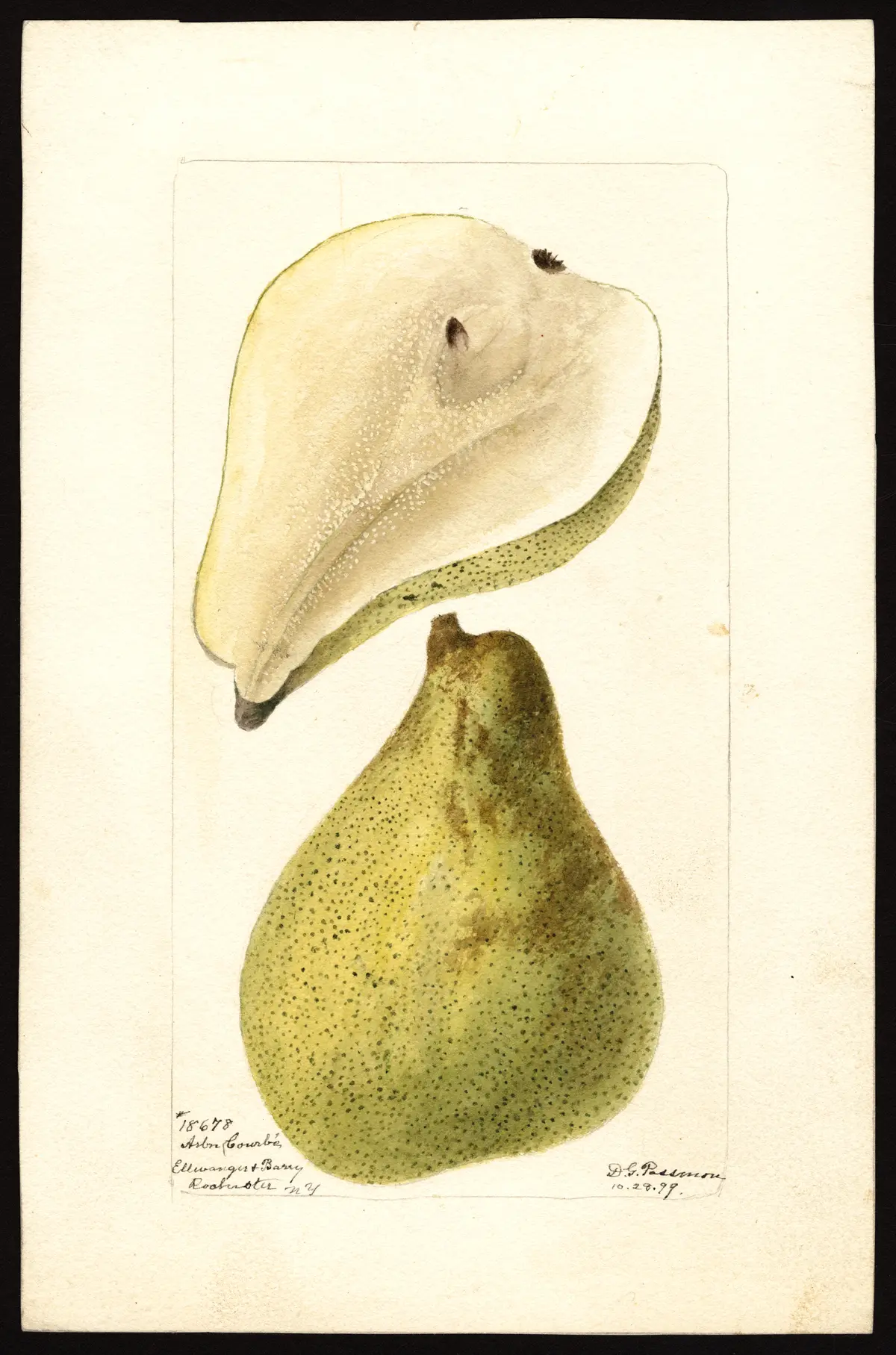
USDA Pomological Watercolor Collection
Arbre Courbe
Origin/History
Hedrick (1921) records that Bivort, successor of Van Mons at the Society's gardens at Louvain, stated this variety was gained by Van Mons about 1830. The variety appears in Card. Chron. 68 (1848), Pom. France 2: No. 59, Pl. 59 (1864) — where it is also listed under the German name Krummholzige Schmalzbirne — and in Dochnahl's Fuhr. Obstkunde 2:67 (1856).
Tree
Tree vigorous, with irregular crooked branches. Young wood yellowish brown, with many specks, angled or bent from joint to joint (Downing). Bark, lenticels, buds, and leaves not described in sources.
Fruit
Size and Form: Downing describes the fruit as medium or large, oval pyriform; Hedrick describes it as large, oblong-obtuse-pyriform.
Stem: Large and fleshy (Downing).
Cavity: Not described in sources.
Calyx: Open (Downing).
Basin: Broad and shallow (Downing).
Skin: Greenish yellow to bright yellow, with patches and russet dots (Downing). Hedrick adds that the surface is rough to the touch, being considerably covered with rough, scaly russet, and freely dotted with russet spots.
Flesh and Flavor: Flesh whitish (Downing) to white (Hedrick), melting, juicy. The two sources differ on texture and quality: Downing describes the flesh as coarse, half buttery, and slightly astringent, rating it Good; Hedrick describes it as rather fine, with grittiness around the core, and judges it a dessert pear but hardly first-rate.
Core/Seeds: Flesh gritty around the core (Hedrick). Core and seed details otherwise not described.
Season
Ripe last of September (Downing); September and October (Hedrick).
Uses
Dessert pear (Hedrick).
Subtypes/Variants
Not described in sources.
Other
Downing also lists Amiral and Colmar Charnay as associated names at the head of the entry.
Book Sources
Described in 2 period pomological works
View original book sources (2)
— A.J. Downing, The Fruits and Fruit Trees of America (1900)Arbre Courbe.
Amiral. Colmar Charnay.
Tree vigorous, with irregular crooked branches. Young wood yellowish brown, with many specks, angled or bent from joint to joint. Fruit medium or large, oval pyriform. Skin greenish yellow, with patches and russet dots. Stalk large and fleshy. Calyx open. Basin broad and shallow. Flesh whitish, coarse, half buttery, melting, juicy, slightly astringent. Good. Ripe last of September.
— U.P. Hedrick, The Pears of New York (1921)Arbre Courbe.
i. Card. Chron. 68. 1848. 2. Pom. France 2: No. 59, Pl. 59. 1864. Krummholzige Schmalzbirne. 3. Dochnahl Fuhr. Obstkunde 2:67. 1856.
Bivort, successor of Van Mons in the Society's gardens at Louvain, stated that this variety was gained by Van Mons about 1830. Fruit large, oblong-obtuse-pyriform; skin rough to the touch, being considerably covered with rough, scaly russet; color bright yellow or greenish-yellow, freely dotted with russet spots; flesh white, rather fine, melting, juicy, gritty around the core; a dessert pear, but hardly first-rate; Sept. and Oct.