Arkansas Beauty
Apple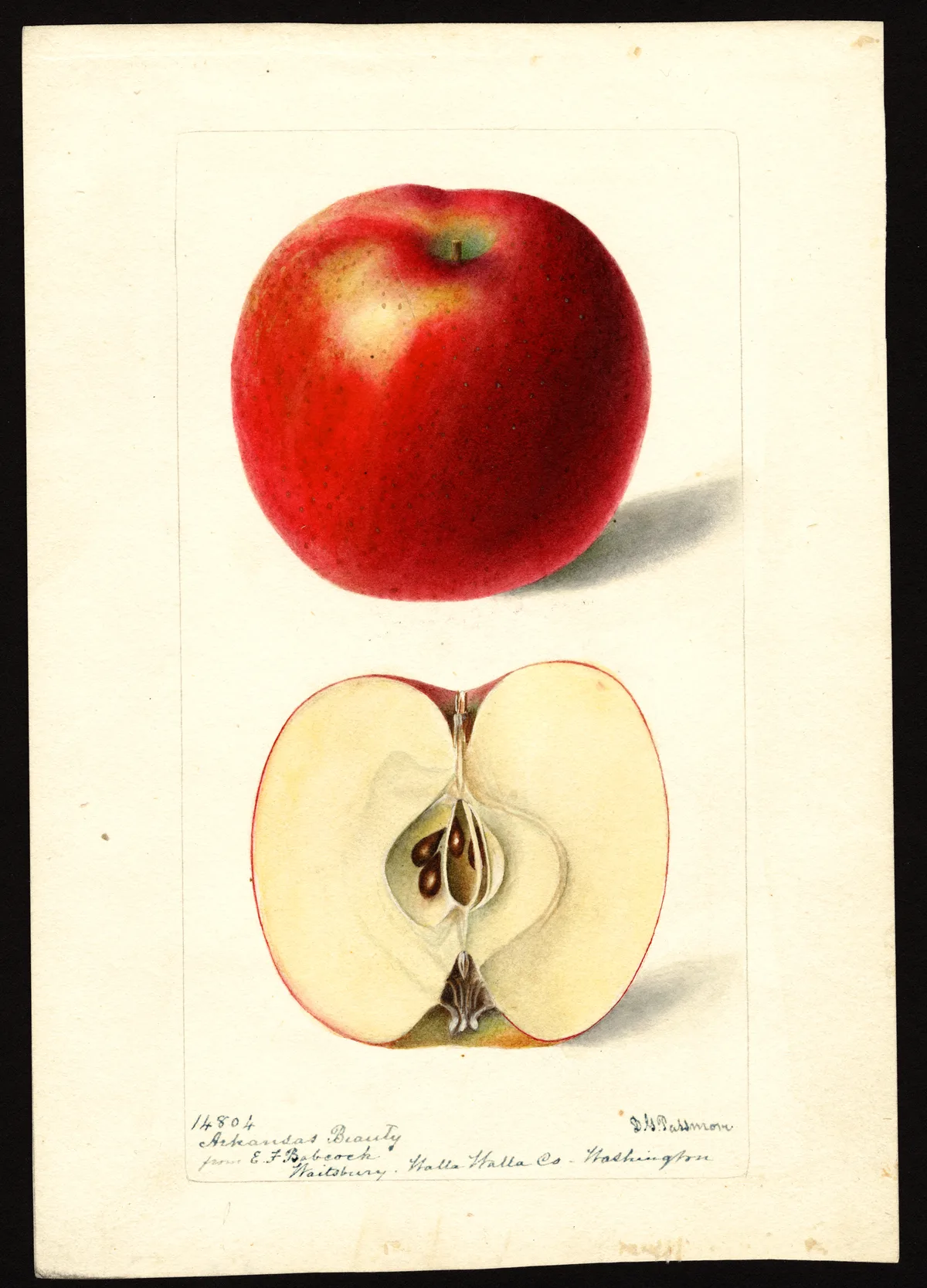
USDA Pomological Watercolor Collection
Arkansas Beauty
Origin / History
Of Arkansas origin. Stinson (Ark. Sta. Bul. 60, 1899) says it is grown to some extent in a few sections of that state but has not proven valuable. Beach: "As grown in this latitude the fruit does not always attain good color or good quality." Budd and Hansen call it a showy fruit, specimens from Iowa somewhat higher colored than Southern specimens. Planted spring 1894 at the Central Experimental Farm, Agassiz, B.C.
Tree
Tree vigorous; at Agassiz an upright grower. Beach: branches long, stout, crooked; form wide spreading with a rather open top. Twigs rather long, moderately stout, often crooked; internodes usually short. Bark olive-green with reddish-brown markings, dull, mottled thickly with scarf-skin; somewhat pubescent. Lenticels rather scattering, roundish or somewhat oblong, medium size to rather small. Buds large to medium, plump, rather obtuse, pubescent. Leaves rather long and narrow.
Fruit
Size: Above medium to large; Beach gives above medium, Budd and Hansen and Agassiz large.
Form: Roundish inclined to conic (Beach); roundish oblate, regular (Budd and Hansen); globular (Agassiz).
Stem: Long to medium, rather slender.
Cavity: Small, deep, broad, nearly symmetrical, slightly furrowed, acute (Beach); obtuse, regular, with some stellate russet (Budd and Hansen).
Calyx: Medium, closed or partly open, pubescent (Beach); closed, segments erect convergent (Budd and Hansen). Calyx tube long, funnel-shaped (Beach), conical (Budd and Hansen). Stamens median (Budd and Hansen).
Basin: Small to medium in depth and width, rather abrupt, somewhat furrowed (Beach); smooth, abrupt, medium deep (Budd and Hansen).
Skin: Tough, smooth, rather glossy. Ground pale green or yellow, blushed with pinkish-red and marked with rather faint stripes of carmine (Beach); yellow mostly, or entirely covered with rather dull red stripes and splashes (Budd and Hansen); green with a dull red cheek (Agassiz). A showy fruit.
Dots: Obscure, numerous, very minute, brown (Budd and Hansen); sprinkled, whitish (Agassiz).
Flesh and flavor: Flesh slightly tinged with yellow, firm, rather fine, moderately crisp, tender, juicy; mild subacid, "good" (Beach). Yellow, fine-grained, very juicy, tender, pleasant, spicy subacid; quality "very good to excellent" (Budd and Hansen). Whitish, crisp, mildly acid (Agassiz).
Core and seeds: Core open (Beach), wide open, abaxile (Budd and Hansen). Cells ovate, slit, with much cellular exudate (Budd and Hansen). Carpels much concave, broadly roundish, emarginate inclined to obcordate, tufted (Beach). Seeds numerous, dark, medium or below, rather wide, plump, obtuse (Beach); many, rounded, plump, short, rather small (Budd and Hansen).
Season
Winter (Budd and Hansen); late Autumn at Agassiz, B.C.
Uses
Not described in source.
Subtypes / Variants
Not described in source.
Other
Not described in source.
Book Sources
Described in 2 period pomological works
Nursery Catalog Sources
Found in 22 catalogs (1890–1921) from Illinois, Maryland, Massachusetts, Missouri, New Jersey, Oregon, Pennsylvania, Washington
- William H. Moon Co. , Morrisville, Bucks County , Pennsylvania — 1890
- Rogers Nursery Co. , Moorestown , New Jersey — 1893
- The Vineland Nurseries (Kelsey & Co. , Proprietors), St. Joseph, Missouri (Office: 13th and Atchison Sts., 2 Blocks East of the Citizens St. Car Line) — 1894
- J.V. Cotta (Cotta Nursery) , Carroll County , Illinois — 1898
- Reading Nursery , Jacob W. Manning, Proprietor, Reading , Massachusetts — 1898
- Stark Bros. Nurseries & Orchards Co. , Louisiana , Missouri — 1898
- Brown Brothers Co. , Continental Nurseries, Rochester, NY (also operated from Toronto, Canada) — 1899
- Central Experimental Farm , Dominion Department of Agriculture, Agassiz, British Columbia (under test; Bulletin No. 3, Second Series) — 1900
- Washington Nursery Co. , Toppenish , Washington — 1901
- Benjamin Buckman (personal inventory) , Farmingdale , Illinois — 1901
- Brown Brothers Co. , Continental Nurseries, Rochester, NY (also operated from Toronto, Canada) — 1901
- The Dalles Nurseries , The Dalles , Oregon — 1906
- Wm. J. Corse (successor to Robert Sinclair / Sinclair Nurseries) , Baltimore , Maryland — 1909
- Washington Nursery Company , Toppenish , Washington — 1909
- Pacific Nursery Company , Portland , Oregon — 1912
- Vineland Nurseries Company , Clarkston , Washington — 1912
- Washington Nursery Company , Toppenish , Washington — 1912
- Benjamin Buckman (personal inventory) , Farmingdale , Illinois — 1913
- Union Nurseries , J.B. Weaver & Sons, Union , Oregon — 1915
- Oregon Nursery Co. , Orenco , Oregon — 1920
- Benedict Nursery Co. , Portland , Oregon — 1921
- North-Western Nurseries , Walla Walla , Washington
View original book sources (3)
— S.A. Beach, The Apples of New York, Vol. 1 (1905)ARKANSAS BEAUTY.
REFERENCES. 1. Stinson. Ark. Sta. Bul., 60:124. 1899. 2. Bailey, An. Hort., 1892:234. 3. Budd-Hansen, 1903:40. 4. Powell and Fulton, U. S. B. P. I. Bul., 48:36. 1903.
The Arkansas Beauty is a variety of Arkansas origin. Stinson (1) says that it is grown to some extent in a few sections of that state but has not proven valuable. As grown in this latitude the fruit does not always attain good color or good quality.
TREE. Tree vigorous; branches long, stout, crooked. Form wide spreading with a rather open top. Twigs rather long, moderately stout, often crooked; internodes usually short. Bark olive-green with reddish-brown markings, dull, mottled thickly with scarf-skin; somewhat pubescent. Lenticels rather scattering, roundish or somewhat oblong, medium size to rather small. Buds large to medium, plump, rather obtuse, pubescent. Leaves rather long and narrow.
FRUIT. Fruit above medium. Form roundish inclined to conic. Stem long to medium, rather slender. Cavity small, acute, deep, broad, nearly symmetrical, slightly furrowed. Calyx medium, closed or partly open, pubescent. Basin small, medium in depth and width, rather abrupt, somewhat furrowed. Skin tough, smooth, rather glossy, pale green or yellow, blushed with pinkish-red, and marked with rather faint stripes of carmine. Calyx tube long, funnel-shaped. Core open. Carpels much concave, broadly roundish, emarginate inclined to obcordate, tufted. Seeds numerous, dark, medium or below, rather wide, plump, obtuse. Flesh slightly tinged with yellow, firm, rather fine, moderately crisp, tender, juicy, mild subacid, good.
— J.L. Budd & N.E. Hansen, American Horticultural Manual, Part II: Systematic Pomology (1914)Arkansas Beauty.—Origin, Arkansas. A showy fruit; specimens from Iowa somewhat higher colored than Southern specimens.
Fruit large, regular, roundish oblate; surface yellow mostly, or entirely covered with rather dull red stripes and splashes; dots obscure, numerous, very minute, brown; cavity obtuse, regular, with some stellate russet; stem long, slender; basin smooth, abrupt, medium deep; calyx closed; segments erect convergent. Core wide open, abaxile; cells ovate, slit, with much cellular exudate; tube conical; stamens median; seeds many, rounded, plump, short, rather small; flesh, yellow, fine-grained, very juicy, tender, pleasant, spicy subacid; quality very good to excellent. Winter.
— Central Experimental Farm, Central Experimental Farm, Agassiz BC — Catalogue of Fruit Trees under Test (Bulletin No. 3, 1900) (1900)Planted Spring 1894. Tree a vigorous upright grower. Fruit of large size, globular. Skin green, with a dull red cheek, and sprinkled with whitish dots. Flesh whitish, crisp, mildly acid. Season, late Autumn.