Aucuba
Apple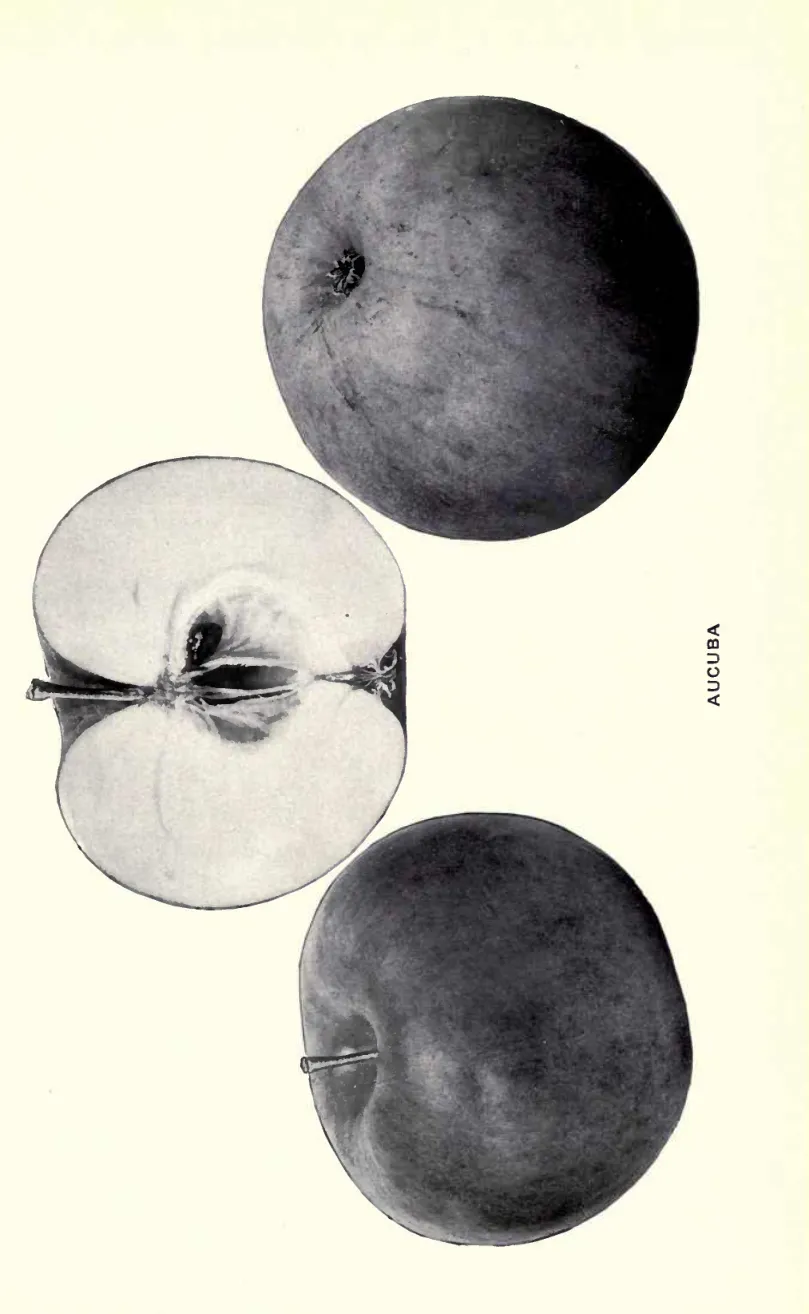
Aucuba
Origin and History
Leroy states that Aucuba was described as early as 1839 in Jardin fruitier p. 216, though its origin remains unknown. In New York state it has been disseminated but sparingly and is not commonly known.
Tree
Tree moderately vigorous; branches moderately long and stout. Form rather open, upright spreading. Twigs long, slightly curved, moderately slender; internodes below medium to short. Bark dark reddish-brown with light scarf-skin, pubescent. Lenticels numerous, small, round. Buds medium, rather long, acute, pubescent, often free. Leaves large and broad.
Aucuba begins bearing rather young and usually bears annual crops. There is some tendency for the fruit to drop before the crop is ready to be gathered.
Fruit
Size and Form. Fruit medium to above, pretty uniform in size and shape. Form roundish inclined to conic, sometimes a little oblate, sides occasionally unequal.
Stem. Usually long and slender.
Cavity. Acuminate, sometimes acute, deep, moderately narrow to rather broad, nearly symmetrical, seldom russeted.
Calyx. Small, closed or partly open; lobes long, acuminate. Basin usually narrow and shallow, sometimes moderately wide and moderately deep, obtuse to rather abrupt, often somewhat furrowed and corrugated.
Skin. Smooth, waxen yellow, rather pale but bright, often nearly covered with bright pinkish-red indistinctly marked with narrow carmine stripes. In well colored fruit the red rather predominates over the yellow. Dots very inconspicuous, gray or russet. General appearance is rather attractive.
Calyx Tube. Either rather short, narrow, cone-shaped, with core lines nearly meeting, or narrowly funnel-form, in which case the core lines clasp the cylinder of the calyx tube. Stamens median.
Core and Seeds. Core medium to small, axile, partly open or sometimes closed. Carpels smooth, slightly emarginate, roundish cordate, sometimes distinctly narrowing toward the apex. Seeds numerous, small to medium, narrow, acute or acuminate.
Flesh and Flavor. Flesh whitish with yellow tinge, firm, breaking, fine, tender, juicy, sprightly subacid, with distinct aroma, good to very good.
Season
October to January; some of the fruit may keep till spring but it is apt to deteriorate in flavor and quality after midwinter.
Uses and Merit
Aucuba is a moderately attractive apple of medium size and pretty good quality. The variety is not recommended for general planting because the fruit is second rate in size, appearance and quality.
Book Sources
Described in 1 period pomological work
Nursery Catalog Sources
Found in 2 catalogs (1901–1913) from Illinois
- Benjamin Buckman (personal inventory) , Farmingdale , Illinois — 1901
- Benjamin Buckman (personal inventory) , Farmingdale , Illinois — 1913
View original book sources (1)
— S.A. Beach, The Apples of New York, Vol. 1 (1905)AUCUBA.
REFERENCES. 1. Leroy, 1873:301. fig. 2. Beach, N. Y. Sta. An. Rpt., 14:586. 1892. 3. Bailey, An. Hort., 1892:234. 4. Thomas, 1903:689. 5. Powell and Fulton, U. S. B. P. I. Bul., 48:36. 1903. 6. Beach and Clark, N. Y. Sta. Bul., 248:111. 1904.
SYNONYMS. ACUBA-LEAVED REINETTE (4). ACUBA-LEAF REINETTE (2). FEUILLES D'AUCUBA (1). AUCUBÆFOLIA (3). Reinette a feuille d'Acuba (2).
The Aucuba is a moderately attractive apple of medium size and pretty good quality. The tree is hardy, healthy and bears regularly and abundantly. It is in season from October to January. The variety is not recommended for general planting because the fruit is second rate in size, appearance and quality.
Historical. Leroy (1) states that Aucuba was described as early as 1839 in Jardin fruitier p. 216, but that its origin is still unknown. In New York state it has been disseminated but sparingly and is not commonly known.
TREE.
Tree moderately vigorous; branches moderately long and stout. Form rather open, upright spreading. Twigs long, slightly curved, moderately slender; internodes below medium to short. Bark dark reddish-brown with light scarf-skin, pubescent. Lenticels numerous, small, round. Buds medium, rather long, acute, pubescent, often free. Leaves large and broad.
Aucuba begins bearing rather young and usually bears annual crops. There is some tendency for the fruit to drop before the crop is ready to be gathered.
FRUIT.
Fruit medium to above, pretty uniform in size and shape. Form roundish inclined to conic, sometimes a little oblate, sides occasionally unequal. Stem usually long and slender. Cavity acuminate, sometimes acute, deep, moderately narrow to rather broad, nearly symmetrical, seldom russeted. Calyx small, closed or partly open; lobes long, acuminate. Basin usually narrow and shallow, sometimes moderately wide and moderately deep, obtuse to rather abrupt, often somewhat furrowed and corrugated.
Skin smooth, waxen yellow, rather pale but bright, often nearly covered with bright pinkish-red indistinctly marked with narrow carmine stripes. In well colored fruit the red rather predominates over the yellow. Dots very inconspicuous, gray or russet. General appearance is rather attractive.
Calyx tube either rather short, narrow, cone-shaped, with core lines nearly meeting, or narrowly funnel-form, in which case the core lines clasp the cylinder of the calyx tube. Stamens median.
Core medium to small, axile, partly open or sometimes closed. Carpels smooth, slightly emarginate, roundish cordate, sometimes distinctly narrowing toward the apex. Seeds numerous, small to medium, narrow, acute or acuminate.
Flesh whitish with yellow tinge, firm, breaking, fine, tender, juicy, sprightly subacid, with distinct aroma, good to very good.
Season October to January; some of the fruit may keep till spring but it is apt to deteriorate in flavor and quality after midwinter.