AUGUSTE JURIE
Pear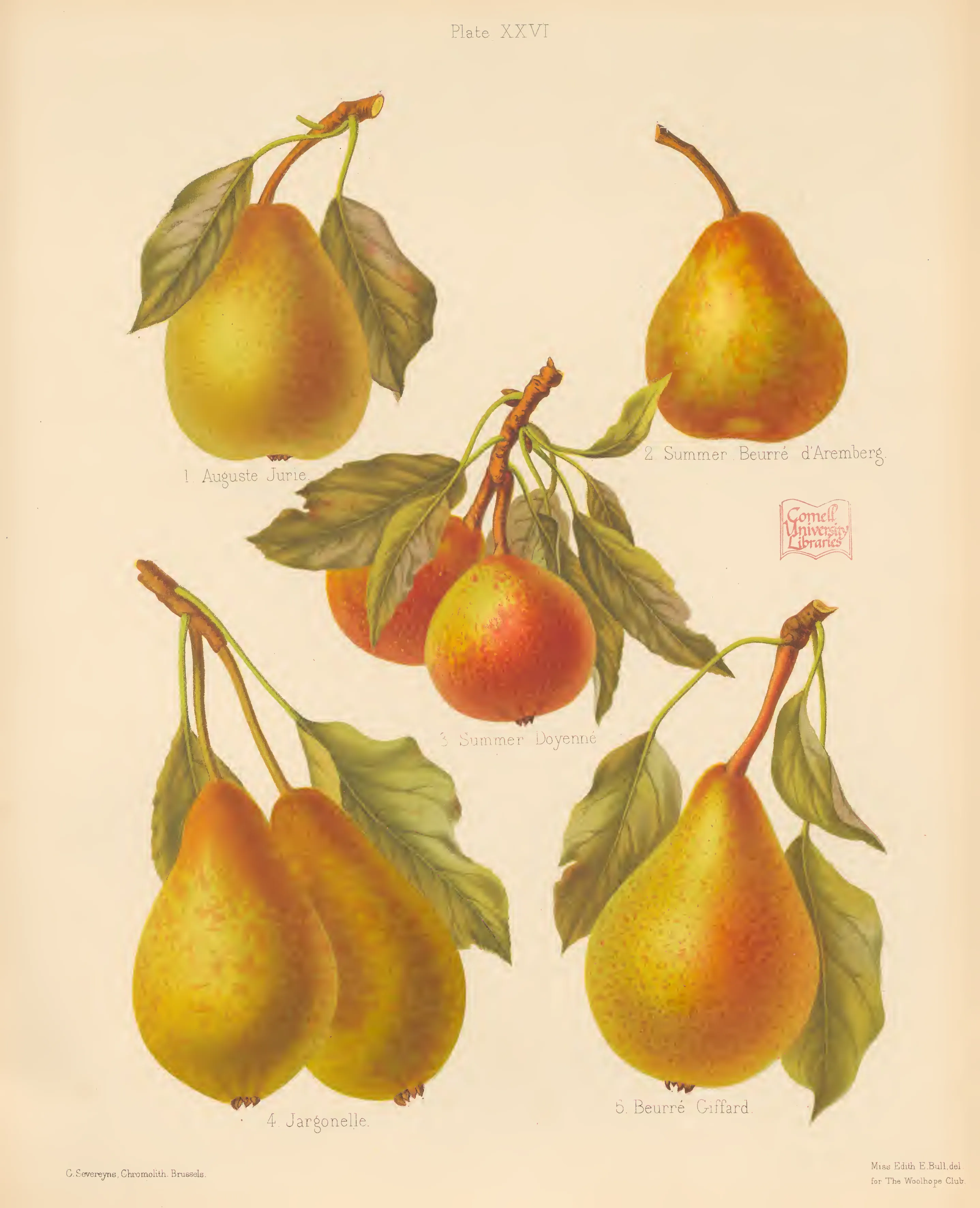
AUGUSTE JURIE
Origin / History
A pear, raised from seed of Beurre Giffard sown on the 11th of August, 1851, at the École d'Horticulture at Ecully, near Lyons, under the direction of the late M. Willermoz. Named in honour of M. Auguste Jurie, President of the Horticultural Society of the Rhone. Downing calls it a seedling of M. Fortune, Willermoz, France. The Herefordshire Pomona figure was taken from fruit grown in the gardens of the Royal Horticultural Society at Chiswick. The Pomona calls it "a valuable early pear" and "well worthy of general cultivation." It received the certificate of the Royal Horticultural Society on August 24th, 1880.
Tree
Moderately vigorous, very productive (Downing). Grows well and bears freely as a pyramid on the quince (Herefordshire Pomona).
Fruit
Size: Above medium, three and a half inches by two and a half inches wide (Herefordshire Pomona); small (Downing).
Form: Obtuse ovate (Herefordshire Pomona); oblate pyriform (Downing). In France more round (Herefordshire Pomona).
Stem: From an inch to an inch and a half long. In France shorter (Herefordshire Pomona).
Cavity: Stalk inserted without depression.
Calyx: Eye closed, with tooth-like segments, set even with the surface.
Basin: Not described in source.
Skin: Green, becoming yellowish green as it ripens, with a thin speckled coat of russet on the side next the sun, and strewed all over with russet patches (Herefordshire Pomona). Yellow, shaded with dark red in the sun (Downing). In France much brighter in color (Abbé Dupuy, as cited in the Herefordshire Pomona).
Dots: Not described in source.
Flesh and flavor: Flesh white (Downing). Crisp, rather granular, sweet, briskly flavored, with a fine melon flavor (Herefordshire Pomona); half melting, juicy, slightly vinous, and slightly musky (Downing). Downing rates it "Good."
Core and seeds: Not described in source.
Season
Early; ripe in the middle of August (Herefordshire Pomona). August (Downing).
Uses
Not described in source.
Subtypes / Variants
Not described in source.
Other
Not described in source.
Book Sources
Described in 2 period pomological works
View original book sources (2)
— Woolhope Naturalists Field Club, The Herefordshire Pomona (1885)PLATE XXVI.
- AUGUSTE JURIE.
This Pear originated from the seed of Beurre Giffard, sown on the 11th of August, 1851. It was grown at the École d'Horticulture at Ecully, near Lyons, under the direction of the late M. Willermoz, and it was named in honour of M. Auguste Jurie, President of the Horticultural Society of the Rhone.
Description.—Fruit: above medium size, three and a half inches by two and a half inches wide, obtuse ovate. Skin: green, becoming yellowish green, as it ripens, with a thin speckled coat of russet on the side next the sun, and strewed all over with russet patches. Eye: closed, with tooth-like segments, and set even with the surface. Stalk: from an inch to an inch and a half long, inserted without depression. Flesh: crisp, rather granular, sweet, briskly flavoured, and with a fine melon flavour.
The fruit here represented and described was grown in the gardens of the Royal Horticultural Society at Chiswick. In France it grows more round in shape, with a shorter stalk, and, as described by the Abbé Dupuy, it has a much brighter colour. It is a valuable early pear, ripe in the middle of August, and well worthy of general cultivation. It received the certificate of the Royal Horticultural Society on August 24th, 1880.
The tree grows well and bears freely as a pyramid on the quince.
— A.J. Downing, The Fruits and Fruit Trees of America (1900)AUGUSTE JURIE.
A seedling of M. Fortune, Willermoz, France. Tree moderately vigorous, very productive.
Fruit small, oblate pyriform, yellow, shaded with dark red in the sun. Flesh white, half melting, juicy, slightly vinous, and slightly musky. Good. August.