Barry
Apple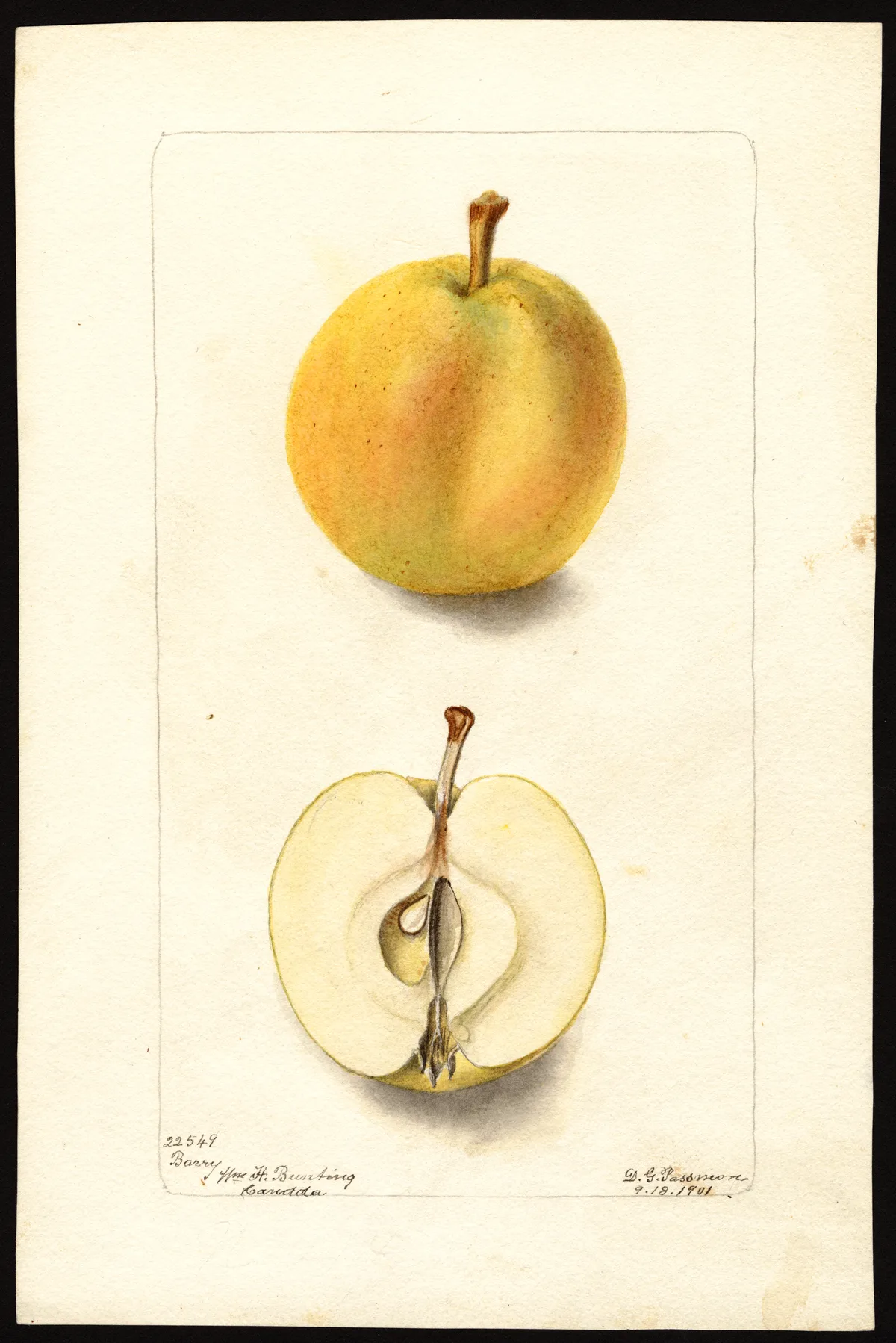
USDA Pomological Watercolor Collection
Barry
Origin and History
The Barry originated about 1880 in the nurseries of Ellwanger & Barry, Rochester, New York. It was recently introduced by that firm after having been thoroughly tested by them. The nursery has recommended it as a novelty of sterling merit and believes it will prove valuable for commercial orchards.
Tree
Tree a good grower; well branched with long upright branches. Form upright, becoming spreading and somewhat open. Twigs curved and often crooked, long, medium, stout; internodes long. Bark rather light olive-green shading to reddish-brown and overlaid with thin gray scarf-skin; quite pubescent. Lenticels scattering, usually small, round, slightly raised. Buds large, broad, obtuse, appressed, pubescent. Leaves large or very large, broad.
Fruit
Size and Form
Fruit medium, sometimes large. Form roundish oblate to roundish conic, obscurely ribbed, somewhat irregular.
Stem
Stem medium.
Cavity
Cavity acute, deep, rather broad, usually with some thin greenish russet, broadly furrowed.
Calyx
Calyx small to medium, closed; lobes acute. Calyx tube medium size, conical or funnel-shaped. Stamens marginal.
Basin
Basin abrupt, rather shallow to rather deep, narrow to moderately wide, with narrow furrows and wrinkled.
Skin
Skin tough, smooth, clear pale yellow or greenish with faint shade of red on the exposed cheek. Dots numerous, minute, pale, submerged, and a few show a brown or russet point. Prevailing effect green or greenish yellow.
Core and Seeds
Core medium to rather large, abaxile, open; core lines clasping. Carpels elliptical, much concave, emarginate, tufted. Seeds numerous, medium, obtuse, medium to dark brown.
Flesh and Flavor
Flesh firm, moderately fine to fine, crisp, tender, juicy, subacid, sprightly, good. The variety resembles the Greening type of apples in color and in the acidity of the flesh.
Season
Late.
Uses
Recommended as valuable for commercial orchards.
Subtypes or Variants
Not described in source.
Book Sources
Described in 1 period pomological work
Nursery Catalog Sources
Found in 3 catalogs (1896–1913) from Illinois, Missouri
- Stark Bros. Nurseries & Orchards Co. , Louisiana , Missouri — 1896
- Central Experimental Farm , Dominion Department of Agriculture, Agassiz, British Columbia (under test; Bulletin No. 3, Second Series) — 1900
- Benjamin Buckman (personal inventory) , Farmingdale , Illinois — 1913
View original book sources (1)
— S.A. Beach, The Apples of New York, Vol. 1 (1905)BARRY.
REFERENCE. 1. Ellwanger & Barry, Rochester, N. Y., Catalogue, 1895.
Resembles the Greening type of apples in color and in the acidity of the flesh.
The Barry originated about 1880, in the nurseries of Ellwanger & Barry, Rochester, N. Y., and has been recently introduced by that firm after having been thoroughly tested by them. It has their recommendation as a novelty of sterling merit, and one which they believe will prove valuable for commercial orchards (1).
TREE.
Tree a good grower; well branched with long upright branches. Form upright, becoming spreading and somewhat open. Twigs curved and often crooked, long, medium, stout; internodes long. Bark rather light olive-green shading to reddish-brown and overlaid with thin gray scarf-skin; quite pubescent. Lenticels scattering, usually small, round, slightly raised. Buds large, broad, obtuse, appressed, pubescent. Leaves large or very large, broad.
FRUIT.
Fruit medium, sometimes large. Form roundish oblate to roundish conic, obscurely ribbed, somewhat irregular. Stem medium. Cavity acute, deep, rather broad, usually with some thin greenish russet, broadly furrowed. Calyx small to medium, closed; lobes acute. Basin abrupt, rather shallow to rather deep, narrow to moderately wide, with narrow furrows and wrinkled. Skin tough, smooth, clear pale yellow or greenish with faint shade of red on the exposed cheek. Dots numerous, minute, pale, submerged, and a few show a brown or russet point. Prevailing effect green or greenish yellow. Calyx tube medium size, conical or funnel-shaped. Stamens marginal. Core medium to rather large, abaxile, open; core lines clasping. Carpels elliptical, much concave, emarginate, tufted. Seeds numerous, medium, obtuse, medium to dark brown. Flesh firm, moderately fine to fine, crisp, tender, juicy, subacid, sprightly, good.
Season. Late.