Beach
Apple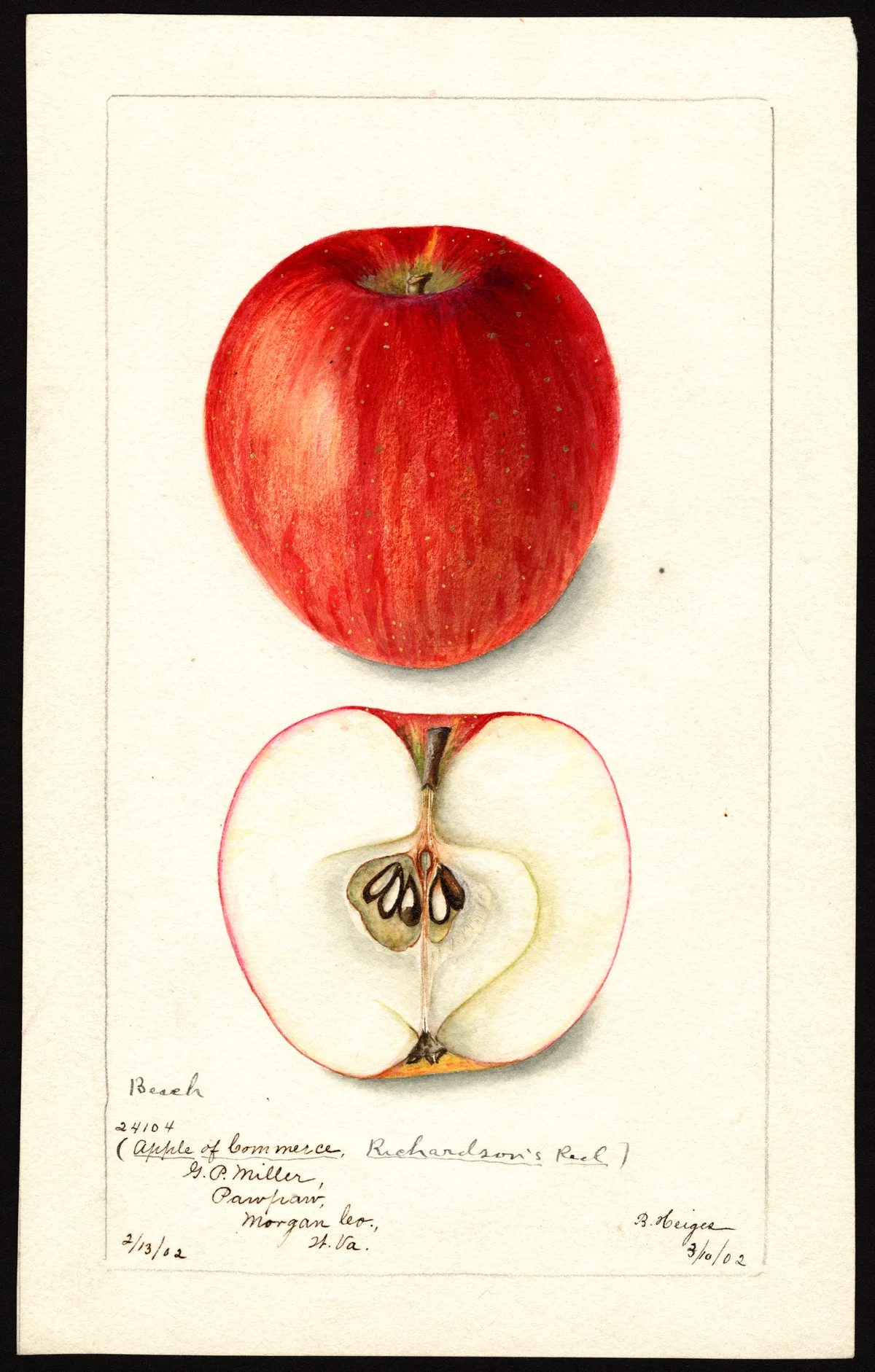
USDA Pomological Watercolor Collection
Beach
Origin / History
Beach is a red apple of Arkansas. Hedrick writes that the variety was first described in Arkansas in 1898.
Stinson reports that it had been grown to a considerable extent in Benton and Washington counties, Arkansas, under the names Lady Pippin and Richardson's Red. It was also introduced under the name Apple of Commerce. He found it productive and a good keeper, but because it is "only fair in quality" he advises against planting it in Arkansas. Budd and Hansen report it "becoming popular in Arkansas for its late keeping and productiveness."
Beach (1905) calls it a variety "as yet … but little tested either in New York or adjacent states." Waugh reports that as grown in Vermont it "appears to be superior in all respects to Ben Davis, and is really good in quality."
By 1922 Hedrick writes that Beach "has been widely distributed in the United States and Canada, and is now offered by many nurserymen." He judges that it "is not likely to become widely grown, and yet it should be known for its late-keeping fruits."
Tree
Tree rather large, vigorous, a good grower; form round and dense; branches somewhat stocky. Twigs moderately stout, with long internodes, somewhat crooked. Bark nearly smooth, clear, bright light reddish-brown, becoming dull dark brown approaching black, thinly mottled with scarf-skin, somewhat pubescent. Lenticels rather numerous, conspicuous, usually roundish, above medium to very large, raised slightly or not at all. Buds small to medium, deep set, obtuse, pubescent. Leaves large, long, often broad; petioles red at base; foliage rather dense.
Productive. Comes into bearing rather young, with a tendency to produce moderate crops annually (Beach). Budd and Hansen call it a sure bearer.
In New York the season is ordinarily not long enough for the proper development of apples of the group to which Beach belongs. There the fruit "appears not to ripen properly," and Beach holds that the variety "can hardly be expected to prove valuable here."
Fruit
Size: About medium; Budd and Hansen alone extend it to large. Pretty uniform in size and shape (Beach).
Form: Usually roundish, slightly obovate or slightly conical, sometimes somewhat oblate. Beach describes it as regular and symmetrical; Thomas and Budd and Hansen call it irregular.
Stem: Medium, rather slender.
Cavity: Acute to acuminate, medium to deep, rather narrow to moderately wide, symmetrical or regular. Green or with outspreading russet; Budd and Hansen describe considerable radiating russet.
Calyx: Medium, closed; segments connivent (Budd and Hansen). Calyx tube rather narrow, deep, conical or funnel-form, with a fleshy projection of the pistil point into its base (Beach). Stamens median to marginal.
Basin: Very shallow to moderately deep, obtuse to rather abrupt, moderately wide. Furrowed, distinctly ribbed, corrugated, sometimes deeply corrugated (Budd and Hansen). Beach finds it often with some mammiform protuberances; Budd and Hansen describe small prominences around the calyx.
Skin: Rather thick, tough, smooth. Ground color bright yellow to greenish yellow. Shaded and mottled with red, splashed red, and striped with dark carmine. Budd and Hansen describe it as almost wholly covered with mixed and marbled rather light red, with broad splashes of darker crimson. Prevailing effect red or red striped. Beach finds it "decidedly attractive"; Hedrick says the apples "are not attractive in form or color."
Dots: Few, inconspicuous or obscure, small to minute, gray or whitish.
Flesh and flavor: Flesh yellowish, somewhat tinged with yellow. Firm to very firm, moderately coarse to rather coarse-grained; Thomas calls it tough. Thomas calls it juicy, while Beach finds it "not very juicy." Subacid. Beach rates it "fair to nearly good in quality" and Budd and Hansen "good." Hedrick finds the apples "pleasant to eat hardly among the best."
Core and seeds: Core axile, medium to rather large, closed; core lines clasping. Carpels broadly ovate, emarginate (Beach). Budd and Hansen describe the cells as ovate and slit, with much exudate. Beach gives the seeds as large, rather narrow, long, acute; Budd and Hansen call them few and plump.
Season
Very late; a very late keeper and one of the latest keeping varieties (Beach). Budd and Hansen give late winter.
Uses
Not described in source.
Subtypes / Variants
Not described in source.
Other
Not described in source.
Book Sources
Described in 4 period pomological works
Nursery Catalog Sources
Found in 6 catalogs (1896–1913) from Illinois, Missouri, Washington
- Stark Bros. Nurseries & Orchards Co. , Louisiana , Missouri — 1896 — listed as Apple of Commerce
- Stark Bros. Nurseries & Orchards Co. , Louisiana , Missouri — 1898 — listed as Apple of Commerce
- Central Experimental Farm , Dominion Department of Agriculture, Agassiz, British Columbia (under test; Bulletin No. 3, Second Series) — 1900 — listed as Apple of Commerce
- Benjamin Buckman (personal inventory) , Farmingdale , Illinois — 1901 — listed as Apple of Commerce
- Vineland Nurseries Company , Clarkston , Washington — 1912
- Benjamin Buckman (personal inventory) , Farmingdale , Illinois — 1913 — listed as Apple of Commerce
View original book sources (4)
— John J. Thomas, The American Fruit Culturist (1903)Beach (Lady Pippin). Medium, roundish, irregular, greenish-yellow, splashed red, flesh yellowish, tough, juicy, sub-acid. Ark.
— S.A. Beach, The Apples of New York, Vol. 1 (1905)BEACH.
REFERENCES. 1. Stinson, Ark. Sta. Bul., 49:9. 1898. fig. 2. Ib., 60:126. 1899. 3. Am. Pom. Soc. Cat., 1899:15. 4. N. C. State Bd. Agr. Bul., 1900:9. 5. Waugh, Vt. Sta. An. Rpt., 14:287. 1901. 6. Budd-Hansen, 1903:44. 7. Powell and Fulton, U. S. B. P. I. Bul., 48:37. 1903.
SYNONYMS. Apple of Commerce (1, 2, 3, 4, 5, 6, 7). Lady Pippin (1). Richardson's Red (1, 2, 3, 4, 6, 7).
A red Arkansas apple, which as yet has been but little tested either in New York or adjacent states. In New York ordinarily the season is not long enough for the proper development of apples of the group to which the Beach belongs. For this reason that variety can hardly be expected to prove valuable here. Waugh reports that, as grown in Vermont, it appears to be superior in all respects to Ben Davis, and is really good in quality (5). It is a very late keeper.
Historical. Stinson reports that this variety has been grown to a considerable extent in Benton and Washington counties, Arkansas, under the names Lady Pippin and Richardson's Red. It has also been introduced under the name Apple of Commerce (1). He has found the variety productive and a good keeper, but because it is only fair in quality he advises against the planting of it in Arkansas (2).
TREE.
Tree rather large, vigorous, productive, comes into bearing rather young, and has a tendency to produce moderate crops annually; branches somewhat stocky. Form round, dense. Twigs moderately stout, with long internodes, somewhat crooked. Bark nearly smooth, clear, bright light reddish-brown, becoming dull dark brown approaching black, thinly mottled with scarf-skin, somewhat pubescent. Lenticels rather numerous, conspicuous, usually roundish, above medium to very large, raised slightly or not at all. Buds small to medium, deep set, obtuse, pubescent. Leaves large, long, often broad; petioles red at base; foliage rather dense.
FRUIT.
Fruit as grown in this region appears not to ripen properly. It is about medium in size and pretty uniform in size and shape. Form usually roundish, slightly obovate, or sometimes somewhat oblate, regular, symmetrical. Stem medium, rather slender. Cavity acute to acuminate, deep to medium depth, moderately wide, green or with outspreading russet, symmetrical. Calyx medium, closed. Basin rather shallow to moderately deep, obtuse to rather abrupt, moderately wide, furrowed, corrugated, often with some mammiform protuberances. Skin rather thick, tough, smooth, bright yellow, shaded and mottled with red and striped with dark carmine. Dots inconspicuous, small, gray or whitish. Prevailing effect red or red striped, decidedly attractive. Calyx tube rather narrow, deep, conical or funnel-form, with fleshy projection of pistil point into its base. Stamens median to marginal.
Core axile, medium to rather large, closed; core lines clasping. Carpels broadly ovate, emarginate. Seeds large, rather narrow, long, acute. Flesh somewhat tinged with yellow, very firm, moderately coarse, not very juicy, subacid, fair to nearly good in quality. Season very late; it is one of the latest keeping varieties.
— J.L. Budd & N.E. Hansen, American Horticultural Manual, Part II: Systematic Pomology (1914)Beach (Richardson's Red, Apple of Commerce).—Origin, Arkansas; tree a good grower and sure bearer; becoming popular in Arkansas for its late keeping and productiveness.
Fruit medium to large, roundish, slightly conical, irregular; surface greenish yellow, almost wholly covered with mixed and marbled rather light red, with broad splashes of darker crimson; dots few, obscure, minute, whitish; cavity regular, rather narrow, medium deep, with considerable radiating russet; stem medium; basin shallow to very shallow, distinctly ribbed, with small prominences around calyx, sometimes deeply corrugated; calyx closed; segments connivent. Core closed, clasping; cells ovate, slit, much exudate; tube funnel-shaped; stamens median; seeds few, plump; flesh yellowish, firm, rather coarse-grained, subacid, good. Late winter.
— U.P. Hedrick, Cyclopedia of Hardy Fruits (1922)BEACH.
Apple of Commerce.
Beach has been widely distributed in the United States and Canada, and is now offered by many nurserymen. It is not likely to become widely grown, and yet it should be known for its late-keeping fruits. The apples are pleasant to eat hardly among the best but are not attractive in form or color. The variety was first described in Arkansas in 1898.
Tree large, vigorous, productive, round, dense; branches stocky. Leaves large, long; petioles red at base. Fruit medium in size and uniform in size and shape, round-obovate, sometimes oblate, regular, symmetrical; stem slender; cavity acuminate, deep, wide, green or with outspreading russet, symmetrical; calyx closed; basin shallow to deep, obtuse, wide, furrowed, corrugated, often with mammiform protuberances; skin thick, tough, smooth, bright yellow, shaded and mottled with red and striped with dark carmine; dots inconspicuous, small, gray; prevailing effect red or red striped; calyx-tube conical; stamens median; core axile, large, closed; core-lines clasping; carpels broadly ovate, emarginate; seeds large, narrow, long, acute; flesh yellow, very firm, coarse, subacid; fair to good in quality; very late.