Beacon
Apple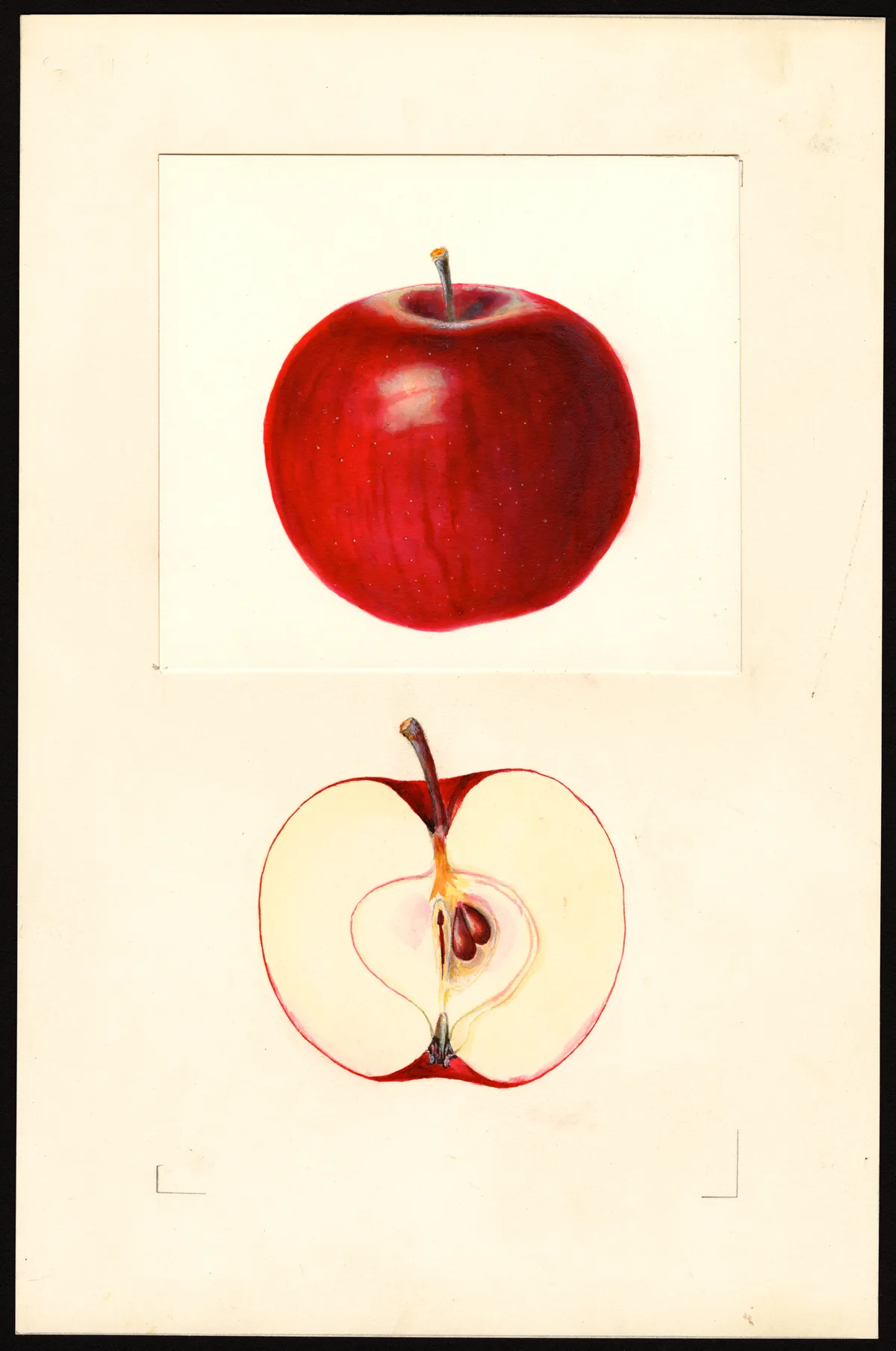
USDA Pomological Watercolor Collection
Beacon
Origin and History
Beacon is recorded as a Malinda seedling in multiple USDA Agricultural Research Service accessions across the United States as of 1963. Material was distributed from several Minnesota sources, including the Agricultural Experiment Station at St. Paul, Andrews Nursery in Faribault, Farmers Seed & Nursery Co. in Faribault, and Summit Nursery in Stillwater. Additional sources included Daniels Nursery in Long Lake, Minnesota; Emlong Nursery in Stevensville, Michigan; Sherman Nursery Co. in Charles City, Iowa; Inter-State Nursery in Hamburg, Iowa; Heuser Nursery in Hartford, Michigan; Moses Fell Annex Farms in Bedford, Indiana; and Loren J. Doud in Wabash, Indiana. The variety was held at multiple USDA research stations and experiment stations throughout the northern United States, including locations in Washington, Michigan, North Dakota, Maryland, New York, Missouri, Maine, South Dakota, Minnesota, Iowa, Wyoming, Kansas, Ohio, Indiana, Illinois, Oregon, Pennsylvania, Virginia, and Oklahoma.
Fruit
Size and Form: Fruit is described as medium size. One accession notes similarity to Opalescent in size, color, and shape.
Color: Beacon is consistently described as solid red or well colored, with bright red coloration noted in at least one accession.
Flavor and Quality: Flavor is described as good or fair to good. The fruit is subacid. It is noted as suitable for both dessert and culinary purposes.
Ripening Season: Beacon is a summer apple, early maturing, ripening in late August. Fruit ripens 10–14 days before Wealthy.
Storage: Good storage behavior is reported.
Tree
Hardiness: Beacon is described as medium hardy and very hardy in different accessions. The tree is noted as quite susceptible to cedar rust and resistant to both fire blight and scab.
Bearing Habit: Early productive.
Season
Early summer to late August; summer apple.
Uses
Dessert-culinary.
Other
Multiple USDA accessions and station numbers are recorded: AP-H-117 and M-763 (Agricultural Research Service, Irrigation Experiment Station, Prosser, Washington); AP-H-227 (Agricultural Research Service, Irrigation Experiment Station, Prosser, Washington); WaM (Moxee Quarantine Station, Moxee, Washington); station no. 12129 (Northern Great Plains Field Station, Mandan, North Dakota); station no. 3-30359 / USDA Plant Introduction No. 260727 (U.S. Plant Introduction Station, Glenn Dale, Maryland); station no. 43 (held by Agricultural Experiment Station, University of Missouri, Columbia, Missouri, and Agricultural Experiment Station, University of Maine, Orono, Maine); station no. A43213 (U.S. Horticultural Field Station, Cheyenne, Wyoming); station no. AP-H-156 (Agricultural Research Service, Irrigation Experiment Station, Prosser, Washington); station no. A5755 (U.S. Horticultural Field Station, Cheyenne, Wyoming). One accession notation indicates "2 years negative on R12740-7A" as reported by the Agricultural Experiment Station, University of Illinois, Urbana, Illinois; the Agricultural Experiment Station, Oklahoma State University, Stillwater, Oklahoma; and the Agricultural Experiment Station, Purdue University, Lafayette, Indiana.
Book Sources
Described in 1 period pomological work
View original book sources (1)
— H.H. Fisher (USDA ARS), A Survey of Apple Clones in the United States (1963)Beacon is recorded across multiple accessions at several reporting stations. At the Agricultural Research Service, Irrigation Experiment Station, Prosser, Washington (station nos. AP-H-117 and M-763), and at the Moxee Quarantine Station, Moxee, Washington (WaM*), material was received from the Agricultural Experiment Station, Excelsior, Minnesota. A separate accession received from Cal Cooper, Pateros, Washington is held as station no. AP-H-227 at the Agricultural Research Service, Irrigation Experiment Station, Prosser, Washington. The Graham Horticultural Experiment Station, Grand Rapids, Michigan received material from Daniels Nursery, Long Lake, Minnesota. The Northern Great Plains Field Station, Mandan, North Dakota (station no. 12129) received material from Farmers Seed & Nursery Co., Faribault, Minnesota; comments note it is a Malinda cp. seedling, with fruit medium, well colored, flavor good, subacid, a summer apple, dessert-culinary, and medium hardy. The U.S. Plant Introduction Station, Glenn Dale, Maryland (station no. 3-30359) holds USDA Plant Introduction No. 260727, received from Andrews Nursery, Faribault, Minnesota. An accession received from the Agricultural Experiment Station, St. Paul, Minnesota in 1936 is described as a Malinda cp. seedling, solid red, quality good, early productive, and is reported by NyC. Material received from N. Y. F. T. A., Geneva, New York is held as station no. 43 and reported by the Agricultural Experiment Station, University of Missouri, Columbia, Missouri, and the Agricultural Experiment Station, University of Maine, Orono, Maine; comments note it is a red summer apple. An accession from the Agricultural Experiment Station, St. Paul, Minnesota is reported by the Agricultural Experiment Station, College Station, South Dakota; the Agricultural Experiment Station, University of Minnesota, St. Paul Campus, St. Paul, Minnesota; the Agricultural Experiment Station, Michigan State University, East Lansing, Michigan; and Wis; comments describe early maturing fruit of medium size, fair to good quality, with good storage. Andrew's Nursery, Faribault, Minnesota is the source for the accession reported by the Agricultural Experiment Station, North Dakota State University, Fargo, North Dakota. Sherman Nursery Co., Charles City, Iowa is the source for the accession held as station no. A43213 at the U.S. Horticultural Field Station, Cheyenne, Wyoming; commented as a medium size apple. Inter-State Nursery, Hamburg, Iowa supplied material to the Agricultural Experiment Station, Iowa State University, Ames, Iowa. Summit Nursery, Stillwater, Minnesota supplied an accession reported by N49; noted as early summer, very hardy. F. J. Strang of Emlong Nursery, Stevensville, Michigan supplied material reported by the Agricultural Experiment Station, Kansas State University, Manhattan, Kansas; the Agricultural Experiment Station, Department of Pomology, Geneva, New York; and the Ohio Agricultural Experiment Station, Wooster, Ohio; comments state the fruit ripens 10–14 days before Wealthy, is similar to Opalescent in size, color, and shape, the tree is resistant to fire blight and scab, quite susceptible to cedar rust, and ripens in late August. The Agricultural Experiment Station, Lafayette, Indiana supplied material reported by the Agricultural Experiment Station, University of Illinois, Urbana, Illinois; the Agricultural Experiment Station, Oregon State University, Corvallis, Oregon; and the Agricultural Experiment Station, Pennsylvania State University, University Park, Pennsylvania. One accession with no stated source is described as fruit brt., solid red, reported by the Agricultural Experiment Station, Virginia Polytechnic Institute, Blacksburg, Virginia. Moses Fell Annex Farms, Bedford, Indiana supplied material held as station no. AP-H-156 at the Agricultural Research Service, Irrigation Experiment Station, Prosser, Washington. Heuser Nursery, Hartford, Michigan supplied material to the Graham Horticultural Experiment Station, Grand Rapids, Michigan. Loren J. Doud, Wabash, Indiana supplied material held as station no. A5755 at the U.S. Horticultural Field Station, Cheyenne, Wyoming. One accession with no stated source is noted as 2 years negative on R12740-7A, reported by the Agricultural Experiment Station, University of Illinois, Urbana, Illinois; the Agricultural Experiment Station, Oklahoma State University, Stillwater, Oklahoma; and the Agricultural Experiment Station, Purdue University, Lafayette, Indiana.