Belmont
Pear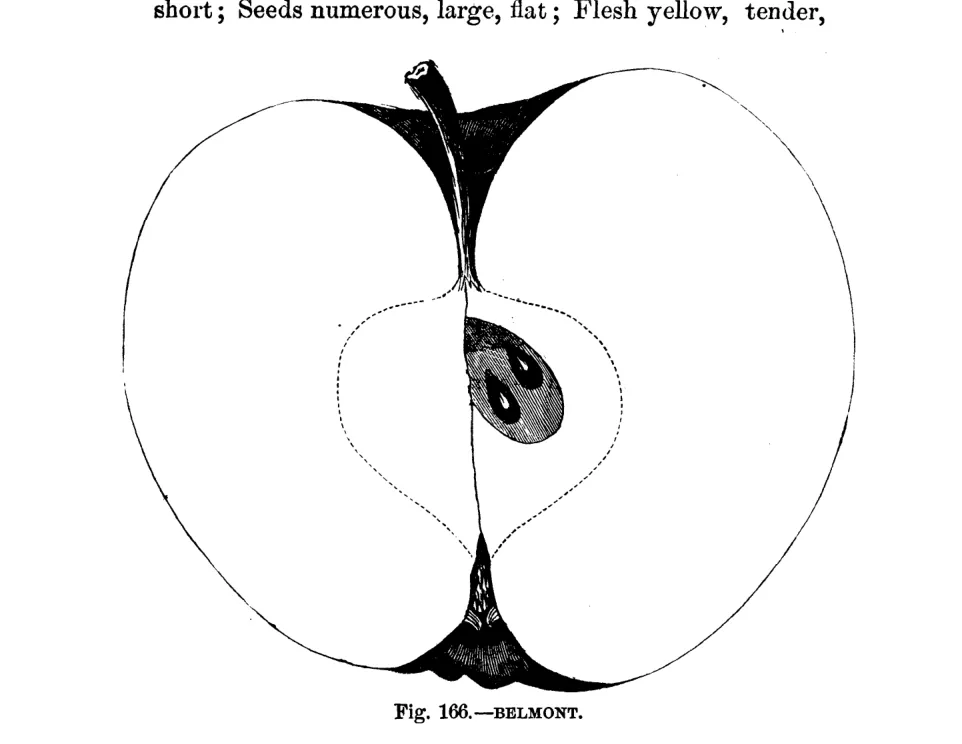
Belmont Pear
Origin / History
An English pear raised by T. A. Knight at Downton Castle, England, about the year 1840 (Hedrick). The Herefordshire Pomona records first seeing this variety in the autumn of 1829, when the tree produced a very heavy crop of fruit of large size — a date that predates Hedrick's c. 1840 raising date and may indicate either an earlier origin or a separate variety history.
References: Mas Pom. Gen. 6:171, fig. 470 (1880); Hogg Fruit Man. 496 (1884).
Tree
Not described in sources.
Fruit
Size: The sources conflict. Hedrick describes the fruit as medium. The Herefordshire Pomona states that the tree produced fruit of large size.
Form: Globular-oval, even and regularly shaped (Hedrick).
Stem: Not described in sources.
Cavity: Not described in sources.
Calyx: Not described in sources.
Basin: Not described in sources.
Skin: The two sources give somewhat different impressions. Herefordshire Pomona describes the color as pale dull yellow, speckled with brown, the ground color very much that of a Blanquet. Hedrick describes the skin as rather rough to the touch, covered with a coating of somewhat rough russet except on the shaded side where it is greenish-yellow, and marked with patches and dots of dark-brown russet; on the side next the sun it shows a coppery-red glow.
Flesh / Flavor: Herefordshire Pomona describes the flesh as melting, rather gritty, sweet and good, and judges it probably an excellent variety, with many specimens proving very excellent. Hedrick describes the flesh as yellowish, rather coarse, sugary, vinous, and finely flavored like Swan Egg; almost first-rate.
Season
October and November (Hedrick). Autumn, consistent with Hedrick (Herefordshire Pomona).
Uses
Hedrick classifies Belmont as an English cooking pear. The Herefordshire Pomona's author, by contrast, found many specimens to be very excellent, implying dessert or dual-purpose quality — a potential conflict with Hedrick's cooking designation.
Subtypes / Variants
Not described in sources.
Other
Not described in sources.
Book Sources
Described in 2 period pomological works
View original book sources (2)
— Woolhope Naturalists Field Club, The Herefordshire Pomona (1885)Belmont Pear.
Pale dull yellow, speckled with brown, the ground colour very much that of a Blanquet. Flesh melting, rather gritty, sweet and good. Probably an excellent variety.
Remarks.—I first saw this variety in the Autumn of 1829, when the tree produced a very heavy crop of fruit of large size; many of which proved to be in my estimation very excellent.
— U.P. Hedrick, The Pears of New York (1921)Belmont.
i. Mas Pom. Gen. 6:171, fig. 470. 1880. 2. Hogg Fruit Man. 496. 1884.
An English cooking pear raised about the year 1840 by T. A. Knight, Downton Castle, Eng. Fruit medium, globular-oval, even and regularly shaped; skin rather rough to the touch, covered with a coating of somewhat rough russet except on the shaded side where it is greenish-yellow, and marked with patches and dots of dark-brown russet; on the side next the sun it shows a coppery-red glow; flesh yellowish, rather coarse, sugary, vinous, finely flavored like Swan Egg; almost first; Oct. and Nov.