Benoni
Apple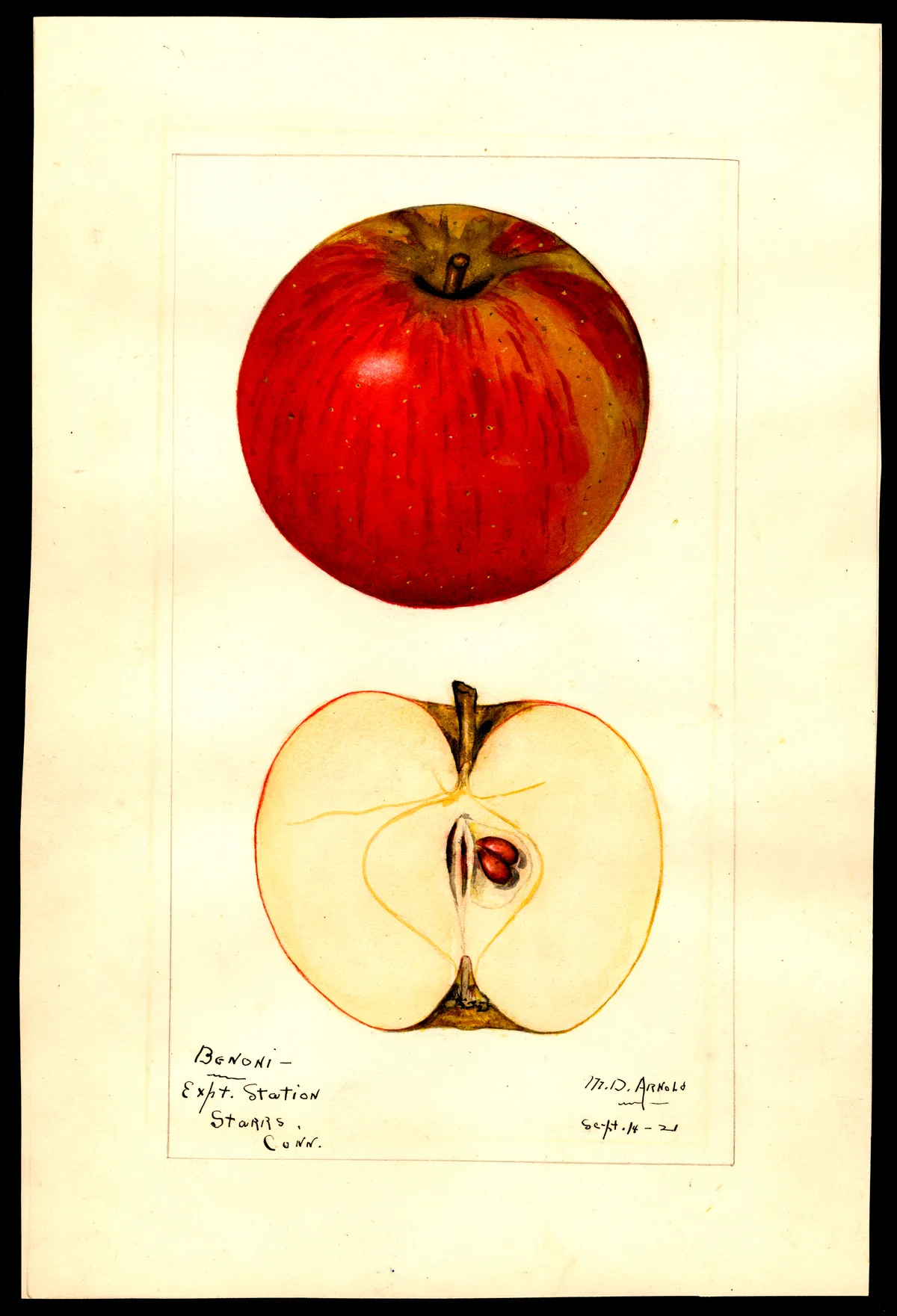
USDA Pomological Watercolor Collection
Benoni
Origin / History
A native variety, raised at Dedham, Massachusetts. Hovey credits its introduction to Mr. E. M. Richards of Dedham, "a zealous amateur, who has devoted much attention to apples, and introduced several varieties of merit." Richards brought it to notice about twenty years before Hovey wrote. He gave a brief account of it in the Magazine of Horticulture for 1835 (vol. i, p. 343), stating that it originated in Dedham upwards of twenty-five years before and first came into bearing in 1831 or 1832. Hovey believed the original tree was still growing, and Beach records it still standing in 1848. Hovey adds that Richards "has repeatedly shown very fine specimens of the Benoni, and pomologists are indebted to him for his endeavors to bring this and other native seedlings into more general cultivation."
Beach dates Richards's introduction to shortly before 1832, citing Kenrick, 1832. Hovey cites Kenrick's American Orchardist, 1st ed., 1833. Beach's earliest reference is the New England Farmer of 1830. Hedrick says the variety originated at Dedham sometime before 1832, when it was first described. Bunyard alone says it was raised at Dedham about the middle of the eighteenth century, and adds that it was introduced to England about 1870.
Downing calls it an excellent early apple, and Warder a handsome and delicious early apple. Hovey says its merits soon became known and its cultivation gradually extended, until it stood in many of the best collections of apples. In his view its quality and productiveness "claim for it a prominent place in every fruit garden or orchard." Warder writes that its good qualities have caused its culture to be widely extended and that it gives very general satisfaction. Beach calls it highly esteemed throughout the country and generally listed by nurserymen throughout the middle and northern portions of the apple-growing regions of the continent.
Elliott says it succeeds finely on the Western prairies, and Thomas that it has not succeeded well in all localities. Hedrick reports it chiefly grown in Illinois, Missouri, and neighboring states. He judges that it falls short of being a most excellent market and home apple through the smallness of the fruit and the unproductiveness and biennial bearing habit of the trees. The Central Experimental Farm at Agassiz, British Columbia, planted it under test in the spring of 1894.
Tree
Erect and upright, close or dense, upright spreading, or erect to somewhat roundish; Bunyard says it makes a roundish tree. Hovey gives it a "peculiarly erect and handsome habit," greatly resembling the Northern Spy. Left to itself it forms a perfect pyramid, its annual branches shooting up four or five feet. The branches ascend at an acute angle with the main stem and form, when fully grown, a handsome round head. Warder calls the tree small; Beach calls it rather large. Vigorous in most accounts, and a vigorous grower at Agassiz, though Hovey calls it moderately vigorous and Bunyard its growth moderate. Hardy (Downing).
Wood moderately strong, dull reddish chestnut, thickly dotted with round russet specks, very short-jointed, the ends of the annual shoots somewhat downy; old wood dull olive brown (Hovey). Shoots and twigs slender and brown, moderately long and straight. Beach gives the internodes as medium. His bark is olive-green shaded with light reddish brown, lightly coated with scarf-skin, pubescent; lenticels scattering, medium, oblong, slightly raised. Downing's tree note gives simply "Light reddish brown."
Buds somewhat woolly to slightly pubescent, small to medium. Hovey gives them as short, broad, flattened, with rather prominent shoulders, the flower buds medium size. Beach gives them as plump, obtuse, appressed, deeply set in the bark.
Leaves medium size, oblong-oval, largest in the middle, narrowing to the base, terminating rather abruptly in a point at the apex. They are deep green, somewhat wavy, regularly serrated, thin and long. Petioles medium length, about three quarters of an inch long, moderately stout (Hovey). Flowers medium size, cupped, tinged with blush (Hovey). Hovey writes that a small tree "loaded with its bright red fruit, is, at all times, a fine object."
Comes into fruit rather earlier than most varieties, an early bearer, or moderately young. Hovey saw nursery trees not more than six or eight feet high bearing several apples. Productive or a good bearer in most accounts. Bunyard calls it only moderately fertile, and Hedrick charges it with unproductiveness. Biennial: Richards says "it bears almost to a fault every second year," and Beach says it yields fair to good crops biennially. Hovey calls it especially desirable as a dwarf on its own stock: the trees branch low and, from their naturally compact form, are more easily kept within a convenient size than many other varieties.
Fruit
Size: Small to medium; most authors give medium, or medium to rather small. Downing gives rather below medium, and Bunyard small. Hovey measures about two and a half inches broad and two and a half deep; Bunyard gives 2¼ by 2¼ inches. Not quite so large as the Williams (Hovey).
Form: Roundish to roundish oblate, inclined to conic, conical, or obscurely conical; Thomas says "sometimes obscurely conical." Narrowing toward the crown or eye, the crown angular. Truncated, somewhat or obscurely angular, irregular, faintly ribbed toward the apex, sides unequal. Bunyard alone calls it oval and regular.
Stem: Short to very short, slender, scarcely half an inch to half an inch long, deeply inserted (Hovey). Warder alone calls it medium, green, often stout.
Cavity: Acute, narrow or rather contracted, moderately deep to deep, russeted to slightly russeted or greenish-russet; Warder calls it brown. Warder and Beach call it wavy; Budd and Hansen call it regular, and Bunyard even.
Calyx: Eye small to large, considerably sunk (Hovey). Partly or a little open (Hovey, Beach, Bunyard), though Elliott calls it open, Warder open or closed, and Downing and Budd and Hansen closed. Slightly pubescent. Segments of medium length, persistent, sometimes a little recurved, or divergent. Budd and Hansen give the calyx tube as funnel-shaped and the stamens as median; Beach gives the stamens as basal.
Basin: Abrupt, medium to deep, medium in width to wide or open; Thomas calls it small. Furrowed, somewhat uneven, or somewhat wrinkled; Budd and Hansen call it nearly smooth, and Bunyard even.
Skin: Fair and smooth. Ground pale yellow to rich or deep yellow, orange-yellow, or orange. Partly or nearly to wholly covered with lively red, mixed red, deep red, or bright red, shaded, marbled, and splashed. Distinctly striped, often in broken stripes, with dark crimson, carmine, or scarlet, and spotted with red. Budd and Hansen give a crimson cheek, marbled and shaded on the sunny side; Bunyard gives a crimson flush. The fruit is handsome, very attractive, and beautiful. Hovey says it lacks "the prepossessing appearance" of the showy Williams.
Dots: Minute, whitish to white, bright, scattered or thinly sprinkled; Budd and Hansen call them distinct and numerous. Thomas notes the red occurring in dots as well as stripes.
Flesh and flavor: Flesh yellow to very yellow with orange veinings, fine-grained, firm, crisp, tender, delicate. Juice abundant. Flavor rich, pleasant subacid to mild subacid, sprightly, vinous, spicy, aromatic, perfumed, "high flavored." Most authors rate it "very good." Warder rates it "best." Hovey calls it "of superior quality," its juice "excellent," fully equal in quality to the Williams. Beach calls it "excellent in quality" in his introduction and "good to very good" in his description. Warder and Hedrick call it delicious.
Core and seeds: Core small to medium, axile, close or rather close to closed, meeting the eye (Warder). Cells closed; Budd and Hansen give them as obovate and slit. Core lines meeting. Carpels roundish, slightly elongated, emarginate (Beach). Seeds few, medium size, plump, obtuse, angular, some abortive. Hovey and Elliott give the seeds as pale brown; Warder and Beach give dark or dark brown.
Season
The recorded season runs from July to mid-September. Most authors give August, or August into early September; Thomas gives late summer. Beach says it begins to ripen early in August and extends into September. Warder alone gives July and August, noting that it is not so early as some other kinds. Bunyard gives mid-September. The Williams ripens about the same time, and the Benoni keeps well (Hovey).
Uses
Above all a dessert apple: "a fine dessert apple" (Beach), "a very good early fruit" (Bunyard), and "a beautiful and delicious dessert apple" when well grown (Hedrick). Warder calls it indispensable to the amateur, for the dessert especially. He gives its uses as dessert, kitchen, and market, and calls it "delicious and profitable." Downing calls it a valuable variety for market or table use. Beach holds it not large enough to be a good market variety.
Subtypes / Variants
Not described in source.
Other
Warder classifies it in Class III, Round Apples; Order II, Irregular; Section 2, Sour; Sub-section 2, Striped.
Book Sources
Described in 9 period pomological works
- Beach, The Apples of New York Vol. 2 (1905)
- Warder, American Pomology: Apples (1867)
- Budd & Hansen, Systematic Pomology (1914)
- Bunyard, A Handbook of Hardy Fruits (1920)
- Downing, Fruits and Fruit Trees of America (1900)
- Elliott, The Western Fruit Book (1865)
- Hedrick, Cyclopedia of Hardy Fruits (1922)
- Thomas, The American Fruit Culturist (1903)
- Hovey, The Fruits of America (1852) — listed as THE BENONI APPLE
Nursery Catalog Sources
Found in 29 catalogs (1845–1921) from California, England, Illinois, Maryland, Massachusetts, Missouri, Nebraska, New Jersey, Oregon, Pennsylvania, Washington
- Winship's Nursery (Brighton Nurseries , operated by the Winship family), Brighton (Boston) , Massachusetts — 1845
- Joseph Breck & Co. , Boston , Massachusetts — 1855
- Felix Gillet , Barren Hill Nursery, Nevada City , California — 1884
- California Nursery Co. , Niles , California — 1889
- William H. Moon Co. , Morrisville, Bucks County , Pennsylvania — 1890
- Rogers Nursery Co. , Moorestown , New Jersey — 1893
- Sherwood Hall Nursery Co. , Timothy Hopkins (Menlo Park Nurseries), San Francisco / Menlo Park , California — 1893
- The Vineland Nurseries (Kelsey & Co. , Proprietors), St. Joseph, Missouri (Office: 13th and Atchison Sts., 2 Blocks East of the Citizens St. Car Line) — 1894
- Stark Bros. Nurseries & Orchards Co. , Louisiana , Missouri — 1896
- Reading Nursery , Jacob W. Manning, Proprietor, Reading , Massachusetts — 1898
- Stark Bros. Nurseries & Orchards Co. , Louisiana , Missouri — 1898
- Brown Brothers Co. , Continental Nurseries, Rochester, NY (also operated from Toronto, Canada) — 1899
- Central Experimental Farm , Dominion Department of Agriculture, Agassiz, British Columbia (under test; Bulletin No. 3, Second Series) — 1900
- Brown Brothers Co. , Continental Nurseries, Rochester, NY (also operated from Toronto, Canada) — 1901
- Mountain Grove Nurseries (Tippin & Moore , Proprietors; Geo. T. Tippin, J. W. Tippin, J. C. Moore), Mountain Grove , Missouri — 1901
- Benjamin Buckman (personal inventory) , Farmingdale , Illinois — 1901
- Phoenix Nursery Company (W. E. Rossney , President; Sidney Tuttle, Vice-President), Bloomington , Illinois — 1904
- Stark Bros. Nurseries & Orchards Co. , Louisiana , Missouri — 1906
- Wm. J. Corse (successor to Robert Sinclair / Sinclair Nurseries) , Baltimore , Maryland — 1909
- Stark Bros. Nurseries & Orchards Co. , Louisiana , Missouri — 1910
- Galbraith Nursery Co. (DeWitt Hansen , Pres.-Mgr.), Fairbury , Nebraska — 1911
- Stark Bros. Nurseries & Orchards Co. , Louisiana , Missouri — 1911
- James Veitch & Sons , Ltd., Royal Exotic Nursery, Chelsea, London (also Coombe Wood, Langley, and Feltham) , England — 1911
- Stark Bros. Nurseries & Orchards Co. , Louisiana , Missouri — 1912
- Vineland Nurseries Company , Clarkston , Washington — 1912
- Benjamin Buckman (personal inventory) , Farmingdale , Illinois — 1913
- Union Nurseries , J.B. Weaver & Sons, Union , Oregon — 1915
- Stark Bros. Nurseries & Orchards Co. , Louisiana , Missouri — 1918
- Benedict Nursery Co. , Portland , Oregon — 1921
View original book sources (10)
— C.M. Hovey, The Fruits of America (1852)THE BENONI APPLE
Benoni. Kenrick's American Orchardist, 1st Ed. 1833.
The Benoni is a summer apple, of superior quality. It is not quite so large as the Williams, which ripens about the same time, — nor has it the prepossessing appearance of that showy and excellent variety, — but it is fully equal to it in quality. It has a firm and crisp flesh, and a rich, pleasant, subacid and sprightly flavor, which, combined with the productiveness of the tree, claim for it a prominent place in every fruit garden or orchard.
The Benoni is a native variety, and was first brought to the notice of cultivators, about twenty years ago, by Mr. E. M. Richards, of Dedham, a zealous amateur, who has devoted much attention to apples, and introduced several varieties of merit. Mr. Richards gave a brief account of this apple in the Magazine of Horticulture for 1835, (vol. i. p. 343.) He there states that it originated in Dedham, Mass., upwards of twenty-five years ago, where the original tree, we believe, is still growing, and that it first came into bearing in 1831 or 1832. Its merits soon became known, and, since that time, its cultivation has gradually extended, until it is now found in many of the best collections of apples. Mr. Richards has repeatedly shown very fine specimens of the Benoni, and pomologists are indebted to him for his endeavors to bring this and other native seedlings into more general cultivation.
The tree has a peculiarly erect and handsome habit, — greatly resembling in this respect the Northern Spy, — and, if left to itself, forming a perfect pyramid, with its annual branches shooting up to the height of four or five feet. The foliage is also of a deep green, and a small tree, loaded with its bright red fruit, is, at all times, a fine object. Mr. Richards states that "it bears almost to a fault every second year." It comes into fruit rather earlier than most varieties, and we have seen young trees standing in the nursery rows, not more than six or eight feet high, bearing several of its handsome apples. As a dwarf, on its own stock, it is especially desirable ; the trees branch low, and, from their naturally compact form, are easier kept within a convenient size than many other varieties.
Tree. — Moderately vigorous, with an erect and upright habit, the branches ascending at an acute angle with the main stem, and forming, when fully grown, a handsome round head.
Wood. — Dull reddish chestnut, thickly dotted with round russet specks, moderately strong, and very short-jointed; ends of the annual shoots somewhat downy ; old wood, dull olive brown ; buds, small, short, broad, flattened, with rather prominent shoulders, somewhat woolly : Flower-buds, medium size.
Leaves. — Medium size, oblong-oval, largest in the middle, narrowing to the base, terminating rather abruptly in a point at the apex, deep green, somewhat wavy, and regularly serrated; petioles medium length, about three quarters of an inch long, and moderately stout.
Flowers. — Medium size, cupped, and tinged with blush.
Fruit. — Medium size, about two and a half inches broad, and two and a half deep : Form, roundish, narrowing towards the crown, which is angular: Skin, fair, smooth, with a deep yellow or orange ground, nearly covered with red, distinctly striped with dark crimson, and covered with scattered, whitish specks : Stem, very short, scarcely half an inch in length, slender, and deeply inserted in a rather contracted cavity : Eye, rather large, partially open, and considerably sunk in a deep, open, furrowed basin ; segments of the calyx medium length : Flesh, yellow, fine, crisp and tender: Juice, abundant, rich, vinous, high flavored and excellent : Core, medium size, rather close : Seeds, medium size, pale brown.
Ripe in August and September, and keeps well.
— F.R. Elliott, The Western Fruit Book (1865)Benoni.
From Massachusetts. Growth, vigorous, erect, good bearer ; fruit, medium, roundish, narrowing towards the eye, deep yellow, striped with crimson, dotted with white specks ; stem, short, slender ; cavity, narrow ; calyx, large, open ; basin, furrowed ; flesh, yellow, crisp, tender, juicy, vinous; "very good;" core, close; seeds, pale brown. August and September. Succeeds finely on the Western prairies.
— John A. Warder, American Pomology: Apples (1867)CLASS III.— ROUND APPLES.
ORDER II.— IRREGULAR.
SECTION 2.— SOUR.
SUB-SECTION 2.— STRIPED.
Benoni.
This handsome and delicious early apple is a native of Dedham, Massachusetts. Its good qualities have caused its culture to be widely extended, and it appears to give very general satisfaction; though not so early as some other kinds, for the dessert especially, it is indispensable to the amateur.
Tree small, upright, close, productive, early bearer; Shoots slender, brown, leaves thin, long.
Fruit small to medium, round, truncated, somewhat angular, irregular; Surface smooth, yellow, covered mixed red, striped scarlet and carmine; Dots minute.
Basin wide, abrupt; Eye large, open or closed.
Fig. 259.— BENONI.
Cavity acute, wavy, brown; Stem medium, green, often stout.
Core small, closed, meeting the eye; Seeds angular, dark; Flesh yellow, fine-grained, juicy; Flavor rich, subacid, spicy; Quality best; Use, dessert, kitchen and market; Season, July and August. Delicious and profitable.
— A.J. Downing, The Fruits and Fruit Trees of America (1900)Benoni
This excellent early apple is a native of Dedham, Mass. The tree is of vigorous, upright, spreading habit ; hardy and productive ; Light reddish brown. It is a valuable variety for market or table use.
Benoni.
Fruit rather below medium size. Form roundish oblate conical. Color pale yellow, shaded, striped, and marbled with dark crimson, and thinly sprinkled with bright dots. Stalk short, slender. Cavity deep russeted. Calyx closed. Segments persistent, sometimes a little recurved. Basin abrupt, quite deep, somewhat uneven. Flesh yellow, juicy, tender, pleasant, subacid. Core small. Very good. August.
— John J. Thomas, The American Fruit Culturist (1903)Benoni.* Medium in size, roundish, sometimes obscurely conical; deep red on rich yellow, in distinct broken stripes and dots; stalk half an inch long; basin small; flesh yellow, tender, rich; mild sub-acid, "very good." Late summer. Tree erect, good bearer. Has not succeeded well in all localities. A native of Dedham, Mass. Fig. 364.
— S.A. Beach, The Apples of New York, Vol. 2 (1905)BENONI.
REFERENCES. 1. N. E. Farmer, 9:46. 1830. 2. Kenrick, 1832:25. 3. Mag. Hort., 1:149, 363. 1835. 4. Manning, 1838:49. 5. Mag. Hort., 6:172. 1840. 6. Ib., 7:43. 1841. 7. Downing, 1845:70. 8. Hovey, Mag. Hort., 14:17. 1848. fig. 9. Thomas, 1849:136. 10. Cole, 1849:101. 11. Emmons, Nat. Hist. N. Y., 3:12. 1851. 12. Hovey, 1:183. 1851. col. pl. and fig. 13. Barry, 1851:279. 14. Am. Pom. Soc. Cat., 1854. 15. Elliott, 1854:122. 16. Mag. Hort., 21:63. 1855. 17. Gregg, 1857:35. 18. Hooper, 1857:17, 106, 108. 19. Horticulturist, 14:425. 1859. 20. Warder, 1867:650. fig. 21. Fitz, 1872:121, 148, 177. 22. Hogg, 1884:20. 23. Lyon, Mich. Hort. Soc. Rpt., 1890:288. 24. Bailey, An. Hort., 1892:235. 25. Woolverton, Ont. Fr. Stas. An. Rpt., 1:24. 1894. 26. Burrill and McCluer, Ill. Sta. Bul., 45:314. 1896. 27. Dickens and Greene, Kan. Sta. Bul., 106:51. 1902. 28. Budd-Hansen, 1903:47. fig.
SYNONYMS. None.
Benoni is a fine dessert apple, very attractive in appearance and excellent in quality but not large enough to be a good market variety. The tree comes into bearing moderately young and yields fair to good crops biennially. It begins to ripen early in August and its season extends into September.
Historical. Originated in Dedham, Massachusetts, where the original tree was still standing in 1848. It was introduced to notice by Mr. E. M. Richards shortly before 1832 (2). It is highly esteemed throughout the country and is generally listed by nurserymen throughout the middle and northern portions of the apple-growing regions of this continent (24).
TREE.
Tree rather large, vigorous. Form erect to somewhat roundish, dense. Twigs moderately long, straight, slender; internodes medium. Bark olive-green, shaded with light reddish-brown, lightly coated with scarf-skin, pubescent. Lenticels scattering, medium, oblong, slightly raised. Buds deeply set in bark, medium size, plump, obtuse, appressed, slightly pubescent.
FRUIT.
Fruit medium to rather small. Form roundish inclined to conic, faintly ribbed toward the apex; sides unequal. Stem short to very short, slender. Cavity acute, rather narrow, moderately deep, wavy, greenish-russet. Calyx rather small to above medium, partly open, slightly pubescent. Basin medium in width and depth, abrupt, somewhat wrinkled. Skin smooth, orange-yellow partly covered with lively red striped with deep carmine. Dots scattering, minute, whitish. Stamens basal. Core small to medium, axile; cells closed; core lines meeting. Carpels roundish, slightly elongated, emarginate. Seeds few, dark brown, medium in size, plump, obtuse. Flesh yellow, firm, crisp, fine-grained, tender, juicy, pleasant subacid, good to very good.
Season August and early September.
— J.L. Budd & N.E. Hansen, American Horticultural Manual, Part II: Systematic Pomology (1914)Benoni.—Origin, Dedham, Massachusetts; tree vigorous, upright, spreading, productive.
Benoni.
Fruit medium, roundish oblate, somewhat conical, obscurely angular; surface rich yellow with a crimson cheek, with distinct broken dark crimson stripes and splashes, marbled and shaded on sunny side; dots distinct, bright, numerous, minute, white; cavity regular, acute, deep, slightly russeted; stem short, slender; basin quite deep, abrupt, nearly smooth; calyx closed; segments divergent. Core closed, small, meeting; cells obovate, axile, slit; tube funnel-shaped; stamens median; seeds plump, some abortive; flesh very yellow with orange veinings, tender, delicate, juicy, pleasant, spicy subacid, perfumed, very good. August.
— E.A. Bunyard, A Handbook of Hardy Fruits (1920)BENONI. Her. Pom., 47. Dessert, mid-September, small, 2¼ by 2¼, oval, regular. Colour, pale yellow, with crimson flush, and stripes. Flesh, tender, yellow, aromatic. Eye, small, a little open in a fairly deep even basin. Stem, short and rather slender in a deep even cavity. Growth, moderate, makes a roundish tree; moderately fertile. Origin, raised at Dedham, Mass., U.S.A., about the middle of the eighteenth century. Introduced to England about 1870. A very good early fruit.
— U.P. Hedrick, Cyclopedia of Hardy Fruits (1922)BENONI. Fig. 9. Benoni falls short of being a most excellent market and home apple through the smallness of the fruits, and the unproductiveness and biennial bearing habit of the trees. When well grown it is a beautiful and delicious dessert apple. The variety originated at Dedham, Massachusetts, sometime before 1832, when it was first described. It is now chiefly grown in Illinois, Missouri, and neighboring states.
Tree large, vigorous, erect or round-topped, dense. Fruit medium or small, round-conic, faintly ribbed toward the apex, sides unequal; stem short or very short, slender; cavity acute, narrow, deep, wavy, greenish-russet; calyx small, partly open, pubescent; basin medium in width and depth, abrupt, wrinkled; skin smooth, orange-yellow, partly covered with red striped with carmine; dots scattering, minute, white; stamens basal; core small, axile; cells closed; core-lines meeting; carpels round, elongated, emarginate; seeds few, dark brown, medium in size, plump, obtuse; flesh yellow, firm, crisp, fine-grained, tender, juicy, pleasant subacid; good to very good; August and early September.
— Central Experimental Farm, Central Experimental Farm, Agassiz BC — Catalogue of Fruit Trees under Test (Bulletin No. 3, 1900) (1900)Planted Spring 1894. Tree a vigorous grower. Fruit small to medium, roundish, conical. Skin yellow, striped and spotted with red and sprinkled with dots. Flesh yellow, tender, juicy, sub-acid. Season August.