Besi de Quessoy
Pear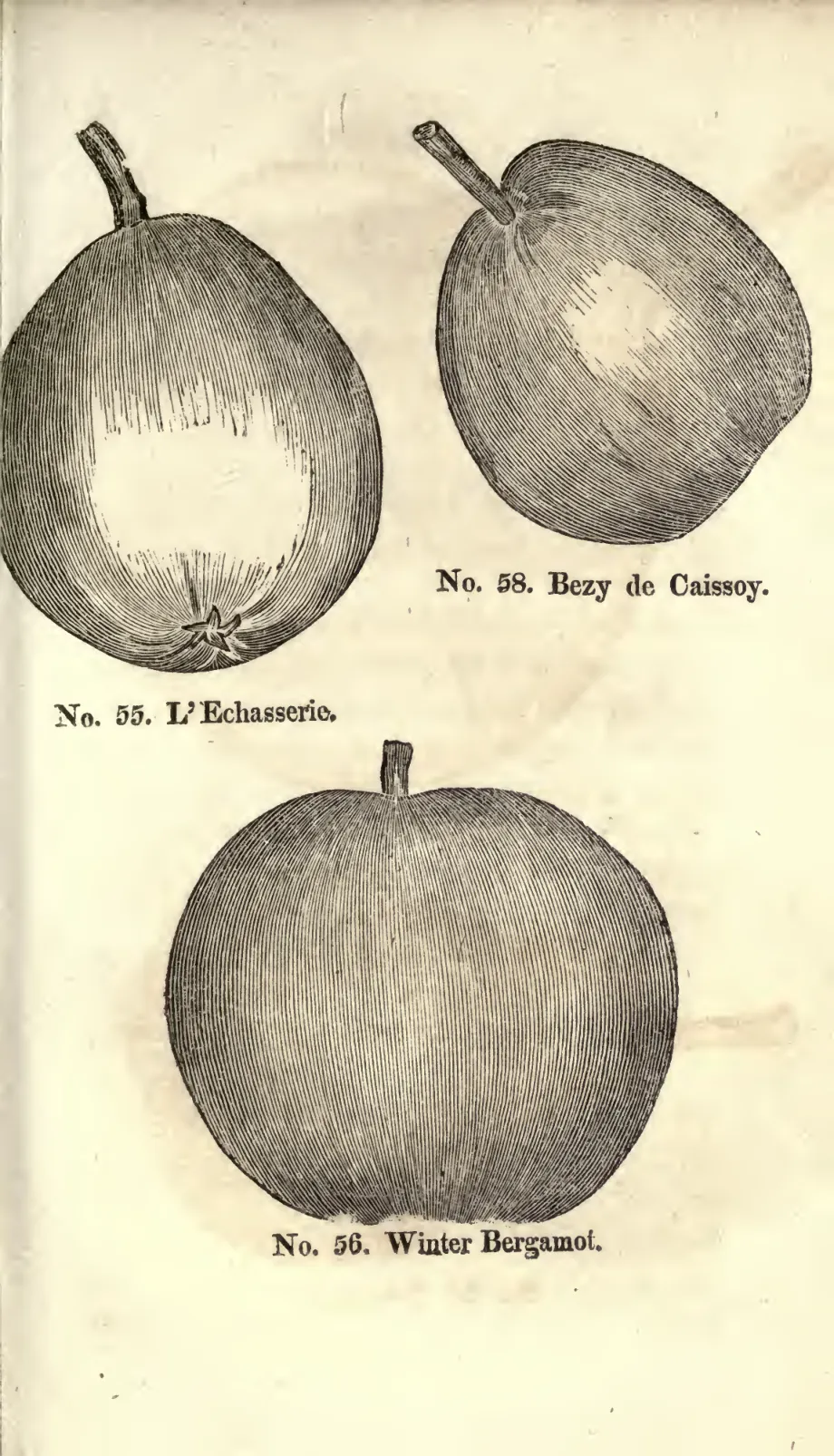
Besi de Quessoy
Origin / History
An old pear, said to have been discovered in the forest of Caissoy, in Bretagne (Downing). Merlet stated in 1675 that the variety was said to have been found originally in the forest of Quessoy near Saint-Brieuc. It was known locally as the Rousette or the Petit Boeure d'Hiver and was propagated at the beginning of the seventeenth century (Hedrick). Coxe (1817) described it as "Bezy de Caissoy". Hedrick cites Duhamel (1768) under the name Bezy de Caissoy, and Leroy (1867) and Hogg (1884) under the name Besi de Quessoy.
Tree
Hardy and very productive (Downing). Young wood slender, dull olive yellow (Downing). Fruit borne in clusters (Hedrick).
Fruit
Size: Small.
Form: Round, a little flat at the crown (Coxe); roundish pyriform (Downing); globular or ovate (Hedrick).
Stem: Straight (Coxe); short (Downing).
Cavity: Rather deep (Downing); stalk deeply planted (Coxe).
Calyx: Small and much sunk (Coxe); open (Downing).
Basin: Not described in source.
Skin: Rough (Hedrick). Green turning yellow when fully ripe, covered with clouds or spots of brown (Coxe); yellow, reddish brown in the sun (Downing); yellowish-green, much russeted (Hedrick).
Dots: Numerous russet specks (Downing).
Flesh and flavor: White (Downing, Hedrick); tender and buttery (Coxe, Downing); delicate, melting, gritty around the core (Hedrick). Sweet and aromatic (Downing); aromatic and savory (Hedrick). Juice resembles that of the Crasanne (Coxe). Quality "Very good" (Downing); "second" (Hedrick).
Core and seeds: Not described in source.
Season
November to February, the span given by Downing and by Hedrick (who has it ripening in succession from November or December). Coxe alone gives only "November" for ripening.
Uses
Not described in source.
Subtypes / Variants
Not described in source.
Other
Not described in source.
Book Sources
Described in 3 period pomological works
- Hedrick, The Pears of New York (1921)
- Coxe, A View of the Cultivation of Fruit Trees (1817) — listed as Bezy de Caissoy
- Downing, Fruits and Fruit Trees of America (1900) — listed as Bezi de Caissoy
View original book sources (3)
— William Coxe, A View of the Cultivation of Fruit Trees (1817)
- BEZY DE CAISSOY.
This fruit is small and round, a little flat at the crown; the stalk is straight and deeply planted, the eye small, and much sunk; the skin green, turning yellow when fully ripe, and covered with clouds or spots of brown—the flesh tender and buttery, the juice resembles that of the Crasanne: it ripens in November.
— A.J. Downing, The Fruits and Fruit Trees of America (1900)Bezi de Caissoy.
Bezy de Quessoy. Nutmeg Pear. Roussette d'Anjou. De Quessoy. Petite Beurre d'Hiver. Small Winter Beurré. Wilding of Caissoy. Besi de Quassoy. Terreneuvaise. Besi de Bretagne.
An old Pear, said to have been discovered in the forest of Caissoy, in Bretagne. Tree hardy and very productive. Young wood slender, dull olive yellow.
Fruit small, roundish pyriform. Skin yellow, reddish brown in sun and numerous russet specks. Stalk short, set in a rather deep cavity. Calyx open. Flesh white, tender, buttery, sweet and aromatic. Very good. November to February.
— U.P. Hedrick, The Pears of New York (1921)Besi de Quessoy.
- Leroy Dict. Pom. 1:285, fig. 1867.
- Hogg Fruit Man. 508. 1884. Bezy de Caissoy. 3. Duhamel Trait. Arb. Fr. 2:178, Pl. XXIX. 1768.
Merlet stated in 1675 that this variety was said to have been found originally in the forest of Quessoy near Saint-Brieuc. It was known locally as the Rousette or the Petit Boeure d'Hiver and was propagated at the beginning of the seventeenth century.
Fruit borne in clusters, small, globular or ovate; skin rough, yellowish-green, much russeted; flesh white, delicate, melting, gritty around the core, aromatic and savory; second; ripens in succession from Nov. or Dec. till Feb.