Beurré Audusson
Pear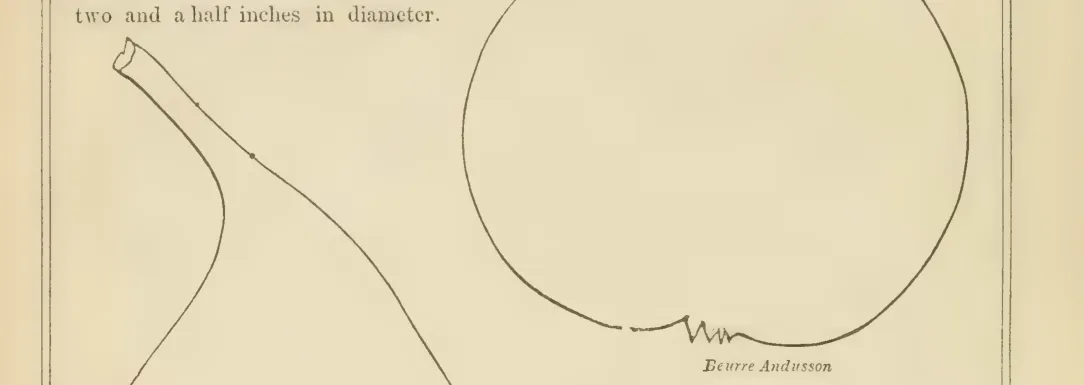
Beurré Audusson
Origin / History
Raised from seed by Anne-Pierre Audusson, Angers, France, in 1833 or 1834 (Hedrick, citing Leroy, Dictionnaire de Pomologie 1:305, fig., 1867). Described by B. Desportes in The Horticulturist (1856) under the name "Beurre Andusson".
Tree
Not described in source.
Fruit
Size: Below medium to medium. Desportes gives two and a half inches long by two and a half inches in diameter and calls it medium; Hedrick calls it below medium.
Form: Obovate, acute pyriform, tapering rather abruptly into the stalk (Desportes); pyriform, slightly obtuse, even in contour (Hedrick).
Stem: Short, stout, fleshy at the point of junction, set in an irregular manner.
Cavity: Not described in source.
Calyx: Large, open.
Basin: Shallow.
Skin: Greenish to yellowish green at maturity, with a dull red cheek on the sunny side; blushed on the side next the sun.
Dots: Numerous, russet (Desportes); large, brown (Hedrick).
Flesh and flavor: Melting, tender, juicy; flavor rich subacid, slightly perfumed with rose; quality "very good" (Desportes). Flesh semi-fine, whitish, rather melting, gritty at the center; juice sufficient, saccharine, having little flavor or perfume; "third" (Hedrick).
Core and seeds: Not described in source.
Season
Ripens from the first to the fifteenth of October (Desportes); end of August (Hedrick).
Uses
Not described in source.
Subtypes / Variants
Not described in source.
Other
Not described in source.
Book Sources
Described in 2 period pomological works
- Hedrick, The Pears of New York (1921)
- The Horticulturist (1855) — listed as Beurre Andusson
View original book sources (2)
— B. Desportes, The Horticulturist (1856)Beurre Andusson. — Size — medium, two and a half inches long by two and a half inches in diameter. Form — obovate, acute pyriform, tapering rather abruptly into the stalk. Stem — short, stout, fleshy at the point of junction, set in an irregular manner. Calyx — large open, in a shallow basin. Color — yellowish green at maturity, with a dull red cheek on the sunny side, and covered with numerous russet dots. Flesh — melting, tender, juicy. Flavor — rich sub-acid, slightly perfumed with rose. Season — ripens from the first to the fifteenth of October. Quality — "very good."
— U.P. Hedrick, The Pears of New York (1921)Beurré Audusson.
- Leroy Dict. Pom. 1:305, fig. 1867.
Raised from seed by Anne-Pierre Audusson, Angers, Fr., in 1833 or 1834. Fruit below medium, pyriform, slightly obtuse, even in contour, greenish, sprinkled with large dots of brown and blushed on the side next the sun; flesh semi-fine, whitish, rather melting, gritty at the center; juice sufficient, saccharine, having little flavor or perfume; third; end of Aug.