Black Foxwhelp
Apple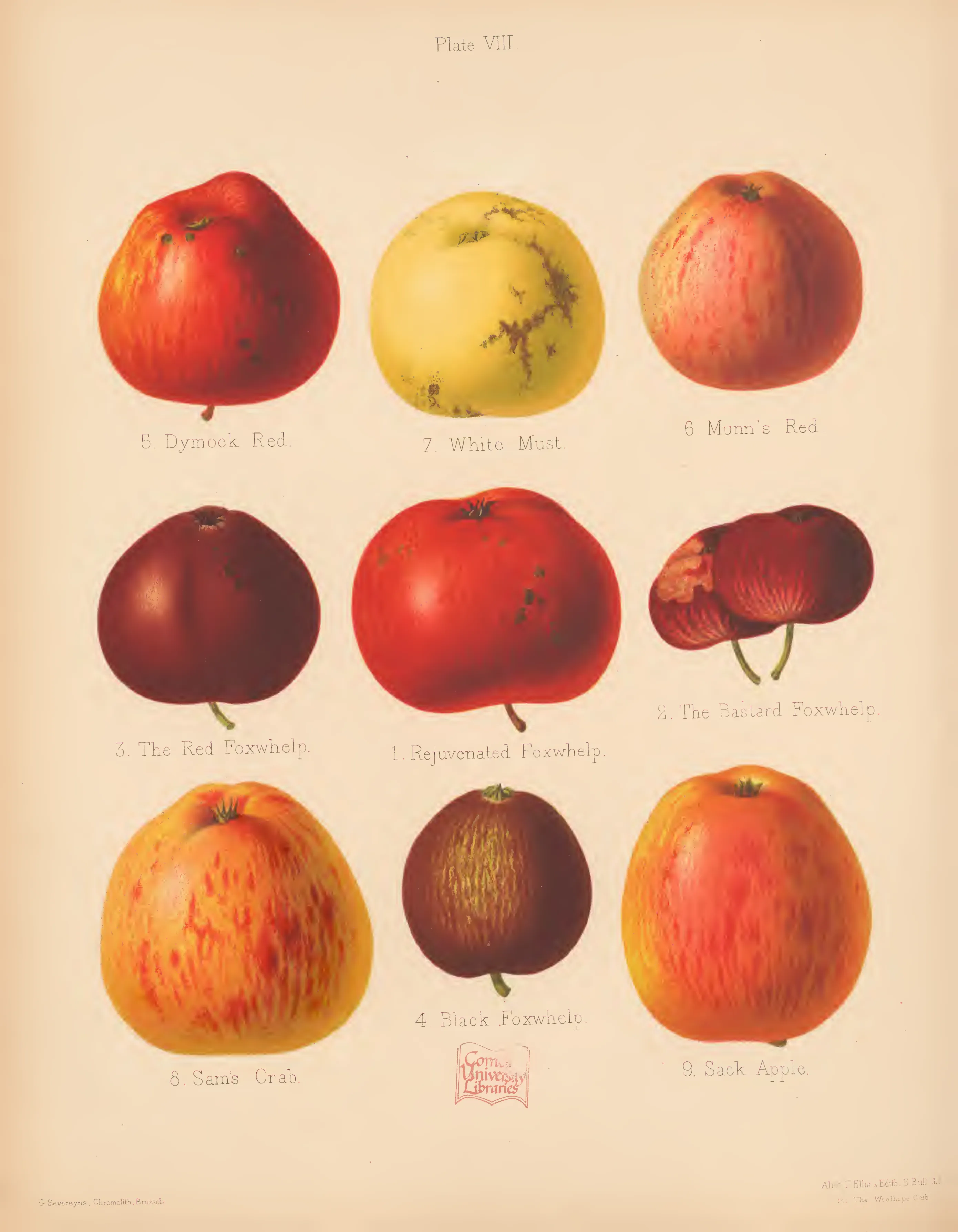
Black Foxwhelp
Origin/History
Historically known also as the Monmouthshire Foxwhelp. Very widely grown throughout Herefordshire, found in the majority of "Apple heaps" (community or estate storage arrangements).
Tree
Bears very freely. Historical assessment suggests poor long-term value — contemporary opinion held that trees should be regrafted or cut down.
Fruit
Size: Small.
Form: Roundish ovate, inclining to short conical; even in outline slightly angular towards the crown, where it is prominently plaited around the eye.
Skin: Smooth and rather shining. Dark mahogany color next the sun; on the shaded side greenish yellow. Covered with broad broken stripes of bright crimson.
Stem (Stalk): Short, set in a shallow cavity.
Calyx (Eye): Small and rather open, with rather connivent segments (segments nearly closed together). Set nearly on a level with the surface, with only a very slight depression. Tube short conical. Stamens medium.
Flesh: Yellowish, sometimes with a greenish tinge. Briskly acid.
Core: Cell structure open; cell-walls obovate.
Identification: The definite ovate shape, smooth surface, and dull color make it quite unmistakeable.
Uses
Cider apple. However, the cider made from Black Foxwhelp is thin and poor — a significant weakness in its application.
Chemistry
Chemical analysis by G. H. With, F.R.A.S. (1885):
| Property | Bastard Foxwhelp | Red Foxwhelp | Black Foxwhelp |
|---|---|---|---|
| Density of Fresh Juice | 1.042 | 1.043 | 1.038 |
| Density after 24 hours exposure | 1.042 | 1.500 | 1.040 |
| Sugar (100 parts by weight) | 7.780 | 10.010 | 6.400 |
| Tannin, Mucilage, Salts, &c. | 4.335 | 4.256 | 5.206 |
| Water | 87.885 | 85.734 | 88.394 |
The relatively low sugar content (6.400) and moderate tannin/salts (5.206) reflect its poor cider quality — lower fermentable sugars and thin body.
Season/Storage
Not described in source.
Other
Not described in source.
Book Sources
Described in 1 period pomological work
View original book sources (1)
— Woolhope Naturalists Field Club, The Herefordshire Pomona (1885)
- BLACK FOXWHELP.
[Syn : Monmouthshire Foxwhelp.]
This apple is very widely grown through the County, and is to be found in the majority of "Apple heaps." Its definite ovate shape, smooth surface, and dull colour, make it quite unmistakeable. It bears very freely, and this perhaps is its best qualification, for the cider made from it is thin and poor.
Description.—Fruit, small, roundish ovate, inclining to short conical, even in its outline slightly angular towards the crown, where it is prominently plaited round the eye. Skin, smooth and rather shining, of a dark mahogany colour next the sun, but on the shaded side it is greenish yellow, covered with broad broken stripes of bright crimson. Eye, small and rather open, with rather connivent segments, and set nearly on a level with the surface, with only a very slight depression; tube, short conical; stamens, medium. Stalk, short, set in a shallow cavity. Flesh, yellowish sometimes, with a greenish tinge, briskly acid. Cells of the core, open; cell-walls, obovate.
The sooner the trees of the Black Foxwhelp are regrafted or cut down the better.
The report of the chemical analysis of these varieties by Mr. G. H. With, F.R.A.S., is as follows :—
                      Bastard        Red          Black
                      Foxwhelp.      Foxwhelp.    Foxwhelp.
Density of Fresh Juice ... 1·042 ... 1·043 1·038 Density after 24 hours exposure ... 1·042 ... 1·500 1·040 100 parts by weight yielded of: Sugar ... 7·780 ... 10·010 6·400 Tannin, Mucilage, Salts, &c. ... 4·335 4·256 5·206 Water ... 87·885 85·734 88·394