Black Huffcap
Pear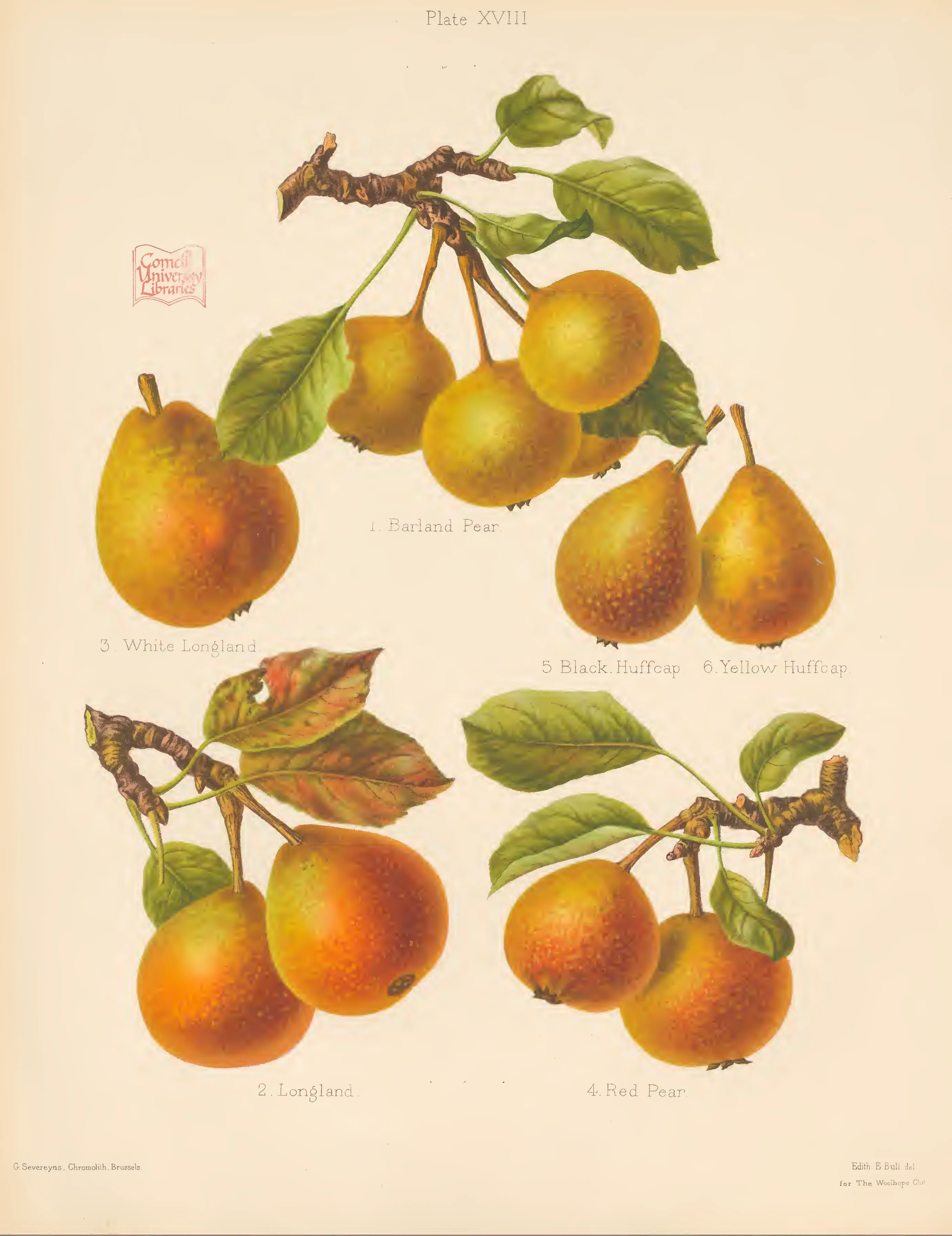
Black Huffcap
Origin/History
The Huffcap Pears have been known from the 17th century, and were thought by Mr. Knight to have been included amongst the "Choke Pears" which abounded in Herefordshire at that time. The variety is represented in Knight's Pomona Herefordiensis, Pl. xxiv., under the name of The Huffcap Pear, described there as the best of all the varieties. A well-known perry pear, it has been cultivated in Herefordshire and Worcestershire, England.
Tree
Not described in source.
Fruit
Size: Quite small (Hedrick).
Form: Oblong, obovate, sometimes elliptical (Herefordshire Pomona); described by Hedrick as pyriform or oblong-ovate. The fruit tapers gradually from the bulge both to the eye and to the stalk, and is even and regular in its outline.
Stem: Three quarters of an inch long, woody, connected with the fruit by a thickened continuation of the flesh.
Cavity: Not described in source.
Calyx/Eye: Prominently set; open, with erect segments.
Basin: Not described in source.
Skin: Olive green on the shaded side and entirely covered with dull rusty red on the side next the sun; the whole surface thickly sprinkled with large grey russet dots.
Flesh/Flavor: Yellowish green, firm, and very gritty. "The fruit is excessively harsh and austere," writes Mr. Knight, "but it becomes very sweet during the process of grinding."
Core/Seeds: Not described in source.
Season
Not described in source.
Uses
Perry production. Knight records that the perry "possesses much strength and richness, and has the credit of intoxicating more rapidly than that made from any other Pear." The variety maintains this character and is therefore one of the most esteemed perry varieties.
The chemical analysis of the juice (1879), made by Mr. G. H. With, F.R.A.S., is as follows:
| Constituent | Value |
|---|---|
| Density of fresh juice | 1.048 |
| Density after 24 hours' exposure to air | 1.051 |
| Sugar | 11.225 parts per 100 by weight |
| Tannin, Mucilage, Salts, &c. | 3.575 parts per 100 by weight |
| Water | 85.200 parts per 100 by weight |
Subtypes/Variants
Not described in source.
Other
The variety is cited in Hogg, Fruit Manual, p. 531 (1884), as noted by Hedrick.
Book Sources
Described in 2 period pomological works
View original book sources (2)
— Woolhope Naturalists Field Club, The Herefordshire Pomona (1885)5 BLACK HUFFCAP.
[Syn : Black Pear ; Brown Huffcap.]
The Huffcap Pear have been known from the 17th century, and were thought by Mr. Knight to have been included amongst the "Choke Pears," which abounded in Herefordshire at that time. This Pear is represented in Mr. Knight's Pomona Herefordiensis. Pl. xxiv., under the name of The Huffcap Pear, as the best of all the varieties.
Description.—Fruit : oblong, obovate, sometimes elliptical, tapering gradually from the bulge both to the eye and stalk ; it is even and regular in its outline. Skin : olive green on the shaded side and entirely covered with dull rusty red on the side next the sun : the whole surface thickly sprinkled with large grey russet dots. Eye : prominently set; open, with erect segments. Stalk : three quarters of an inch long, woody, connected with the fruit by a thickened continuation of the flesh. Flesh : yellowish green, firm, and very gritty.
"The fruit is excessively harsh and austere," says Mr. Knight, "but it becomes very sweet during the process of grinding ; its Perry possesses much strength and richness, and has the credit of intoxicating more rapidly than that made from any other Pear.
It maintains the same character at the present time and is therefore one of the most esteemed varieties.
The chemical analysis of the juice of this Pear (1879) made by Mr. G. H. With, F.R.A.S., is as follows :—
Density of fresh juice ... 1·048 Ditto after 24 hours exposure to air 1·051 One hundred parts by weight contained :— Sugar 11·225 Tannin, Mucilage, Salts, &c., 3·575 Water 85·200 100
— U.P. Hedrick, The Pears of New York (1921)Black Huffcap.
- Hogg Fruit Man. 531. 1884.
A well-known perry pear cultivated in Herefordshire and Worcestershire, Eng. Fruit quite small, pyriform or oblong-ovate, olive-green on the shaded side and covered with dull rusty red on the sun-exposed side; flesh yellowish-green, firm and very gritty.