Black Oxford
Apple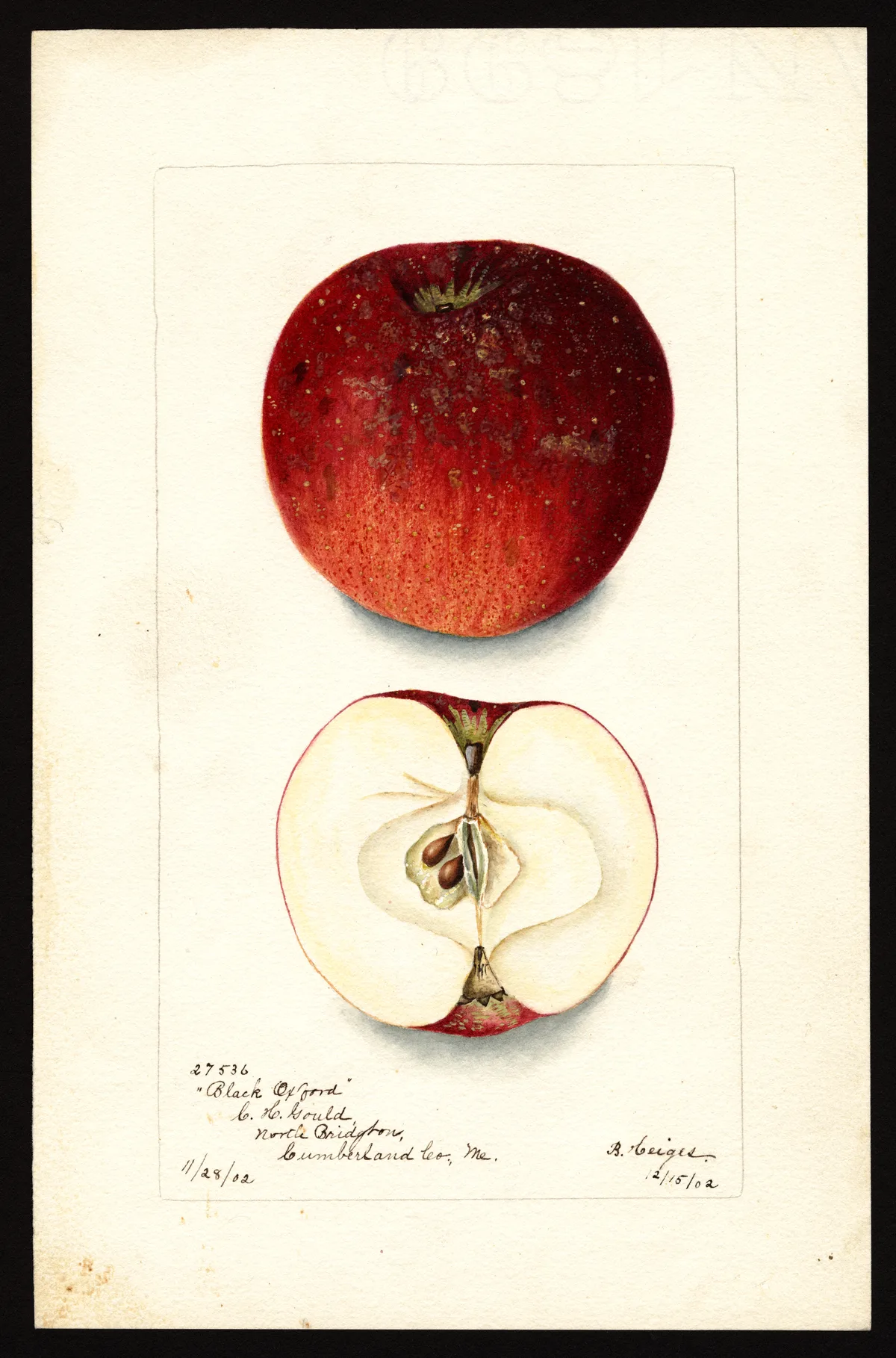
USDA Pomological Watercolor Collection
Black Oxford
Origin / History
Black Oxford originated in Maine. Downing writes that it is "by many highly esteemed" there, "especially as a good keeper and great bearer." Hansen likewise records it as esteemed in Maine for its long keeping and productiveness.
Tree
Productive; a great bearer in Maine. At Cedar Falls, Iowa, it has done well top-grafted (Hansen).
Fruit
Size: Medium. Elliott alone calls it small.
Form: Roundish oblate, slightly conic.
Stem: Long; slender (Elliott), curved (Hansen).
Cavity: Deep and russeted, the russet sometimes extending out over the base in large irregular patches (Hansen).
Calyx: Open in Hansen's account, with segments erect and convergent; half open in Elliott's. Tube funnel-shaped; stamens median (Hansen).
Basin: Shallow, wrinkled, somewhat leather-cracked (Hansen); slightly russeted (Elliott).
Skin: Yellow, nearly covered with red. Downing describes the red as shades of red. Hansen calls it a dark, solid brownish red overlaid with gray net-veining, "a peculiar color."
Dots: Numerous and light-colored. Hansen calls them conspicuous and notes a few large russet dots.
Flesh and flavor: Whitish, compact or firm. The flesh runs from not juicy (Elliott) to moderately juicy (Hansen). The flavor is mild subacid. Downing and Hansen both rate it "good."
Core and seeds: Core closed, irregular in outline; cells ovate (Hansen).
Season
March to May. A long keeper.
Uses
Not described in source.
Subtypes / Variants
Not described in source.
Other
Not described in source.
Book Sources
Described in 4 period pomological works
Nursery Catalog Sources
Found in 4 catalogs (1900–1913) from Illinois, Washington
- Central Experimental Farm , Dominion Department of Agriculture, Agassiz, British Columbia (under test; Bulletin No. 3, Second Series) — 1900
- Benjamin Buckman (personal inventory) , Farmingdale , Illinois — 1901
- Vineland Nurseries Company , Clarkston , Washington — 1912
- Benjamin Buckman (personal inventory) , Farmingdale , Illinois — 1913
View original book sources (4)
— F.R. Elliott, The Western Fruit Book (1865)Black Oxford. Fruit small, roundish, yellowish, nearly covered with red, light dots; stem, long, slender; calyx, half open; basin, slightly russeted; flesh, whitish, compact, not juicy, sub-acid. March to May.
— A.J. Downing, The Fruits and Fruit Trees of America (1900)Black Oxford.
Originated in Maine, where it is by many highly esteemed, especially as a good keeper and great bearer.
Fruit medium, roundish oblate, slightly conic, yellow, nearly covered with shades of red, numerous light-colored dots. Flesh whitish, compact, not very juicy, mild subacid. Good. March to May.
— N.E. Hansen, A Study of Northwestern Apples (1902)Black Oxford—Origin, Maine—There esteemed for its long keeping and productiveness. At Cedar Falls, Iowa, it has done well top-grafted. Fruit medium, roundish oblate, slightly conical; surface yellow, nearly covered with dark solid brownish red, overlaid with gray net-veining; a peculiar color; dots numerous; conspicuous, light, a few large russets dots; cavity deep, russeted, the russet sometimes extending out over the base in large irregular patches; stem long, curved; basin shallow, wrinkled, somewhat leather-cracked; calyx open, segments erect convergent; core closed, outline irregular; cells ovate; tube funnel-shape; stamens median; flesh whitish, firm, moderately juicy, mild subacid, good. March to May.
— J.L. Budd & N.E. Hansen, American Horticultural Manual, Part II: Systematic Pomology (1914)Black Oxford. — Origin, Maine; there esteemed for its long keeping and productiveness ; at Cedar Falls, Iowa, it has done well top-grafted. Fruit medium, roundish oblate, slightly conical; surface yellow, nearly covered with dark solid brownish red, overlaid with gray net-veining, a peculiar color; dots numerous, conspicuous, light, a few large russet dots; cavity deep, russeted, the russet sometimes extending out over base in large irregular patches; stem long, curved; basin shallow, wrinkled, somewhat leather-cracked; calyx open; segments erect convergent. Core closed, outline irregular; cells ovate; tube funnel-shaped; stamens median; flesh whitish, firm, moderately juicy, mild subacid, good. March to May.