Bon Chretien D'Espagne
Pear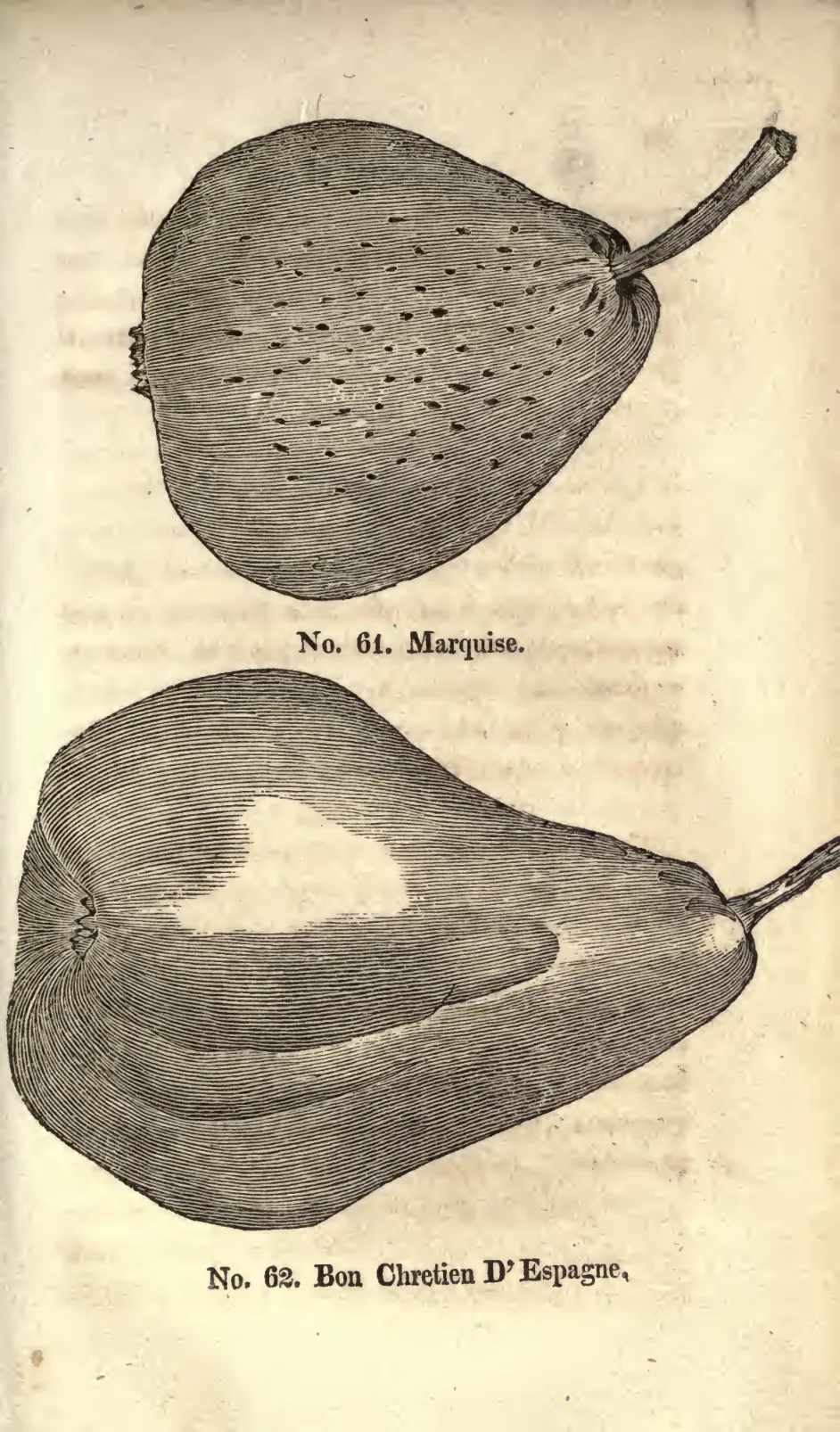
Bon Chretien D'Espagne
Origin / History
A very old pear (Downing) of ancient and uncertain origin (Hedrick). Merlet described it in 1675 and La Quintinye in 1692. Duhamel described and figured it in 1768 (Traité des Arbres Fruitiers, Pl. 46). Mas figured it in Le Verger (1866–73, fig. 64). Hogg's Fruit Manual (1884) entered it under the name Spanish Warden. Coxe (1817) described it as No. 62, "Bon Chretien D'Espagne, or Good Christian of Spain," with an engraved plate. Hedrick calls it well known, citing Messrs. Simon-Louis of Metz, Lorraine, who gave it some forty synonyms in their 1895 catalog.
Tree
A good bearer (Downing).
Fruit
Size: Large to very large (Coxe).
Form: Pyriform and long, gradually lessening toward the stem, a little curved, and truncated about the foot of the stalk (Coxe). Very ventriculous in the lower half, which is more or less bossed, the upper part narrowing to an obtuse end (Hedrick).
Stem: Large and very long (Coxe).
Cavity: Not described in source.
Calyx: Eye small (Coxe).
Basin: Deep and wide, bordered with ridges that extend toward the middle of the fruit (Coxe).
Skin: Thick (Hedrick). Greenish yellow, changing at maturity to yellow or deep yellow, pale yellow on the shaded side when ripe. A fine, lively, brilliant red cheek on the side exposed to the sun, which Hedrick finds highly colored with vivid red. Marked with fawn-russet (Hedrick).
Dots: Brown to reddish brown specks; fawn-russet (Hedrick).
Flesh and flavor: Flesh white, crisp or half breaking; coarse, breaking, and juicy, with a pleasant, brisk flavor and musky aroma (Hedrick). Coxe finds it blended with grains of green, "dry and hard, or breaking and tender, according to the season and soil," the juice mild and sweet when the tree grows on a favorable soil and is well exposed.
Core and seeds: Not described in source.
Season
November to March, chiefly November through January. Coxe has it ripening in November and December. Hedrick carries it into January "and even Mar."
Uses
A cooking pear, highly valued for cooking (Downing). Hedrick rates it "third for the table, first for the kitchen."
Subtypes / Variants
Not described in source.
Other
Not described in source.
Book Sources
Described in 4 period pomological works
- Coxe, A View of the Cultivation of Fruit Trees (1817) — listed as No. 62. Bon Chretien D'Espagne
- Hedrick, The Pears of New York (1921) — listed as Bon-Chrétien d'Espagne
- Downing, Fruits and Fruit Trees of America (1900) — listed as Spanish Bon Chrétien
- Thomas, The American Fruit Culturist (1903) — listed as Spanish Bon Chrétien
Nursery Catalog Sources
Found in 2 catalogs (1849–1900) from Massachusetts
- Hovey & Co. , Cambridge , Massachusetts — 1849 — listed as Spanish Bon Chrétien
- Central Experimental Farm , Dominion Department of Agriculture, Agassiz, British Columbia (under test; Bulletin No. 3, Second Series) — 1900
View original book sources (4)
— William Coxe, A View of the Cultivation of Fruit Trees (1817)[Text unreadable — pages 339–340 are the reverse sides of engraved plate pages; heavy ink bleed-through from the illustrations on pages 338 and 341 obscures the text entirely. Only the plate caption 'No. 62. Bon Chretien D'Espagne' on page 338 is legible.]
[Additional entry in this volume: "BON CHRETIEN D'ESPAGNE, OR GOOD CHRISTIAN OF SPAIN", pp. 342–342]
- BON CHRETIEN D'ESPAGNE, OR GOOD CHRISTIAN OF SPAIN.
This pear is very large and long, gradually lessening towards the stem, a little curved and truncated about the foot of the stalk, which is large and very long—the eye is small, and planted in a deep and wide hollow, bordered with ridges which extend towards the middle of the fruit; the skin is spotted with dots, of a brown colour, of a fine lively red towards the sun, with a pale yellow on the shady side when ripe; the flesh is white, blended with grains of green, dry and hard, or breaking and tender, according to the season and soil—the juice is mild and sweet when growing on a favourable soil, and well exposed; it ripens in November and December.
— A.J. Downing, The Fruits and Fruit Trees of America (1900)SPANISH BON CHRÉTIEN.
Bon Chrétien d'Espagne. Bon Chrétien doré d'Espagne. Spina. Van Dyck. De Janvry. Compagnie d'Ostende. Bon Chrétien d'Automne. Janvry. Gratiole d'Automne. Grosse Grande Bretagne dorée. Président d'Espagne. Vermillon d'Espagne d'Hiver. Safran d'Automne. Gracioli de la Toussaint. Safran rosat d'Automne. Vandyck. Bon Chrétien Jaune d'Automne. Good Christian of Spain. Blanche. Spanish Warden. Grosse Grande Bretagne. Autumn Bon Chrétien. Bon Chrétien Spina.
A very old variety. Tree a good bearer, and the fruit highly valued for cooking.
Fruit large, pyriform. Skin at maturity deep yellow, with a brilliant red cheek, and dotted with reddish brown specks. Flesh white, crisp, or half breaking, good for cooking. December to January.
— John J. Thomas, The American Fruit Culturist (1903)Bon Chrétien, Spanish. Large, pyriform, deep yellow and red; half breaking—cooking.
— U.P. Hedrick, The Pears of New York (1921)Bon-Chrétien d'Espagne.
- Duhamel Trait. Arb. Fr. 2:216, Pl. 46. 1768. 2. Mas Le Verger 1:131, fig. 64. 1866-73. Spanish Warden. 3. Hogg Fruit Man. 648. 1884.
The origin of Bon-Chrétien d'Espagne or Spanish Warden is ancient and uncertain. Merlet described it in 1675, and so did La Quintinye, in 1692. It was well known; for Messrs. Simon-Louis of Metz, Lorraine, gave it some forty synonyms in their 1895 catalog. Fruit large, pyriform, very ventriculous in its lower half where it is more or less bossed, the upper part narrows to an obtuse end; skin thick, greenish-yellow changing to yellow, dotted and marked with fawn-russet, and highly colored with vivid red on the side exposed to the sun; flesh white, coarse, breaking, juicy, with a pleasant, brisk flavor and musky aroma; third for the table, first for the kitchen; Nov., Jan. and even Mar.