Bromley
Apple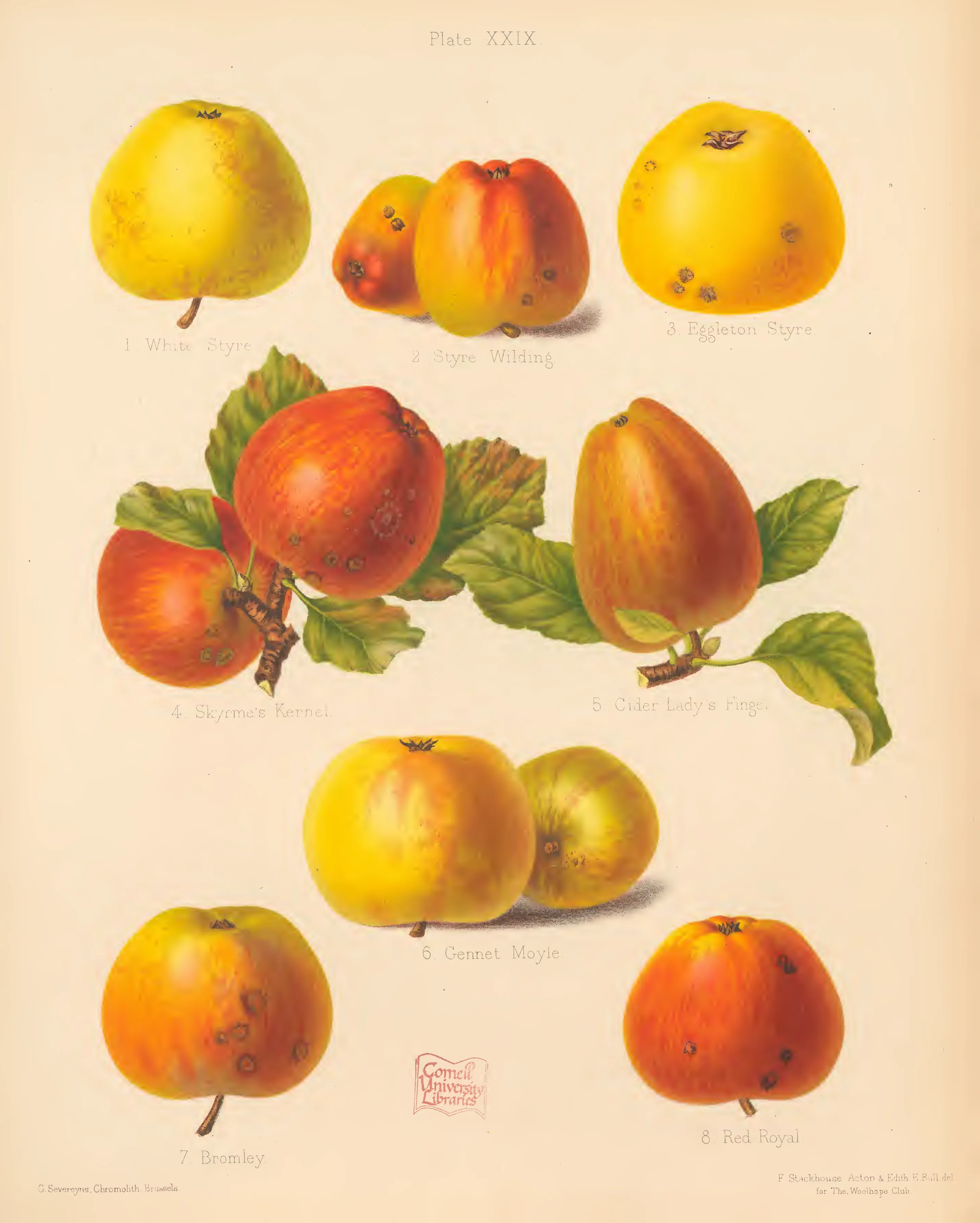
Bromley
Origin / History
A very old variety spread through the orchards of Gloucestershire and Herefordshire, but not abundant in the latter county. It is without any known history. Held in high esteem in Gloucestershire, where growers maintain it in their orchards for its market and keeping merits.
Tree
Tree grows to a large size and spreads broadly. Considered rather shy in bearing, and for this reason not much propagated of late years.
Fruit
Size: Medium.
Form: Roundish and flattened, very uneven and angular on the sides; knobbed both at the crown and the base.
Stem: Stalk straight and stout, from half to three quarters of an inch long.
Cavity: Deep.
Calyx: Eye closed, with broad, flat, convergent segments. Tube funnel-shaped; stamens basal.
Basin: Deep and angular.
Skin: Bright yellow, much covered with firm broken streaks of crimson nearly over the whole surface, but especially where exposed to the sun; russety all over the base, whence it extends in lines up the sides.
Dots: Not described in source.
Flesh and flavor: Flesh yellowish, firm and somewhat woolly in texture. Juice pale, plentiful, fairly sweet, and with a brisk acidity.
Core and seeds: Cells of the core open.
Season
A late apple; keeps well.
Uses
Cooks well; as a sauce apple unsurpassed. Sells well in the market. The analysis of the juice does not indicate any great merit as a cider apple, but some in Gloucestershire think it makes a strong good cider next to Skyrmes Kernel, strong but not sweet. Mr. With's analysis (season 1880): density of fresh juice 1.033, and 1.035 after 24 hours' exposure to air; one hundred parts by weight of fresh juice yield sugar 12.10, tannin, mucilage, salts, etc. 1.30, water 86.6.
Subtypes / Variants
Not described in source.
Other
Not described in source.
Book Sources
Described in 1 period pomological work
View original book sources (1)
— Woolhope Naturalists Field Club, The Herefordshire Pomona (1885)BROMLEY.
[Syn : Old Bromley.]
A very old variety spread through the Orchards of Gloucestershire and Herefordshire, but not abundant in the latter county. It is without any known history.
Description.—Fruit: medium size, roundish and flattened, very uneven and angular on the sides ; and knobbed both at the crown and the base. Skin : bright yellow, much covered with firm broken streaks of crimson nearly over the whole surface, but especially where exposed to the sun ; russety all over the base, whence it extends in lines up the sides. Eye : closed, with broad, flat, convergent segments, set in a deep angular basin : tube, funnel shaped : stamens, basal. Stalk : straight and stout, from half to three quarters of an inch long, set in a deep cavity. Flesh : yellowish, firm and somewhat woolly in texture. Juice : pale, plentiful, fairly sweet, and with a brisk acidity. Cells of the core open.
Mr. With's analysis of the Bromley Apple (season 1880), is as follows :— Density of fresh juice ... ... ... ... 1·033 Ditto after 24 hours exposure to air... ... ... 1·035 One hundred parts by weight of fresh juice yield :— Sugar ... ... ... ... ... 12·10 Tannin, Mucilage, Salts, &c. ... ... ... 1·30 Water ... ... ... ... ... 86·6
The analysis of the juice of this fruit does not indicate any great merit as a cider apple, but it is held in high esteem in Gloucestershire where some think it makes a strong good cider next to Skyrmes Kernel, strong but not sweet. It cooks well ; and as a sauce apple is unsurpassed.
It is a late apple ; keeps well ; and will sell well in the market—all great merits, that no doubt enable it to maintain its place in the esteem of the growers.
The tree grows to a large size and spreads broadly, but it is considered rather shy in bearing, and for this reason has not been much propagated of late years.