Buff
Apple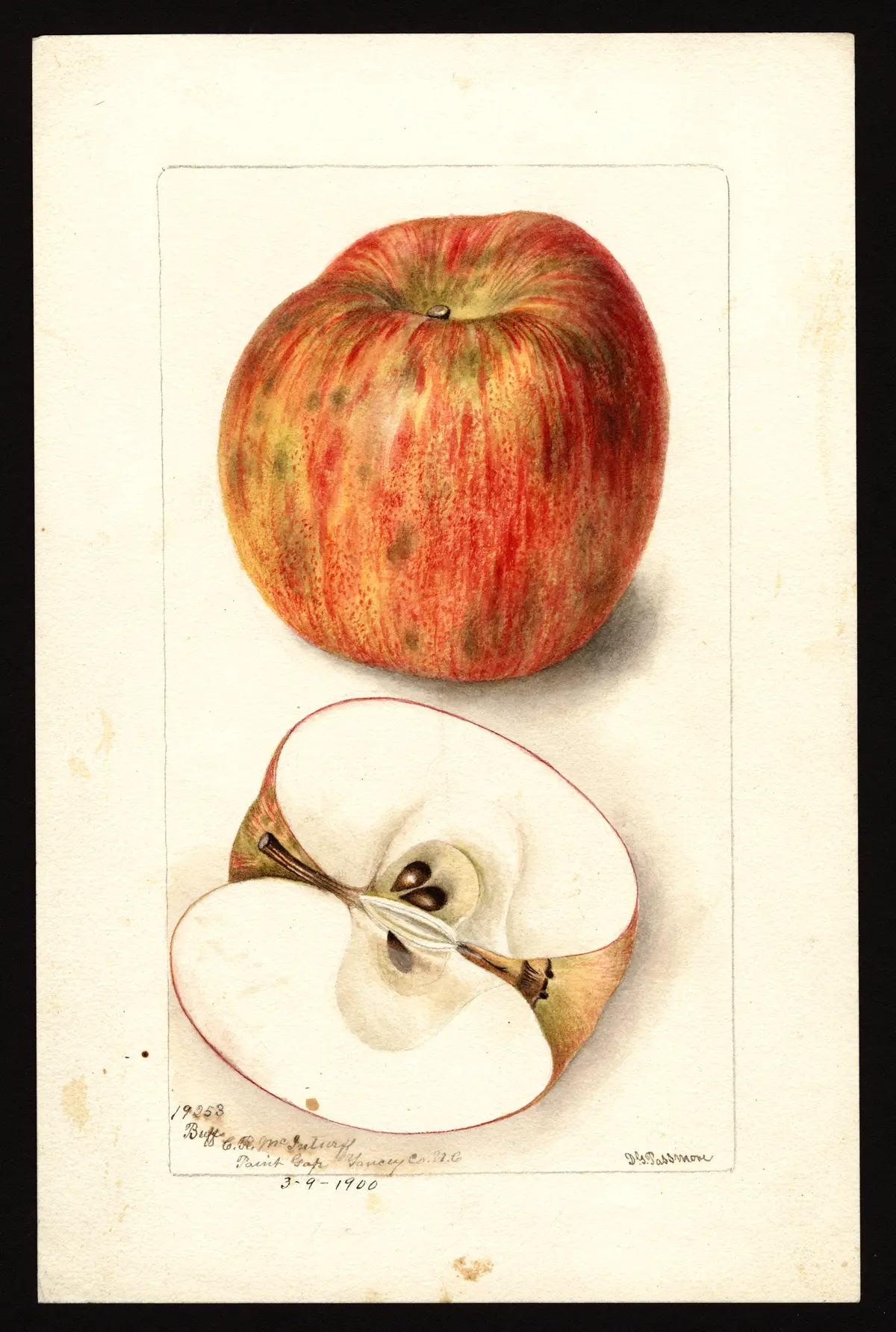
USDA Pomological Watercolor Collection
Origin & History
Origin uncertain. Much valued at the South (Thomas).
Both Warder and Elliott attribute their descriptions to White's Gardener (via Downing in Warder's case, directly cited in Elliott's).
Tree
Vigorous, erect.
Fruit
Size: Very large (Warder, Elliott). Large (Thomas).
Form: Roundish flattened and slightly irregular (Warder) or slightly angular (Elliott). Thomas describes it as round, oblate, smooth.
Skin: Thick, yellow, striped and shaded with red, very dark next the sun, marked with a few greenish russet spots (Warder, Elliott). Thomas describes it as smooth, distinctly striped with light and dark red.
Stem: Three-fourths of an inch long, in a medium cavity (Warder, Elliott).
Cavity: Medium (Warder, Elliott). Broad and deep (Thomas).
Calyx: In a large, irregular basin (Warder, Elliott).
Basin: Large, irregular (Warder, Elliott). Round, furrowed (Thomas).
Flesh & Flavor: White, and when fully ripened, tender and excellent, sometimes indifferent (Warder, Elliott). Thomas describes the flesh as white, tender, sub-acid, mild, agreeable, "good," or perhaps "very good," sometimes poor.
Core & Seeds: Not described in source.
Season
November to March.
Uses
Not described in source.
Subtypes & Variants
Not described in source.
Other
The Encyclopedia of Practical Horticulture (1914) lists Buff in a variety-characteristic table only:
Description absent; variety present in variety-characteristic table.
Buff. L rob yr G f W 1* 4*
Book Sources
Described in 4 period pomological works
View original book sources (4)
— John A. Warder, American Pomology: Apples (1867)Buff.
For description of this fruit I take Downing's quotation from White's Gardener:
"Origin uncertain; Tree vigorous, erect; Fruit very large, irregular, roundish flattened and slightly irregular; Skin thick, yellow, striped, and shaded with red, very dark next the sun, marked with a few greenish russet spots; Stem three-fourths of an inch long, in a medium cavity; Calyx in a large, irregular basin; Flesh white, and when fully ripened, tender and excellent, sometimes indifferent; November to March."
— Granville Lowther (ed.), Encyclopedia of Practical Horticulture (1914)Buff. L rob yr G f W 1* 4*
— F.R. Elliott, The Western Fruit Book (1865)Buff. Granny Buff. Origin, uncertain. Tree, vigorous, erect. Fruit, very large, irregular, roundish flattened, and slightly angular ; skin, thick, yellow, striped, and shaded with red, very dark next the sun, marked with a few greenish russet spots ; stem, three-fourths of an inch long, in a medium cavity ; calyx, in a large, irregular basin ; flesh, white, and when well ripened, tender and excellent, sometimes indifferent. November to March. (White's Gard.)
— John J. Thomas, The American Fruit Culturist (1903)Buff. Large, round, oblate, smooth; distinctly striped with light and dark red; cavity broad and deep; basin round, furrowed; flesh white, tender, sub-acid, mild, agreeable, "good," or perhaps "very good," sometimes poor. Much valued at the South.