Buff
Apple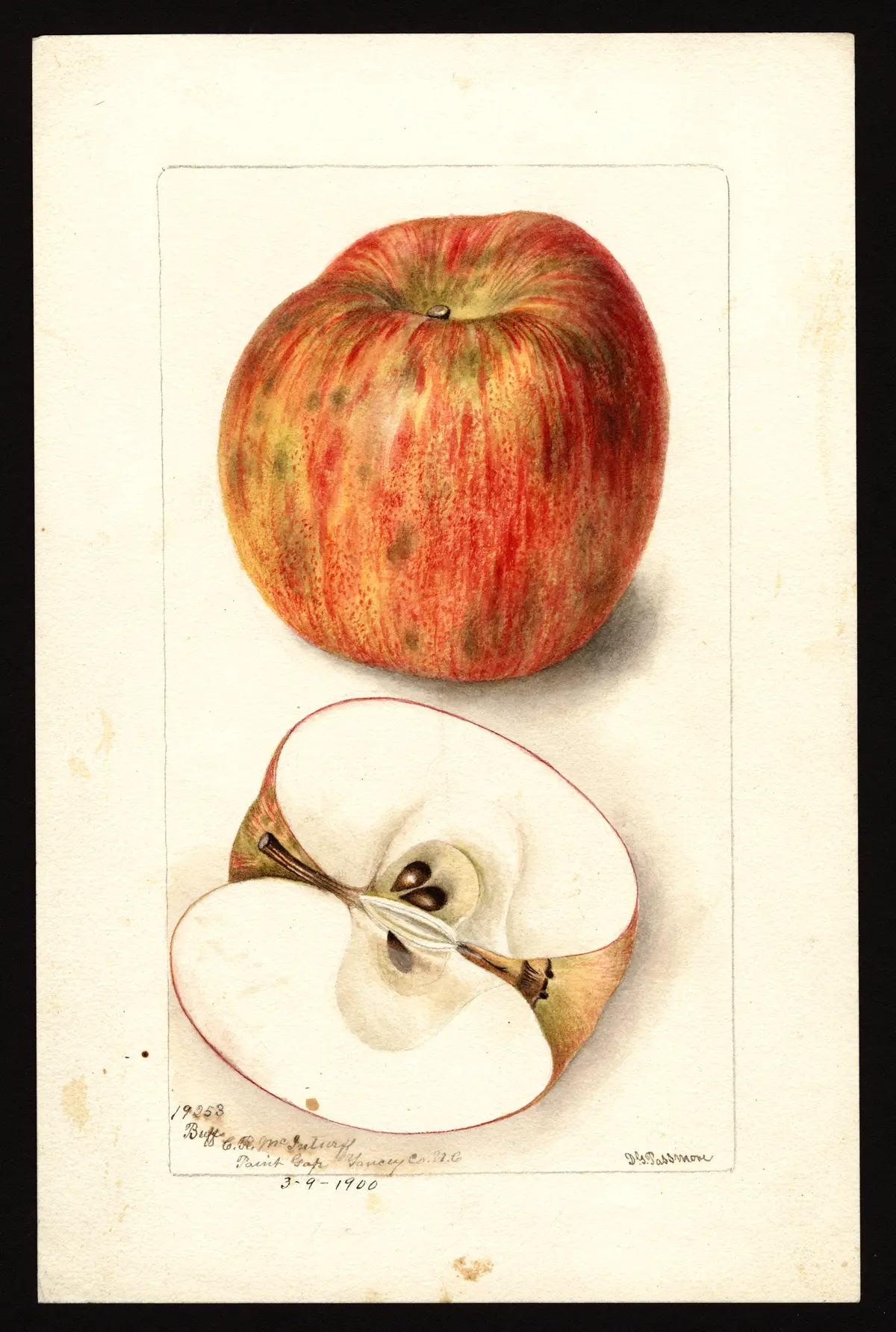
USDA Pomological Watercolor Collection
Buff
Origin / History
Origin uncertain (Warder, citing Downing's quotation from White's Gardener; Elliott). Elliott also records the name "Granny Buff" in association with this variety.
Tree
Vigorous, erect (Warder, Elliott).
Fruit
Size and Form
Very large; irregular, roundish flattened, and slightly irregular (Warder) / slightly angular (Elliott). Thomas describes it as large, round, oblate, and smooth. Lowther describes it as large and roundish oblate in form.
Stem
Three-fourths of an inch long (Warder, Elliott).
Cavity
Medium (Warder, Elliott); broad and deep (Thomas).
Calyx
Not described in source.
Basin
Large and irregular (Warder, Elliott); round and furrowed (Thomas).
Skin
Thick, yellow, striped and shaded with red, very dark next the sun, marked with a few greenish russet spots (Warder, Elliott). Thomas describes it as distinctly striped with light and dark red. Lowther describes the skin as yellow-red.
Flesh and Flavor
Flesh white. When fully ripened (Warder) / well ripened (Elliott), tender and excellent, sometimes indifferent. Thomas: white, tender, sub-acid, mild, agreeable, "good," or perhaps "very good," sometimes poor. Quality good (Lowther).
Core and Seeds
Not described in source.
Season
November to March (Warder, Elliott); winter (Lowther).
Uses
Family use (Lowther). Much valued at the South (Thomas).
Subtypes / Variants
Not described in source.
Other
Reported by 1 station in the Northern Division (also reported in another division) and 4 stations in the Central Division (also reported in another division); not reported in the Southern Division (Lowther).
Book Sources
Described in 4 period pomological works
View original book sources (4)
— John A. Warder, American Pomology: Apples (1867)Buff.
For description of this fruit I take Downing's quotation from White's Gardener:
"Origin uncertain; Tree vigorous, erect; Fruit very large, irregular, roundish flattened and slightly irregular; Skin thick, yellow, striped, and shaded with red, very dark next the sun, marked with a few greenish russet spots; Stem three-fourths of an inch long, in a medium cavity; Calyx in a large, irregular basin; Flesh white, and when fully ripened, tender and excellent, sometimes indifferent; November to March."
— Granville Lowther (ed.), Encyclopedia of Practical Horticulture (1914)Buff is large, roundish oblate in form, with yellow-red skin. Quality is good. Use is family. Season is winter. Reported by 1 station in the Northern Division (also reported in another division) and 4 stations in the Central Division (also reported in another division). Southern Division: not reported.
— F.R. Elliott, The Western Fruit Book (1865)Buff. Granny Buff. Origin, uncertain. Tree, vigorous, erect. Fruit, very large, irregular, roundish flattened, and slightly angular ; skin, thick, yellow, striped, and shaded with red, very dark next the sun, marked with a few greenish russet spots ; stem, three-fourths of an inch long, in a medium cavity ; calyx, in a large, irregular basin ; flesh, white, and when well ripened, tender and excellent, sometimes indifferent. November to March. (White's Gard.)
— John J. Thomas, The American Fruit Culturist (1903)Buff. Large, round, oblate, smooth; distinctly striped with light and dark red; cavity broad and deep; basin round, furrowed; flesh white, tender, sub-acid, mild, agreeable, "good," or perhaps "very good," sometimes poor. Much valued at the South.