Bunker Hill
Apple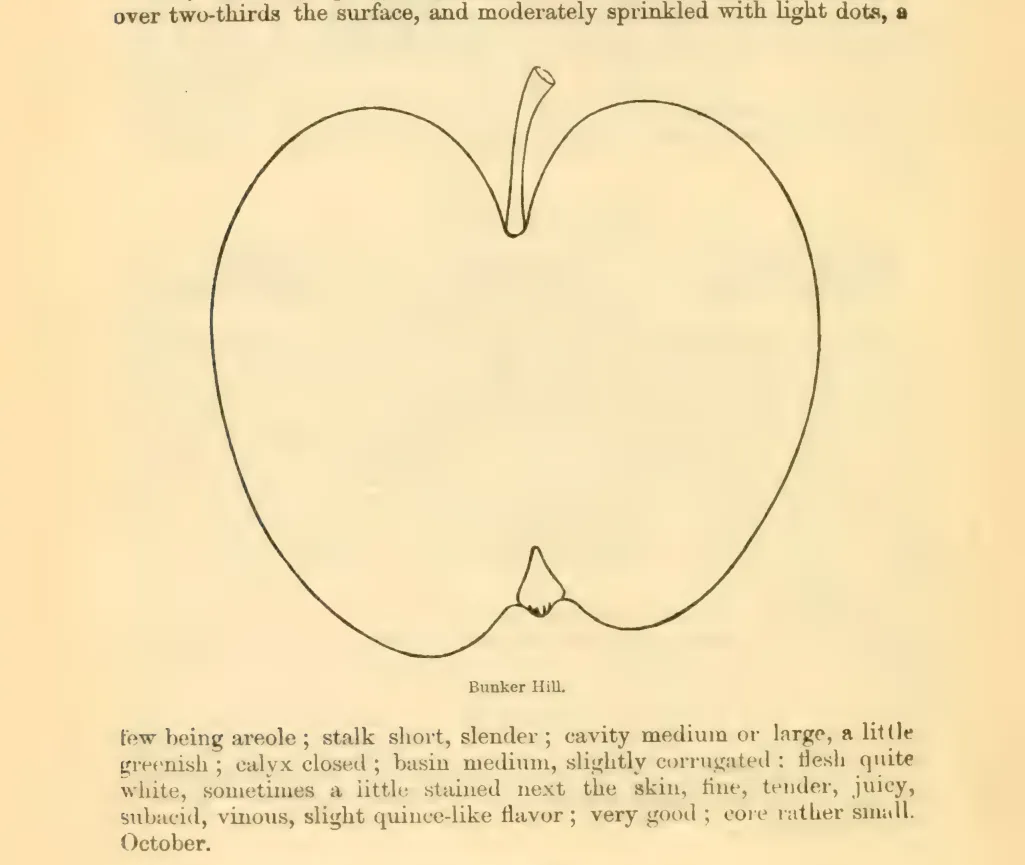
Bunker Hill
Origin/History
Originated in the orchard of Dr. Paige, Dryden, Tompkins County, New York. (Downing refers to "the late Dr. Paige.") The variety has been planted to some extent in Central New York and is regarded by some fruit growers in that region as a profitable commercial sort.
Tree
The tree is large, upright spreading, vigorous to moderately vigorous, with long, spreading, moderately stout twigs. It is hardy, healthy, and medium to long-lived. Downing describes it as a healthy, rapid grower and an early and abundant bearer, valued where known. Beach characterizes it as a reliable cropper, usually bearing heavy crops biennially.
Fruit
Size and Form: Medium, roundish conical, regular.
Stem: Short, slender.
Cavity: Medium or large, a little greenish.
Calyx: Closed.
Basin: Medium, slightly corrugated.
Skin: Pale whitish yellow, shaded, mottled, striped, and splashed with two shades of red, rather thinly over two-thirds of the surface, and moderately sprinkled with dots, a few being areole. [Note: Downing (1900) describes the dots as "bright"; Beach (1905), citing the 1872 Downing edition, gives "light."]
Flesh/Flavor: Quite white, sometimes a little stained next the skin; fine, tender, juicy, subacid, vinous, with a slight quince-like flavor. Quality: very good.
Core/Seeds: Core rather small.
Season
Downing gives October. Beach places the fruit in season from mid-autumn to early winter.
Uses
Good either for dessert or culinary uses.
Subtypes/Variants
Not described in source.
Other
Not described in source.
Book Sources
Described in 2 period pomological works
View original book sources (2)
— A.J. Downing, The Fruits and Fruit Trees of America (1900)Bunker Hill.
Originated in the orchard of the late Dr. Paige, of Dryden, New York. Tree a healthy, rapid grower, an early and abundant bearer, and valued where known.
Fruit medium, roundish conical, regular; skin pale whitish yellow, shaded, mottled, striped and splashed with two shades of red, rather thinly over two-thirds the surface, and moderately sprinkled with bright dots, a few being areole; stalk short, slender; cavity medium or large, a little greenish; calyx closed; basin medium, slightly corrugated; flesh quite white, sometimes a little stained next the skin, fine, tender, juicy, subacid, vinous, slight quince-like flavor; very good; core rather small. October.
— S.A. Beach, The Apples of New York, Vol. 2 (1905)BUNKER HILL.
REFERENCE. 1. Downing, 1872:4 app. fig.
SYNONYMS. None.
This variety has been planted to some extent in Central New York and is regarded by some fruit growers in that region as a profitable commercial sort. The tree is large, upright spreading, vigorous to moderately vigorous with long, spreading, moderately stout twigs. It is hardy, healthy, medium to long-lived and a reliable cropper, usually bearing heavy crops biennially. The fruit is subacid and good either for dessert or culinary uses. It is in season from mid-autumn to early winter.
Historical. Originated in the orchard of Dr. Paige, Dryden, Tompkins county, N. Y. (1).
FRUIT (1). "Fruit medium, roundish conical, regular; skin pale whitish-yellow shaded, mottled, striped and splashed with two shades of red, rather thinly over two-thirds of the surface, and moderately sprinkled with light dots, a few being areole; stalk short, slender; cavity medium or large, a little greenish; calyx closed; basin medium, slightly corrugated; flesh quite white, sometimes a little stained next the skin, fine, tender, juicy, subacid, vinous, slight quince-like flavor; very good; core rather small."