BURLINGTON PIPPIN
Apple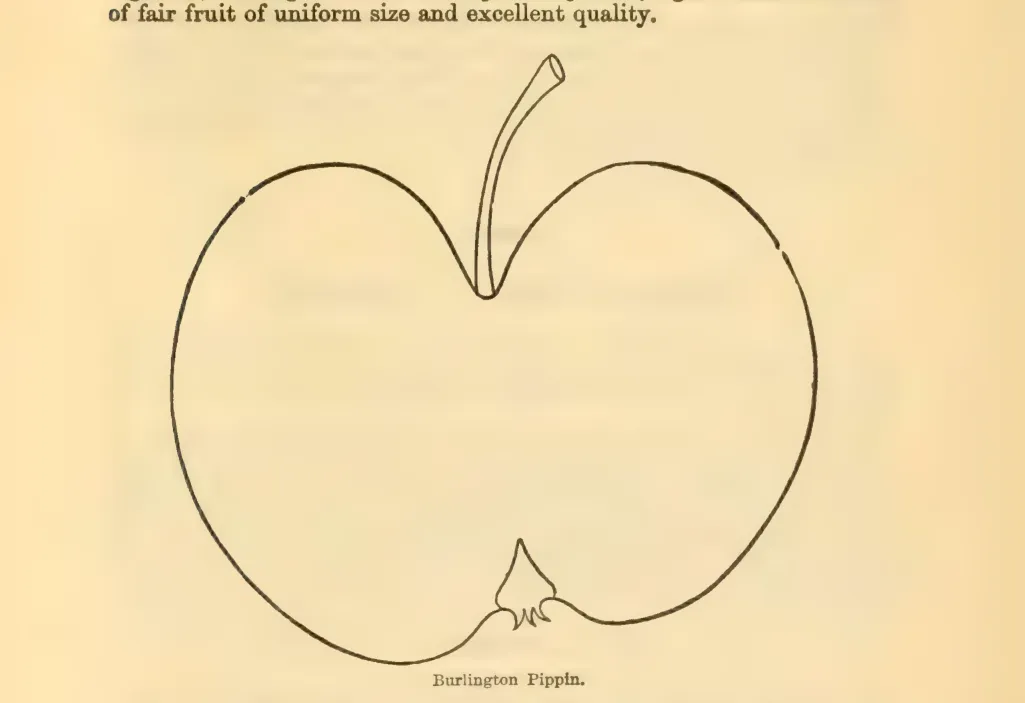
BURLINGTON PIPPIN
Origin/History
The sources disagree on the geographic origin of BURLINGTON PIPPIN. Downing (1900) states the origin is unknown but supposed to be Burlington, Vermont, and lists an alternate name "Town House." Hansen (1902) records a distinct entry under the name "Burlington" originating near Burlington, Iowa, describing it as a small local variety of excellent quality. It is possible these represent two distinct varieties sharing the Burlington name; both accounts are preserved here with attribution.
Tree
Downing describes the tree as hardy and vigorous, forming a round, rather spreading head. It is a good bearer annually, producing fair fruit of uniform size and excellent quality. Not described in source (Hansen, Encyclopedia).
Fruit
Size
Sources conflict. Downing gives the size as medium or above. Hansen describes it as small. The Encyclopedia of Practical Horticulture (1914) gives size as medium.
Form
Sources conflict. Downing describes the fruit as oblate, slightly conic, and slightly angular. Hansen describes it as regular, roundish, truncated, and cylindrical.
Stem
Downing: stalk medium, slender. Hansen: stem short.
Cavity
Sources conflict. Downing: cavity broad, deep, with slight russet. Hansen: cavity wide, shallow, regular.
Calyx
Both Downing and Hansen agree: calyx closed.
Basin
Downing: basin medium, slightly plaited. Hansen: basin wide, deep, folded.
Skin
Sources conflict. Downing: skin pale whitish yellow, shaded and mottled with light red, with stripes and broken splashes of dark red, and a few light and grayish dots. Hansen: surface greenish yellow, with a shade of pale red on the sunny side; dots whitish, many, with a dark dot in the centre. The Encyclopedia gives color as yellow-red.
Flesh and Flavor
Sources conflict on flesh color. Downing: flesh quite white, sometimes a little stained next the skin, half fine, tender, juicy, pleasant mild subacid, and a little vinous. Hansen: flesh yellow, tender, mild subacid, rich, very good.
Core and Seeds
Downing: core medium. Hansen: core small. Not described in source (Encyclopedia).
Season
Downing gives the season as October through January. Hansen gives winter. The Encyclopedia gives winter.
Uses
The Encyclopedia of Practical Horticulture specifies use as both kitchen and market. No station reports are noted for the Northern, Central, or Southern Divisions. Downing does not specify use explicitly, though the description of "excellent quality" and the October–January keeping window implies fresh eating and storage. Hansen does not specify use.
Subtypes/Variants
Not described in source.
Other
The Encyclopedia entry for Burlington (Pippin) is in semi-tabular format; the form field reads "fle," which is an abbreviation whose expansion is unclear from context. The full entry as printed: size medium; form fle; color yellow-red; quality very good; use both kitchen and market; season winter.
Book Sources
Described in 3 period pomological works
- Downing, Fruits and Fruit Trees of America (1900)
- Lowther (ed.), Encyclopedia of Practical Horticulture (1914) — listed as Burlington (Pippin)
- Hansen, A Study of Northwestern Apples (1902) — listed as Burlington
View original book sources (3)
— A.J. Downing, The Fruits and Fruit Trees of America (1900)BURLINGTON PIPPIN.
Town House.
Origin unknown, supposed to be Burlington, Vermont; tree hardy, vigorous, forming a round rather spreading head; a good bearer annually of fair fruit of uniform size and excellent quality.
Fruit medium or above, oblate, slightly conic, slightly angular; skin pale whitish yellow, shaded and mottled with light red, with stripes and broken splashes of dark red, and a few light and grayish dots; stalk medium, slender; cavity broad, deep, slight russet; calyx closed; basin medium, slightly plaited; flesh quite white, sometimes a little stained next the skin, half fine, tender, juicy, pleasant mild subacid, and a little vinous; core medium. October, January.
— Granville Lowther (ed.), Encyclopedia of Practical Horticulture (1914)Burlington (Pippin): size medium; form fle; color yellow-red; quality very good; use both kitchen and market; season winter. No stations are reported in the Northern, Central, or Southern Divisions.
— N.E. Hansen, A Study of Northwestern Apples (1902)Burlington—Originated near Burlington, Iowa, a small local variety of excellent quality—Fruit small, regular, roundish, truncated, cylindrical; surface greenish yellow, with a shade of pale red on sunny side; dots whitish, many, with dark dot in centre; cavity wide, shallow, regular; stem short; basin wide, deep, folded; calyx closed. Core small; flesh yellow, tender, mild subacid, rich, very good. Winter.