Camack's Sweet
Apple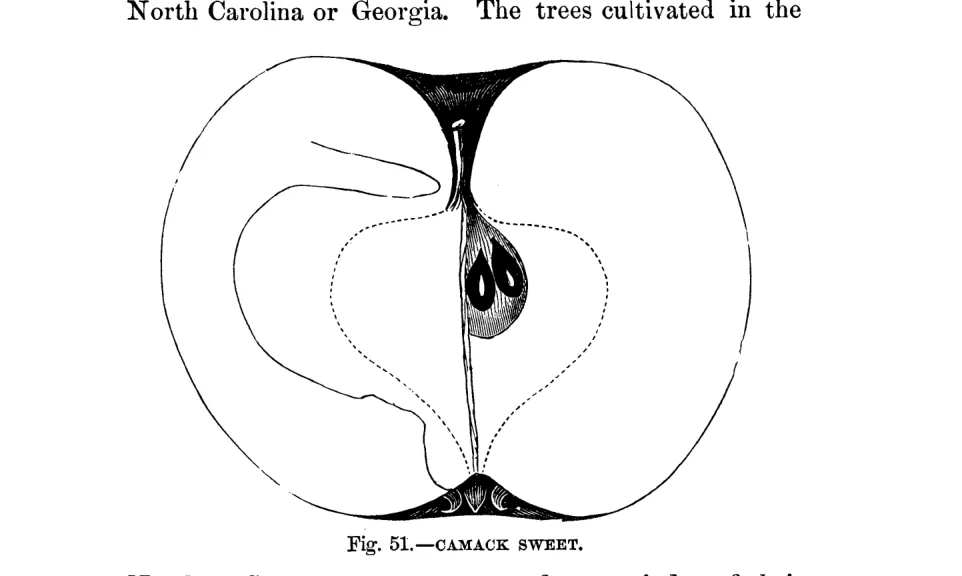
Origin/History
Originated in Macon County, North Carolina (Downing). Warder describes it as "newly introduced" (as of 1867) and states it "is said to have originated in North Carolina or Georgia." Elliott identifies it simply as "Southern." Warder notes that trees cultivated in the Northern States were still too young to fully judge their characteristics as of his writing.
Tree
A slow grower with small wiry branches, irregular spreading habit, an early and abundant bearer (Downing). Warder, observing young trees in the North, reports they "appear to be healthy and vigorous."
Fruit
Size: Medium (Warder, Downing). Warder gives "medium to large." Elliott describes it as "below medium."
Form: Roundish, sometimes conical (Downing). Roundish conical (Elliott). Flat, regular (Warder). The discrepancy between Warder's "flat" and Downing's and Elliott's "roundish, sometimes conical" is notable.
Stem: Rather long (Warder).
Cavity: Deep, acute (Warder).
Calyx: Large, closed (Elliott). Medium, open (Warder). These two sources directly conflict on calyx size and closure.
Basin: Broad, shallow, and regular or wavy (Warder).
Skin: Smooth, greenish-white, rarely blushed with red (Warder). Light yellow green, red in sun (Downing). Whitish green, clouded with green russet (Elliott). Warder and Downing broadly agree on a greenish-white to light yellow-green ground color with limited red coloring; Elliott alone mentions green russet clouding.
Flesh/Flavor: Yellowish, firm, juicy. Warder describes it as "rather tough, but juicy, rich and sweet." Downing calls it "brisk, pleasant, saccharine" and rates it "Good." Elliott describes the flesh as "firm, slightly sweet, juicy" and rates it "very good."
Core/Seeds: Core small (Downing).
Season
Warder states it "keeps well, lasting until May." Downing gives February. Elliott gives December to March. The variety is clearly a winter keeper, with sources spanning December through May depending on conditions.
Uses
Elliott notes it "will prove valuable throughout the Southwest." Warder states it was "not yet sufficiently tested in the North" as of 1867. The long keeping quality and firm flesh suggest a storage apple.
Subtypes/Variants
Not described in sources.
Other
The Encyclopedia of Practical Horticulture (Lowther, 1914) lists Camack Sweet in a variety-characteristic table only:
Camack Sweet.... M | rob | y | G | b | W | ........ | 1* | 4*
Book Sources
Described in 4 period pomological works
View original book sources (4)
— John A. Warder, American Pomology: Apples (1867)Camack Sweet.
This newly introduced sort is said to have originated in North Carolina or Georgia. The trees cultivated in the Northern States are yet too young for us to judge of their characteristics, but they appear to be healthy and vigorous.
Fruit medium to large, flat, regular. Surface smooth, greenish-white, rarely blushed with red. Basin broad, shallow, and regular or wavy; Eye medium, open. Cavity deep, acute; Stem rather long; Flesh yellowish, firm, rather tough, but juicy, rich and sweet. This variety keeps well, lasting until May. Not yet sufficiently tested in the North.
— A.J. Downing, The Fruits and Fruit Trees of America (1900)Camack's Sweet. Camack's Winter Sweet. Grape Vine. Origin, Macon Co., N. C. Tree a slow grower, with small wiry branches, irregular spreading, an early and abundant bearer. Fruit medium, roundish, sometimes conical, light yellow green, red in sun. Flesh yellowish, firm, juicy, brisk, pleasant, saccharine. Good. Core small. February.
— Granville Lowther (ed.), Encyclopedia of Practical Horticulture (1914)Camack Sweet.... M | rob | y | G | b | W | ........ | 1* | 4*
— F.R. Elliott, The Western Fruit Book (1865)Camack's Sweet. Camack's Winter Sweet, | Grape Vine. Southern. Fruit, below medium, roundish conical, whitish green, clouded with green russet; calyx, large, closed; flesh, firm, slightly sweet, juicy; "very good." December to March. Will prove valuable throughout the Southwest.