Canada Baldwin
Apple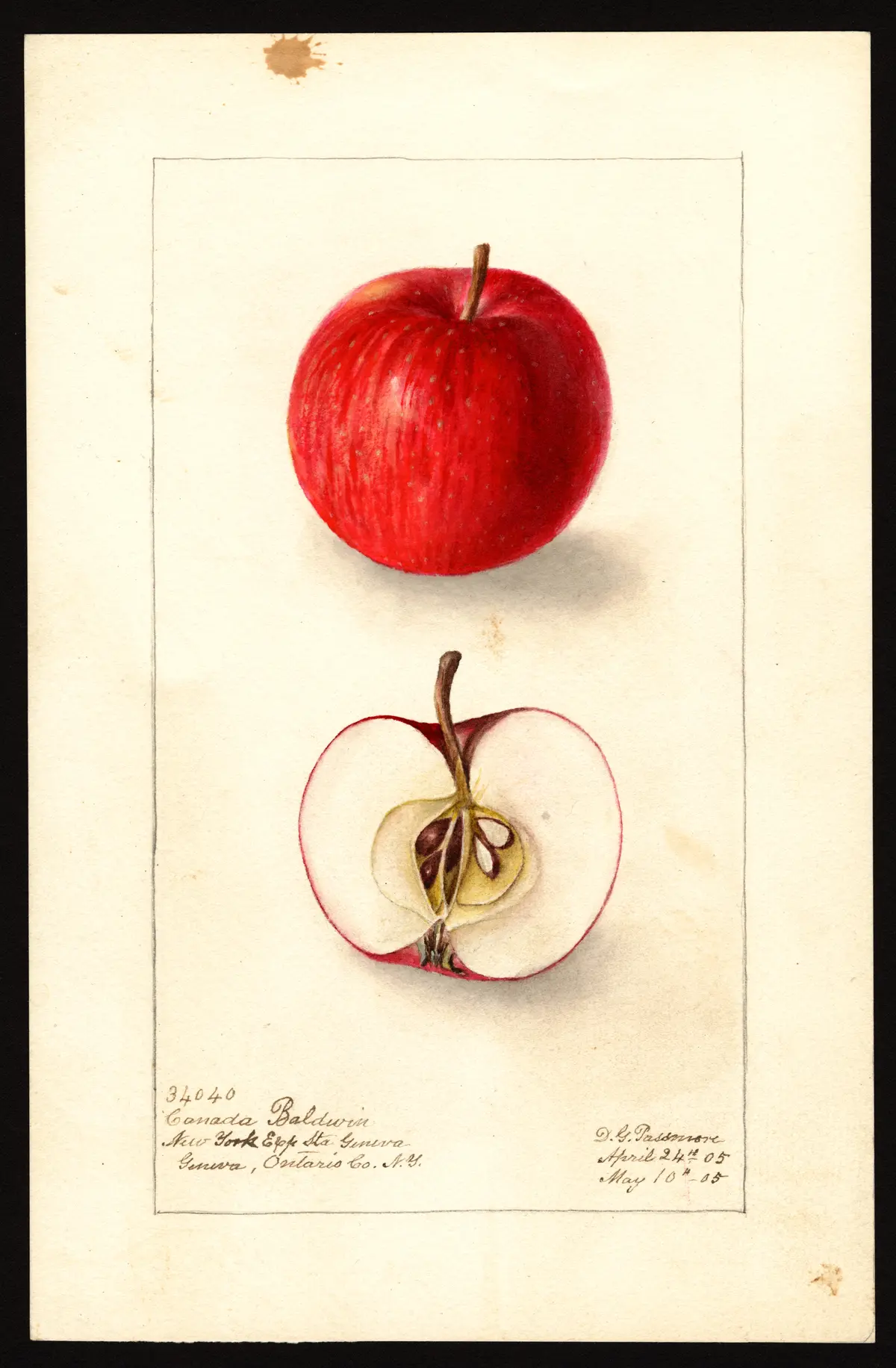
USDA Pomological Watercolor Collection
Canada Baldwin
Origin / History
Canada Baldwin originated some years prior to its documentation in the orchard of Alexis Dery (also given as Déry), St. Hilaire, in Rouville County, Province of Quebec, Canada. Downing and Budd-Hansen describe it as probably of the Fameuse type; Beach, Hedrick, and the historical record cited by Beach confirm it belongs in the Fameuse group. According to Beach, citing Macoun (Can. Dept. Agr. Bul., 37:43, 1901), the variety was "said to have originated from seed of Pomme de Per on the farm of Alexis Dery, St. Hilaire, Que. It was given its name by N. C. Fisk, Abbotsford, Que., who propagated it in 1855." Budd-Hansen give the introduction date as about 1855; Hedrick gives the origin date as about 1850. Beach notes the name "is an unfortunate selection, since this variety does not resemble Baldwin, but belongs in the Fameuse group," and Hedrick similarly calls Canada Baldwin "an inapt name."
Beach does not recommend it for planting except in regions where a hardy variety of the Fameuse type is desired to extend the Fameuse season. Hedrick agrees that it deserves a place on apple lists in northern regions to extend the season of Fameuse, while noting it is not so attractive in appearance nor so well-flavored as the better-known Fameuse.
Tree
The tree is hardy, a vigorous and thrifty grower (Downing; Central Experimental Farm), of strong upright growth, upright at first and gradually spreading with age and bearing (Downing; Budd-Hansen; Beach; Hedrick). Beach describes it as a moderate grower both in the nursery and in the orchard, with good hard wood and strong deep roots; in the orchard it becomes rather open and spreading with age. Branches are long, moderately stout (Beach) or long and stout (Hedrick).
Twigs medium to short, somewhat curved, moderately stout; internodes short to above medium in length. Bark dull dark brown, tinged with reddish-brown, mingled with olive-green, and lightly streaked with gray scarf-skin; slightly pubescent near tips. Lenticels rather numerous, medium to small, roundish or oblong, raised. Buds of medium size, plump, acute, free, quite pubescent. Leaves medium in size, broad (Beach); leaves broad (Hedrick).
Bearing: it begins to bear rather early (Downing; Budd-Hansen call it an early bearer), giving heavy and light crops on alternate years (Downing). Beach reports it yields moderately heavy crops and under favorable conditions tends to become an annual bearer. The Central Experimental Farm catalogue (Agassiz BC, planted Spring 1890) describes it as "not a free bearer."
Soil and site: it is said to succeed best on heavy soils (Downing) or does best on clay or clay loam (Budd-Hansen). On light, warm soils, and with sudden changes of temperature, the trunk is apt to sun-scald, which often causes premature decay (Downing); on light warm soils it is injured by sunscald and bark-splitting (Budd-Hansen).
Fruit
Size: Medium or below (Downing); fruit averages below medium (Beach); medium (Budd-Hansen; Hedrick; Lowther; Central Experimental Farm).
Form: Oblate, slightly angular (Downing; Budd-Hansen describe as roundish oblate, slightly angular); oblate (Lowther; Central Experimental Farm). Beach gives form as roundish inclined to conic, or sometimes slightly oblate, obscurely ribbed, usually symmetrical, regular, with sides sometimes unequal, pretty uniform in size and shape. Hedrick gives round-conic, sometimes oblate, obscurely ribbed, symmetrical, regular.
Stem / Stalk: Short to medium, slender (Downing); short, stout (Budd-Hansen). Beach: stem pubescent, sometimes long, moderately slender and bracted, but more often short and thick. Hedrick: stem pubescent, long, slender, bracted, or more often short and thick.
Cavity: Rather large, deep, regular (Downing); large, wide, deep, regular (Budd-Hansen). Beach: rather large, acute to somewhat obtuse, moderately deep to deep, moderately broad, smooth or partly covered with thin greenish russet, often slightly furrowed or compressed; pubescent near base of stem. Hedrick: large, acute, deep, broad, smooth or covered with thin russet, often furrowed or compressed, pubescent near base of stem.
Calyx: Small, closed (Downing); closed (Budd-Hansen). Beach: closed or partly open, pubescent; lobes often long and acuminate, reflexed. Hedrick: closed or open, pubescent, with long, acuminate, reflexed lobes.
Basin: Large, deep, slightly corrugated (Downing); medium, deep, slightly corrugated (Budd-Hansen). Beach: shallow to moderately deep, medium in width, obtuse or somewhat abrupt, often furrowed or compressed, irregularly wrinkled, often with a tendency to mammiform protuberances. Hedrick: shallow, obtuse, often furrowed or compressed, irregularly wrinkled, often with mammiform protuberances.
Skin: Downing: quite white, thickly striped and splashed with rich red and crimson, purplish crimson where fully exposed, having a slight bloom, and many white dots. Budd-Hansen: surface smooth yellowish white, mostly covered with stripes and splashes of rich red and crimson, a purplish crimson on sunny side with slight bloom. Central Experimental Farm: yellowish, freely sprinkled with red. Lowther: red.
Beach gives the most detailed account: skin thick, tough, smooth, pale yellow or greenish, mottled and blushed with bright red, splashed and striped with purplish-carmine, conspicuously marked with areolar dots and covered with a thin whitish bloom which makes the fruit somewhat dull in color. Prevailing effect in highly colored specimens beautiful and attractive, the color being a deep dark red, but as grown in Western New York the color effect is that of pale yellow striped with red. The skin takes a brilliant polish. Hedrick concurs: skin thick, tough, smooth, pale yellow, mottled and blushed with bright red, splashed and striped with carmine, conspicuously marked with areolar dots and covered with a thin bloom.
Dots: Many white dots (Downing). Beach: large, numerous, whitish, areolar with russet or gray center. Hedrick: large, numerous, areolar with russet or gray center.
Flesh / Flavor: Downing: very white, fine, sometimes a little stained next the skin, and sometimes veined in the flesh, tender, juicy, refreshing, with a mild subacid, peculiar slight quince-like flavor; very good. Budd-Hansen: very white, fine, sometimes stained with pink, tender, juicy, refreshing, mild subacid, with slight quince-like flavor, good to very good. Central Experimental Farm: white, tender, juicy, mildly acid, with a pleasant flavour, quality very good.
Beach: flesh white, often tinged with red, firm, moderately coarse, crisp, moderately tender, juicy, mild subacid, sometimes slightly astringent, with a Fameuse-like aroma, pleasant, good or possibly very good in quality. Hedrick: flesh white, tinged with red, firm, coarse, crisp, tender, juicy, mild subacid, pleasant; good or very good. Lowther: quality very good. Note the divergence in flesh texture — Downing and Budd-Hansen describe the flesh as fine and tender, while Beach calls it firm, moderately coarse, crisp, moderately tender, and Hedrick describes it as firm, coarse, crisp, tender. Downing and Budd-Hansen note the distinctive slight quince-like flavor; Beach instead notes a Fameuse-like aroma.
Calyx tube and stamens: Beach: calyx tube generally tends toward funnel-shape but is sometimes conical; stamens marginal to median. Hedrick: calyx-tube funnel-shape; stamens marginal to median.
Core and seeds: Core small (Downing; Budd-Hansen). Beach: core medium or above, closed or partly open; core lines clasping; often part of the cells are not well developed because of abortive seeds. Carpels smooth, ovate to roundish, or obovate, slightly emarginate, mucronate. Seeds medium to large, plump, acute, numerous, rather narrow, long, smooth or sometimes slightly tufted, variable in color. Hedrick: core closed or partly open; core-lines clasping; carpels smooth, ovate, emarginate, mucronate; seeds large, plump, acute, numerous, narrow, long, smooth or tufted.
Season
Downing: January to April. Budd-Hansen: January to April. Beach: November to January, but often some portion of the fruit may keep till April. Hedrick: November to January. Central Experimental Farm (Agassiz BC): December. Downing considers it one of the most valuable, long-keeping apples of its locality. Beach notes it is a better keeper than Fameuse, but is less attractive.
Uses
A handsome fruit of very good quality, considered valuable both for market and family use (Downing). Beach: use similar to Fameuse, suitable for dessert; it cooks quickly but the color and texture of the cooked fruit are not good. Lowther lists use as not given.
Subtypes / Variants
Not described in source.
Other
Not described in source.
Book Sources
Described in 5 period pomological works
Nursery Catalog Sources
Found in 3 catalogs (1900–1913) from Illinois
- Central Experimental Farm , Dominion Department of Agriculture, Agassiz, British Columbia (under test; Bulletin No. 3, Second Series) — 1900
- Benjamin Buckman (personal inventory) , Farmingdale , Illinois — 1901
- Benjamin Buckman (personal inventory) , Farmingdale , Illinois — 1913
View original book sources (6)
— A.J. Downing, The Fruits and Fruit Trees of America (1900)Canada Baldwin.
This beautiful apple is said to have originated, some years since, in the orchard of Alexis Dery, St. Hilaire, in Rouville County, Province of Quebec, and is probably of the Fameuse type. Tree hardy, vigorous, thrifty grower, upright at first, gradually spreading with age and bearing; it begins to bear rather early, giving heavy and light crops on alternate years; it is a handsome fruit, of very good quality; it is considered one of the most valuable, long-keeping apples of its locality, both for market and family use; it is said to succeed best on heavy soils, while on light, warm soils, and sudden changes of temperature, the trunk is apt to sun-scald, which often causes premature decay.
Fruit medium or below, oblate, slightly angular; skin quite white, thickly striped and splashed with rich red and crimson, purplish crimson where fully exposed, having a slight bloom, and many white dots; stalk short to medium, slender; cavity rather large, deep, regular; calyx small, closed; basin large, deep, slightly corrugated; flesh very white, fine, sometimes a little stained next the skin, and sometimes veined in the flesh, tender, juicy, refreshing, with a mild subacid, peculiar slight quince-like flavor; very good; core small. Season January, April.
— S.A. Beach, The Apples of New York, Vol. 1 (1905)CANADA BALDWIN.
REFERENCES. 1. Montreal Hort. Soc. An. Rpt., 2:28. 1876. 2. Ib., 4:120. 1878. 3. Amer. Pom. Soc. Cat., 1881:6. 4. Downing, 1881:79. app. 5. Thomas, 1885:505. 6. Can. Hort., 12:337. 1889. 7. Ib., 15:337. 1892. 8. Rural N. Y., 52:51. 1893. 9. Munson, Me. Sta. An. Rpt., 1893:132. 10. Amer. Gard., 15:288. 1894. 11. Taylor, Am. Pom. Soc. Rpt., 1895:193. 12. Lyon, Mich. Sta. Bul., 169:179. 1899. 13. Waugh, Vt. Sta. Bul., 83:90. 1900. 14. Macoun, Can. Dept. Agr. Bul., 37:43. 1901. 15. Rural N. Y., 61:800. 1902. 16. Stone and Wellington, Rural N. Y., 62:36. 1903. 17. Budd-Hansen, 1903:59. 18. Beach and Clark, N. Y. Sta. Bul., 248:114. 1904.
The name is an unfortunate selection, since this variety does not resemble Baldwin, but belongs in the Fameuse group. It yields moderately heavy crops, and under favorable conditions tends to become an annual bearer. It is a better keeper than Fameuse, but is less attractive; yet highly colored specimens are beautiful and attractive. It is not recommended for planting, except in those regions where a hardy variety of the Fameuse type is desired to extend the Fameuse season.
Historical. "Said to have originated from seed of Pomme de Per on the farm of Alexis Dery, St. Hilaire, Que. It was given its name by N. C. Fisk, Abbotsford, Que., who propagated it in 1855." (14).
TREE.
Tree in the nursery is a moderate grower, with good hard wood and strong deep roots. In the orchard it is a moderate grower, upright, becoming rather open and spreading with age; branches long, moderately stout. Twigs medium to short, somewhat curved, moderately stout; internodes short to above medium in length. Bark dull dark brown, tinged with reddish-brown, mingled with olive-green, and lightly streaked with gray scarf-skin; slightly pubescent near tips. Lenticels rather numerous, medium to small, roundish or oblong, raised. Buds of medium size, plump, acute, free, quite pubescent. Leaves medium in size, broad.
FRUIT.
Fruit averages below medium. Form roundish inclined to conic, or sometimes slightly oblate, obscurely ribbed, usually symmetrical, regular, sides sometimes unequal; pretty uniform in size and shape. Stem pubescent, sometimes long, moderately slender and bracted, but more often short and thick. Cavity rather large, acute to somewhat obtuse, moderately deep to deep, moderately broad, smooth or partly covered with thin greenish russet, often slightly furrowed or compressed; pubescent near base of stem. Calyx closed or partly open, pubescent; lobes often long and acuminate, reflexed. Basin shallow to moderately deep, medium in width, obtuse or somewhat abrupt, often furrowed or compressed, irregularly wrinkled, often with a tendency to mammiform protuberances.
Skin thick, tough, smooth, pale yellow or greenish, mottled and blushed with bright red, splashed and striped with purplish-carmine, conspicuously marked with areolar dots and covered with a thin whitish bloom which makes the fruit somewhat dull in color. Dots large, numerous, whitish, areolar with russet or gray center. Prevailing effect in highly colored specimens beautiful and attractive, the color being a deep dark red, but as grown in Western New York the color effect is that of pale yellow striped with red. The skin takes a brilliant polish.
Calyx tube generally tends toward funnel-shape but is sometimes conical. Stamens marginal to median.
Core medium or above, closed or partly open; core lines clasping; often part of the cells are not well developed because of abortive seeds. Carpels smooth, ovate to roundish, or obovate, slightly emarginate, mucronate. Seeds medium to large, plump, acute, numerous, rather narrow, long, smooth or sometimes slightly tufted, variable in color.
Flesh white, often tinged with red, firm, moderately coarse, crisp, moderately tender, juicy, mild subacid, sometimes slightly astringent, with a Fameuse-like aroma, pleasant, good or possibly very good in quality.
Season November to January but often some portion of the fruit may keep till April.
Use similar to Fameuse, suitable for dessert. Cooks quickly but the color and texture of the cooked fruit are not good.
— J.L. Budd & N.E. Hansen, American Horticultural Manual, Part II: Systematic Pomology (1914)Canada Baldwin.—Originated in the province of Quebec, Canada, on the farm of Alexis Déry, St. Hilaire, introduced about 1855; tree of strong upright growth, gradually spreading with age; an early bearer, does best on clay or clay loam; on light warm soils it is injured by sunscald and bark-splitting. Fruit medium, roundish oblate, slightly angular; surface smooth yellowish white, mostly covered with stripes and splashes of rich red and crimson, a purplish crimson on sunny side with slight bloom; cavity large, wide, deep, regular; stem short, stout; basin medium, deep, slightly corrugated; calyx closed. Core small; flesh very white, fine, sometimes stained with pink, tender, juicy, refreshing, mild subacid, with slight quince-like flavor, good to very good. January to April.
— Granville Lowther (ed.), Encyclopedia of Practical Horticulture (1914)Canada Baldwin. Size: medium. Form: oblate. Color: red. Quality: very good. Use and season are not listed. Division reporting data is not listed.
— U.P. Hedrick, Cyclopedia of Hardy Fruits (1922)CANADA BALDWIN.
Canada Baldwin, an inapt name, is a very late Fameuse, and deserves a place on apple lists in northern regions to extend the season of Fameuse. It is not so attractive in appearance nor so wellflavored as the better-known Fameuse. The variety originated on the farm of Alexis Dery, St. Hilaire, Quebec, about 1850.
Tree upright, becoming open and spreading; branches long, stout. Leaves broad.
Fruit medium, round-conic, sometimes oblate, obscurely ribbed, symmetrical, regular; stem pubescent, long, slender, bracted, or more often short and thick; cavity large, acute, deep, broad, smooth or covered with thin russet, often furrowed or compressed, pubescent near base of stem; calyx closed or open, pubescent, with long, acuminate, reflexed lobes; basin shallow, obtuse, often furrowed or compressed, irregularly wrinkled, often with mammiform protuberances; skin thick, tough, smooth, pale yellow, mottled and blushed with bright red, splashed and striped with carmine, conspicuously marked with areolar dots and covered with a thin bloom; dots large, numerous, areolar with russet or gray center; calyx-tube funnel-shape; stamens marginal to median; core closed or partly open; core-lines clasping; carpels smooth, ovate, emarginate, mucronate; seeds large, plump, acute, numerous, narrow, long, smooth or tufted; flesh white, tinged with red, firm, coarse, crisp, tender, juicy, mild subacid, pleasant; good or very good; November to January.
— Central Experimental Farm, Central Experimental Farm, Agassiz BC — Catalogue of Fruit Trees under Test (Bulletin No. 3, 1900) (1900)Planted Spring 1890. Tree a vigorous and upright grower, not a free bearer. Fruit of medium size, oblate. Skin yellowish, freely sprinkled with red. Flesh white, tender, juicy, mildly acid, with a pleasant flavour, quality very good. Season December.