Cann Apple
Apple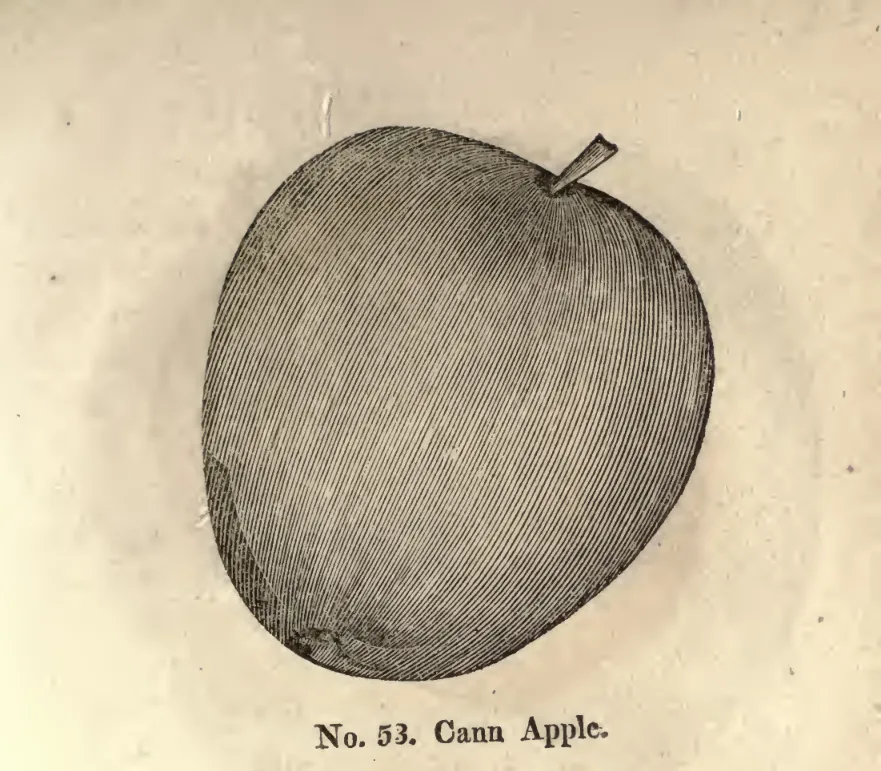
Cann Apple
Origin / History
An American apple (Elliott). In 1817 Coxe recorded it as cultivated in West-Jersey as a fine cider fruit. It takes its name from the peculiarity of its shape, which "resembles a cann in form" (Coxe).
Tree
Thrifty in growth, of spreading form (Coxe); vigorous and productive (Downing).
Fruit
Size: Moderate to large. Coxe calls it of moderate size; Downing calls it large.
Form: Conic or nearly so, approaching a cone (Coxe); roundish conic (Downing).
Stem: Of ordinary size (Coxe).
Cavity: Not described in source.
Calyx: Not described in source.
Basin: Not described in source.
Skin: Olive green, dull green, or greenish yellow (Downing gives greenish yellow), with a little red, or a dull crimson cheek, on the side next the sun. The skin inclines to a brownish red toward the blossom end (Coxe). Elliott also notes a little red near the stem.
Dots: Faint, brown, slightly sprinkled over the skin. Coxe calls them faint spots; Downing calls them brown dots.
Flesh and flavor: Flesh white, compact, not very juicy; sweet, rich, and pleasant (Downing gives compact, not very juicy, rich, and pleasant). Elliott gives the quality as "very good."
Core and seeds: Core large (Downing).
Season
October to March. Elliott gives October to December; Downing gives December to March.
Uses
A fine cider fruit in West-Jersey (Coxe). A good cooking and market apple (Downing).
Subtypes / Variants
Not described in source.
Other
Not described in source.
Book Sources
Described in 4 period pomological works
Nursery Catalog Sources
Found in 1 catalog (1900)
- Central Experimental Farm , Dominion Department of Agriculture, Agassiz, British Columbia (under test; Bulletin No. 3, Second Series) — 1900 — listed as Winter Bough
View original book sources (4)
— William Coxe, A View of the Cultivation of Fruit Trees (1817)NO. 53. CANN APPLE.
This apple is cultivated in West-Jersey as a fine cider fruit; it takes its name from the peculiarity of the shape, which resembles a cann in form, it approaches to a cone the size is moderate, the colour an olive green, with a portion of red in the cheek next the Sun: the skin is dotted with faint spots, and towards the blossom end inclines to a brownish red; the stern is of ordinary size the flesh white and sweet the tree is of thrifty growth, with a spreading form.
— F.R. Elliott, The Western Fruit Book (1865)Cann.
American. Fruit, medium, nearly conical, dull green, little red in sun and near the stem; flesh, white, sweet; "very good." October to December. Tree, thrifty, spreading.
— A.J. Downing, The Fruits and Fruit Trees of America (1900)Cann. Winter Sweet Bough. Winter Bough. Sweet Cann. Tree vigorous and productive. Fruit large, roundish, conic, greenish yellow, with a dull crimson cheek, slightly sprinkled with brown dots. Flesh white, compact, not very juicy, rich, sweet, and pleasant. Core large. December to March. A good cooking and market apple.
[Additional entry in this volume: "Cann", pp. 140–140]
Cann. Winter Sweet Bough. Winter Bough. Sweet Cann. Tree vigorous and productive. Fruit large, roundish, conic, greenish yellow, with a dull crimson cheek, slightly sprinkled with brown dots. Flesh white, compact, not very juicy, rich, sweet, and pleasant. Core large. December to March. A good cooking and market apple.
— John J. Thomas, The American Fruit Culturist (1903)Cann, or Sweet Cann. Large, conic, greenish, dull cheek; sweet, pleasant. Winter.