Cannon Pearmain
Apple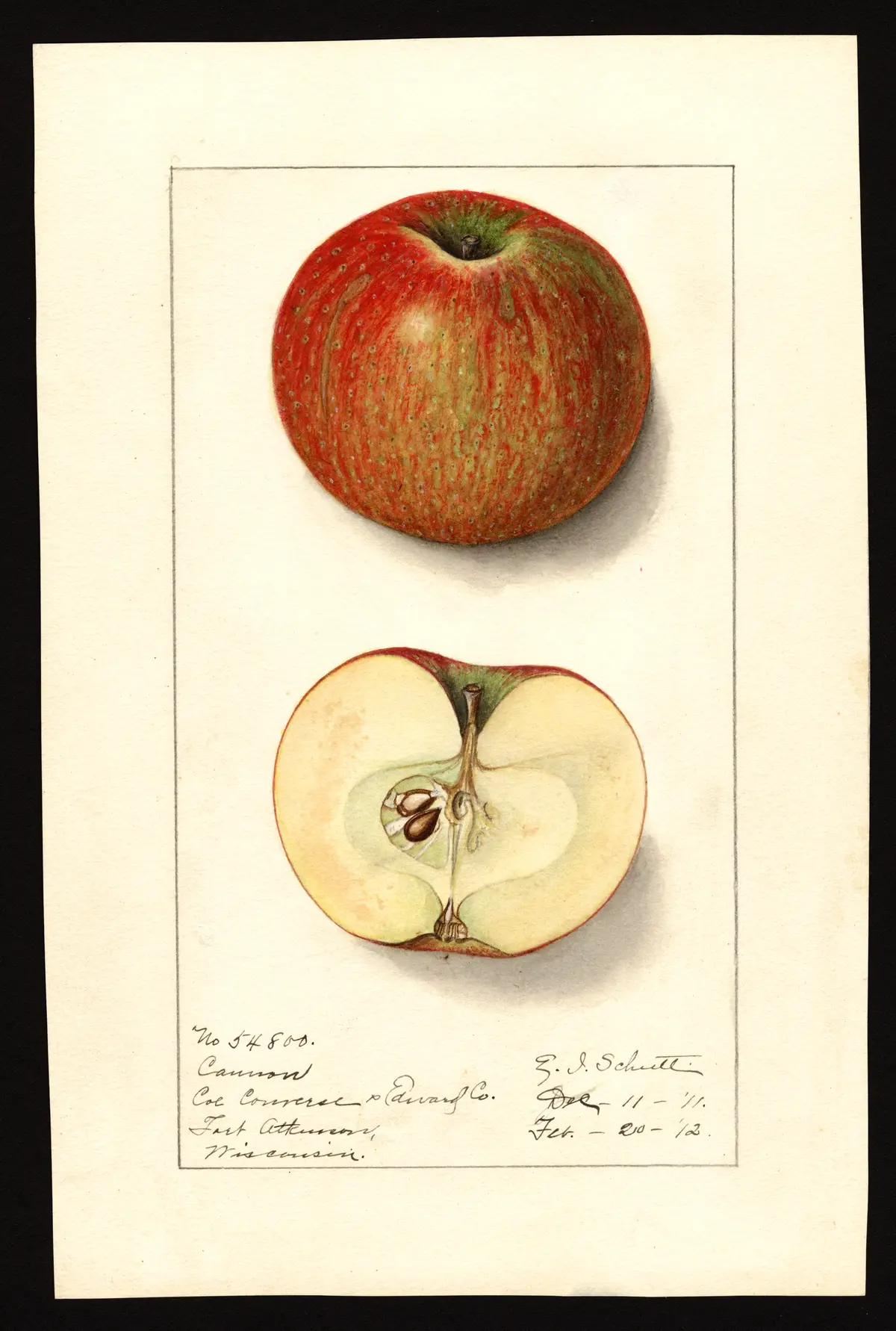
USDA Pomological Watercolor Collection
Cannon Pearmain
Origin / History
An old southern American apple, originating in Virginia or North Carolina (Beach; Hedrick; Warder; Elliott; Thomas; Budd & Hansen). Warder calls it "a southern apple; probably from North Carolina," and Downing notes it was "much grown in North Carolina, and some portions of the West." Beach records that it first appeared in pomological literature in 1851. Hedrick describes it as "an old southern apple, valued as a long-lived sort, which first appeared in pomological literature in 1851 with the statement that it originated in Virginia or North Carolina," and notes it "is still grown in the South Atlantic states." Warder observes that it is "grown to some extent in parts of the West, where it proves a substitute for the Ben Davis, keeping longer." Beach notes it is "valued in the South as a long keeping apple of fairly good quality" but "not adapted to New York conditions." Elliott classifies it simply as "American."
Tree
Tree vigorous, healthy, spreading, and productive (Beach; Hedrick; Downing; Budd & Hansen; Thomas; Warder). Warder specifies the tree is "productive when old." Elliott describes the tree as a "good grower" with "branches diverging."
Fruit
Size and Form
Size is variously reported: medium (Warder; Budd & Hansen; Downing); medium to nearly large (Beach); medium to large (Hedrick); rather large (Thomas); small (Elliott); and medium with a form of "re" (Lowther).
Form is regular, symmetrical, and uniform (Beach; Hedrick; Budd & Hansen; Warder). Shape is variously described as round, oblong, or ovate (Warder); roundish conic (Downing; Budd & Hansen); ovate varying to roundish (Beach; Hedrick); roundish or oblong-conical (Thomas); and roundish (Elliott).
Stem
Stem long and slender (Warder; Budd & Hansen), and red (Warder). Downing and Elliott describe the stalk/stem as short.
Cavity
Cavity is variously described as acute, often lipped (Warder); small, russeted (Downing; Budd & Hansen); small (Thomas); and shallow, russety (Elliott).
Calyx / Eye
Eye small, closed (Warder; Elliott). Downing describes the calyx as "large, open."
Basin
Basin deep, abrupt, regular, rarely wavy (Warder); large, round, deep, and open, corrugated (Downing); large, regular, deep, abrupt, regular, rarely wavy or corrugated (Budd & Hansen); abrupt (Thomas); and furrowed (Elliott).
Skin / Surface
Surface smooth (Warder). Color is yellow shaded red and faintly striped (Warder); yellow, striped, and marbled with red and dark crimson (Downing); greenish-yellow, mottled and washed with bright red faintly striped with carmine (Beach; Hedrick); yellow, striped, shaded, and marbled with red and dark crimson (Budd & Hansen); red on yellow (Thomas); yellow with dull red (Elliott); and red striped or splashed (Lowther).
Dots large, yellow, gray (Warder; Budd & Hansen); large grayish (Downing); yellowish, often areolar with russet point (Beach); yellow, often areolar with russet point (Hedrick); large yellow specks (Elliott).
Flesh / Flavor
Flesh yellow (Warder; Budd & Hansen; Hedrick; Elliott) or tinged with yellow (Beach), or yellowish (Thomas). Texture firm and breaking (Warder); firm (Downing; Budd & Hansen; Thomas); very firm, somewhat coarse, crisp, juicy (Beach); firm, coarse, crisp, juicy (Hedrick); crisp (Elliott).
Flavor is mild sub-acid (Warder; Thomas); rich, brisk, subacid (Downing; Budd & Hansen); aromatic, subacid (Beach; Hedrick); rich, spicy, mild sub-acid (Thomas); and sprightly (Elliott).
Quality is rated "only good" by Warder, "very good" by Downing, Budd & Hansen, and Lowther, and "good" by Beach and Hedrick. Beach calls it "a long keeping apple of fairly good quality."
Core / Seeds
Core medium, regular, oval, closed, clasping (Warder); medium, axile, closed, with core lines somewhat clasping (Beach); medium, axile, closed, with core-lines clasping (Hedrick). Seeds numerous, long, pointed (Warder).
Season
Season January to April (Warder; Beach; Hedrick; Budd & Hansen); December to March (Downing; Elliott); winter (Lowther); "keep still spring" (Thomas). Noted as a long-keeping variety (Beach; Hedrick; Warder, who notes it keeps longer than Ben Davis).
Uses
Market, kitchen, and table (Warder); family use (Lowther).
Subtypes / Variants
Not described in source.
Other
Lowther reports the variety from 7 stations in the Northern Division and 2 stations in the Central Division, with the asterisk on both division counts indicating the variety is reported as adapted to more than one division. Beach lists the synonym record "Cannon Pearmain (8)" referencing Barry, 1883:344.
Book Sources
Described in 8 period pomological works
- Warder, American Pomology: Apples (1867)
- Beach, The Apples of New York Vol. 1 (1905)
- Budd & Hansen, Systematic Pomology (1914)
- Downing, Fruits and Fruit Trees of America (1900)
- Elliott, The Western Fruit Book (1865)
- Lowther (ed.), Encyclopedia of Practical Horticulture (1914)
- Thomas, The American Fruit Culturist (1903)
- Hedrick, Cyclopedia of Hardy Fruits (1922) — listed as CANNON
Nursery Catalog Sources
Found in 2 catalogs (1901–1913) from Illinois
- Benjamin Buckman (personal inventory) , Farmingdale , Illinois — 1901
- Benjamin Buckman (personal inventory) , Farmingdale , Illinois — 1913
View original book sources (8)
— John A. Warder, American Pomology: Apples (1867)Cannon Pearmain.
A southern apple; probably from North Carolina. Grown to some extent in parts of the West, where it proves a substitute for the Ben Davis, keeping longer.
Fig. 279. — CANNON PEARMAIN.
Tree vigorous, healthy, productive when old; Fruit medium, round, oblong or ovate, regular; Surface smooth, yellow, shaded red, faintly striped; Dots large, yellow, gray.
Basin deep, abrupt, regular, rarely wavy; Eye small, closed.
Cavity acute, often lipped; Stem long, slender, red.
Core medium, regular, oval, closed, clasping; Seeds numerous, long, pointed; Flesh yellow, firm, breaking; Flavor mild sub-acid; Quality only good; Use, market, kitchen, table; Season, January to April.
— A.J. Downing, The Fruits and Fruit Trees of America (1900)Cannon Pearmain.
Tree vigorous, spreading, and productive ; much grown in North Carolina, and some portions of the West.
Fruit medium, roundish conic. Color yellow, striped, and marbled with red and dark crimson, with large grayish dots. Stalk short. Cavity small, russeted. Calyx large, open. Basin large, round, deep, and open, corrugated. Flesh yellow, firm, with a rich, brisk, subacid flavor. Very good. December to March.
— S.A. Beach, The Apples of New York, Vol. 1 (1905)CANNON PEARMAIN.
REFERENCES. 1. Emmons, Nat. Hist. N. Y., 3:102. 1851. fig. 2. Downing, 1857:126. 3. Elliott, 1858:126. 4. Am. Pom. Soc. Cat., 1860. 5. Mag. Hort., 27:99. 1861. 6. Warder, 1867:676. fig. 7. Am. Pom. Soc. Rpt., 1871:38. 8. Barry, 1883:344. 9. Bailey, An. Hort., 1892:236. 10. Ala. Sta. Bul., 47:7. 1893. 11. Powell and Fulton, U. S. B. P. I. Bul., 48:39. 1903.
SYNONYM. Cannon Pearmain (8).
Valued in the South as a long keeping apple of fairly good quality. Not adapted to New York conditions.
Historical. Originated in Virginia or North Carolina (2, 3, 6, 7).
TREE.
Tree healthy, vigorous, spreading.
FRUIT.
Fruit medium to nearly large, ovate varying to roundish, regular, symmetrical; pretty uniform. Skin greenish-yellow, mottled and washed with bright red faintly striped with carmine. Dots yellowish, often areolar with russet point. Core medium, axile, closed; core lines somewhat clasping. Flesh tinged with yellow, very firm, somewhat coarse, crisp, juicy, aromatic, subacid, good.
Season January to April.
— Granville Lowther (ed.), Encyclopedia of Practical Horticulture (1914)Cannon Pearmain is medium in size, with a form of "re", and red striped or splashed skin. Quality is very good. Primary use is family. Season of use is winter. Reported by 7 stations in the Northern Division and 2 stations in the Central Division; the asterisk on both division counts indicates the variety is reported as adapted to more than one division.
— F.R. Elliott, The Western Fruit Book (1865)Cannon Pearmain. American. Tree, good grower, branches diverging. Fruit, small, roundish, yellow, with dull red and large yellow specks; stem, short; cavity, shallow, russety; calyx, small, closed; basin, furrowed; flesh, yellow, crisp, sprightly. December to March.
— John J. Thomas, The American Fruit Culturist (1903)Cannon Pearmain. Rather large, roundish or oblong-conical; red on yellow; cavity small, basin abrupt; flesh yellowish, firm, rich, spicy, mild sub-acid. Keep still spring. Tree vigorous, spreading, productive. North Carolina.
— J.L. Budd & N.E. Hansen, American Horticultural Manual, Part II: Systematic Pomology (1914)Cannon Pearmain.—Origin, North Carolina; tree vigorous, spreading, productive.
Fruit medium, form regular, roundish conic; surface yellow, striped, shaded, and marbled with red and dark crimson; dots large, yellow, gray; cavity small, russeted; stem long, slender; basin large, regular, deep, abrupt, regular, rarely wavy or corrugated; flesh yellow, firm, with a rich, brisk, subacid flavor, very good. January to April.
— U.P. Hedrick, Cyclopedia of Hardy Fruits (1922)CANNON. Cannon Pearmain. Cannon is an old southern apple, valued as a long-lived sort, which first appeared in pomological literature in 1851 with the statement that it originated in Virginia or North Carolina. It is still grown in the South Atlantic states. Tree healthy, vigorous, spreading. Fruit medium to large, ovate varying to roundish, regular, symmetrical, uniform ; skin greenish-yellow, mottled and washed with bright red faintly striped with carmine ; dots yellow, often areolar with russet point ; core medium, axile, closed ; core-lines clasping ; flesh yellow, firm, coarse, crisp, juicy, aromatic, subacid ; good ; January to April.