Catline
Apple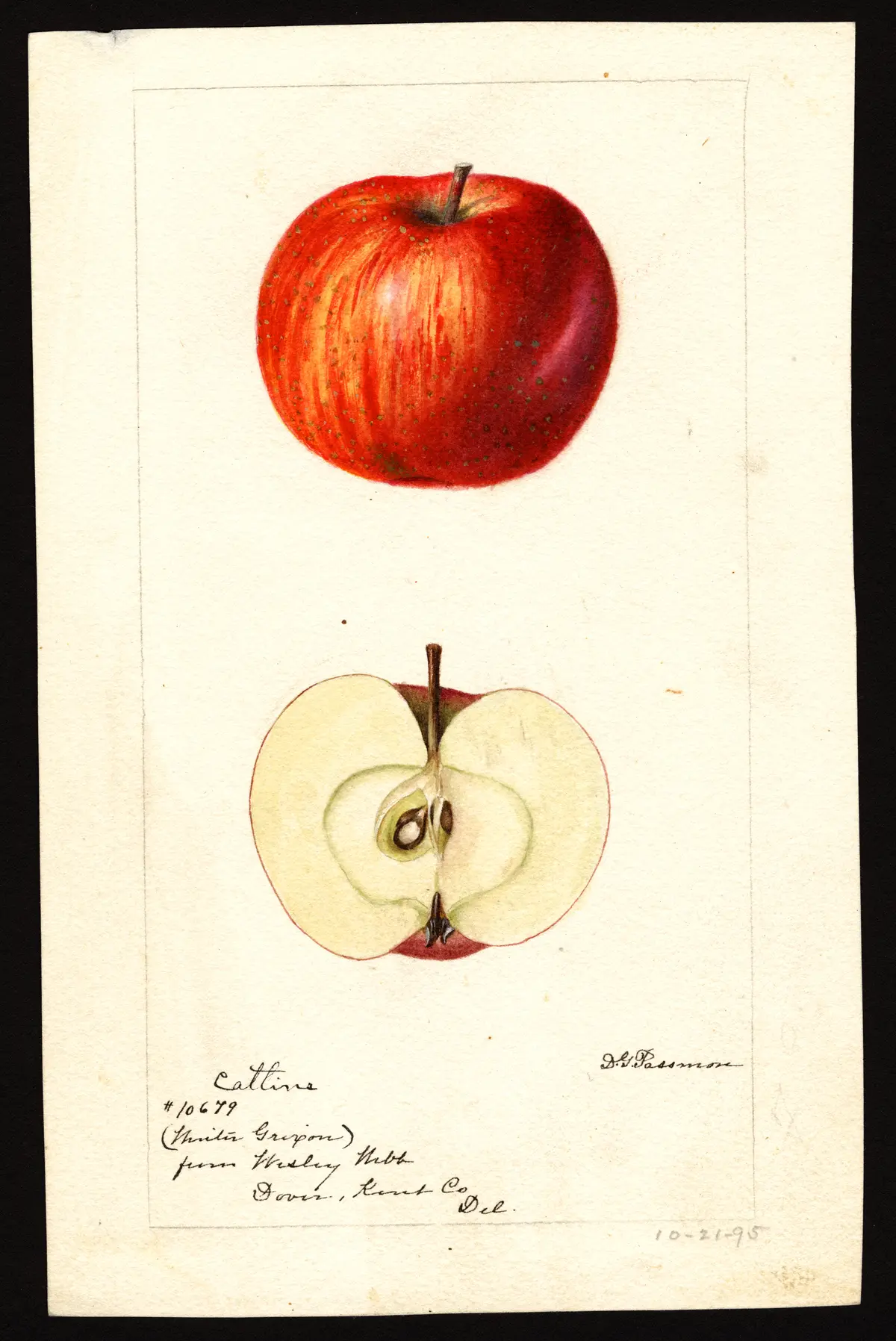
USDA Pomological Watercolor Collection
Origin & History
Origin, Maryland (Downing). Much esteemed in the lower part of Delaware (Downing; Thomas also associates the variety with Delaware).
Tree
Small, with a regular, round head (Coxe). Shoots straight and delicate; foliage of a lively green (Coxe). Slow growth (Downing). Very productive — a great bearer that bears abundantly in six or seven years after transplanting when well cultivated (Coxe; Downing also notes it is very productive).
Fruit
Size: Sources disagree. Rather below the middling size, and sometimes in a fruitful year on a full-bearing tree quite small (Coxe). Below medium size (Downing). Small (Thomas). Elliott, however, describes it as medium.
Form: Flat (Coxe). Oblate (Downing, Thomas). Elliott describes it as roundish.
Stem: Short and thick (Coxe).
Cavity: Not described in source.
Calyx: Not described in source.
Basin: Not described in source.
Skin: Smooth, of a beautiful yellow with a clear and brilliant red towards the sun, with numerous streaks and many dark spots scattered on the surface (Coxe). Yellow with a bright red cheek, with stripes (Downing). Greenish yellow, red in sun (Elliott). Striped (Thomas).
Flesh & Flavor: Pale yellow, tender, rich, juicy, and sweet; as an eating apple in October, November, and December it is particularly fine (Coxe). Tender, rich, juicy, and sweet; rated Good (Downing). Rich, sweet (Thomas). Elliott, however, describes the flesh as pale yellow and only "nearly sweet."
Core & Seeds: Not described in source.
Season
October to December (Coxe, Downing, Elliott). Thomas gives simply "Autumn."
Uses
Considered a fine eating apple (Coxe). Also a good early cider apple, although not sufficiently strong for bottling (Coxe). Elliott likewise notes it as a cider apple.
Subtypes & Variants
White Catline: A distinct form described by Downing. Smaller in size, oblate, greenish white, maturing in September and October. Juicy, tender, pleasant. Rated Good.
Book Sources
Described in 4 period pomological works
Nursery Catalog Sources
Found in 2 catalogs (1901–1913) from Illinois
- Benjamin Buckman (personal inventory) , Farmingdale , Illinois — 1901
- Benjamin Buckman (personal inventory) , Farmingdale , Illinois — 1913
View original book sources (4)
— William Coxe, A View of the Cultivation of Fruit Trees (1817)NO. 22. CATLINE, OR GREGSON APPLE.
The Catline is an apple rather below the middling size: and is sometimes, in a fruitful year, and on a full bearing tree, quite small: it is a great bearer—the form is flat, the stalk short and thick, the skin smooth, and of a beautiful yellow, with a clear and brilliant red towards the sun, with numerous streaks and many dark spots scattered on the surface. The flesh is a pale yellow, tender, rich, juicy and sweet: as an eating apple in October, November, and December, it is particularly fine; and is considered as a good early cider apple, although not sufficiently strong for bottling; the tree is small, the form regular, and round in the head; the shoots straight and delicate; the foliage of a lively green—it is very productive, and in six or seven years after transplanting, it bears abundantly, when well cultivated.
— A.J. Downing, The Fruits and Fruit Trees of America (1900)Catline. Gregson Apple. Origin, Maryland. Tree of slow growth, very productive, much esteemed in the lower part of Delaware. Below medium size, oblate, yellow, bright red cheek, with stripes. Flesh tender, rich, juicy, and sweet. Good. October to December. There is also a White Catline, which is smaller in size, oblate, greenish white, and maturing in September and October. It is juicy, tender, pleasant. Good.
— F.R. Elliott, The Western Fruit Book (1865)Catline. Gregson, | Winter Grixon. Medium, roundish, greenish yellow, red in sun ; flesh, pale yellow, nearly sweet, for cider. October, December.
— John J. Thomas, The American Fruit Culturist (1903)Catline. Small, oblate, striped; rich, sweet. Autumn. Del.