Celestia
Apple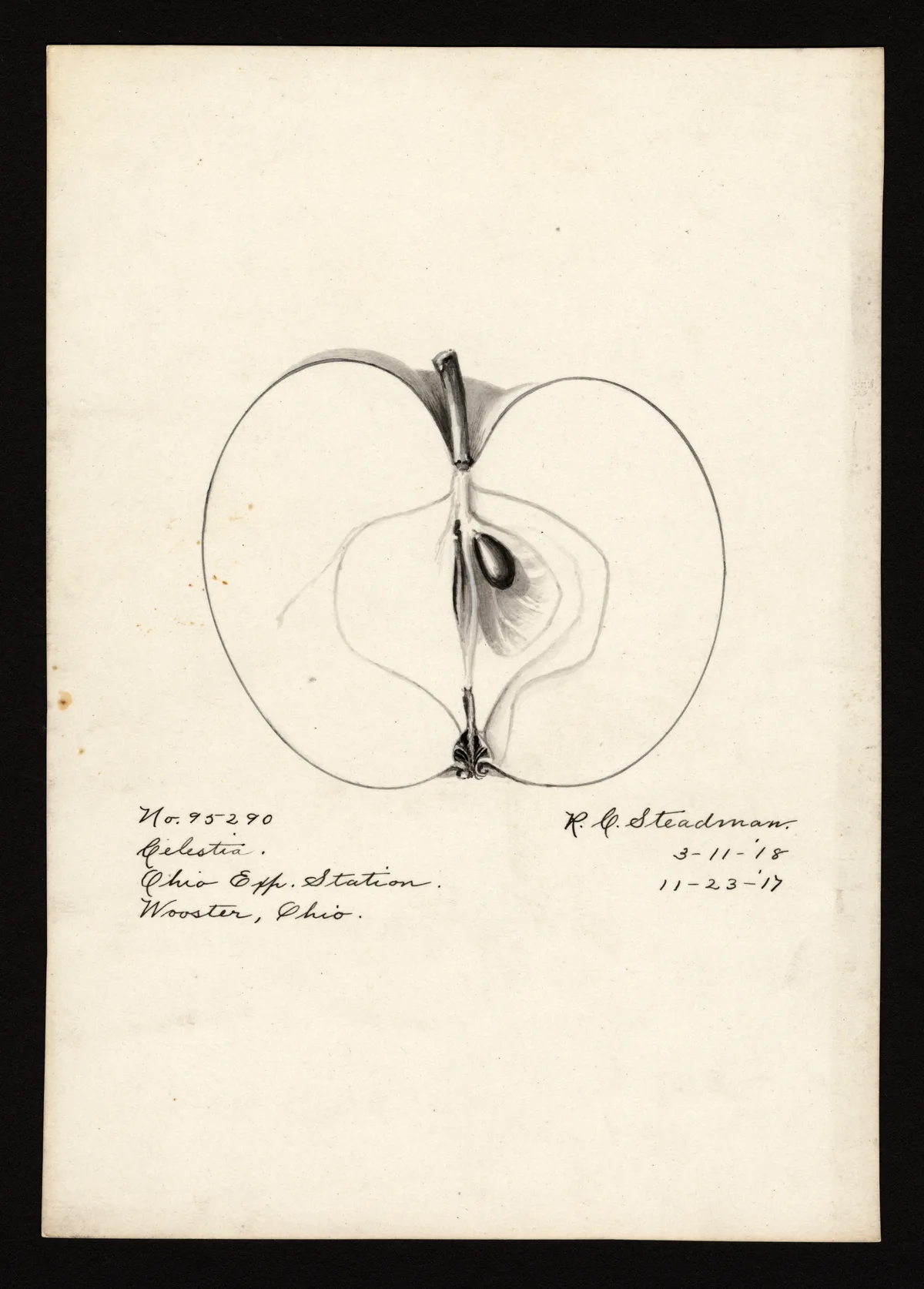
USDA Pomological Watercolor Collection
Celestia
Origin / History
Celestia originated as a seedling of Stillwater Sweet, raised by L. S. Mote of Miami County, Ohio. Warder (1867) described it as a fine amateur fruit that appeared destined to take the place of the Dyer, being more handsome. Beach (1905) cites earlier published references including Warder (1867), Downing (1869), Fitz (1872), Bailey (1892), Dickens and Greene (1902), and Beach and Clark (1904).
Tree
Per Beach: tree moderately vigorous with short, stout, curved branches; not very productive. Form upright spreading, roundish, rather dense. Twigs short to moderately long, slightly curved, moderately slender; internodes medium to long. Bark clear brownish-red with some olive-green, lightly mottled with scarf-skin; pubescent. Lenticels numerous, small to medium, elongated or roundish, slightly raised. Buds medium size, plump, obtuse to somewhat acute, free, slightly pubescent.
Fruit
Size
Large (Warder, Downing, Lowther); Beach gives medium to large, usually above medium, uniform in size and shape.
Form
Warder: conical, truncated, angular; surface somewhat uneven, smooth. Downing: roundish, conical, slightly ribbed. Beach: roundish inclined to conic, somewhat flattened at the base, markedly ribbed, irregular, somewhat angular. Lowther: oblate.
Stem
Warder: long or medium, sometimes knobby. Downing: rather short and slender. Beach: medium to long, thick.
Cavity
Warder: wide, shallow, angular. Downing: deep, uneven. Beach: obtuse to somewhat acute, moderately deep to deep, rather broad, somewhat furrowed, usually russeted.
Calyx / Eye
Warder: eye small, long, closed. Downing: calyx closed; segments long, slender, partially recurved. Beach: calyx medium in size, usually closed; lobes medium in length, rather narrow, acute. Calyx tube very long to medium, deep, funnel-shape. Stamens median to somewhat marginal.
Basin
Warder: narrow, folded. Downing: rather small, furrowed. Beach: shallow, narrow, rather abrupt, much furrowed and wrinkled.
Skin
Warder: waxen-yellow; dots scattered, distinct, gray, with green bases. Downing: pale yellow, moderately sprinkled with gray or brown dots, and sometimes large dots of red. Beach: skin thick, smooth, rather tender, yellow marbled with pale green, and occasionally having a thin brownish blush; dots numerous, small, inconspicuous, submerged, light or russet. Lowther: greenish yellow.
Flesh / Flavor
Warder: flesh yellow, very fine grained, very tender, juicy; flavor sub-acid, very sprightly, and spicy, aromatic; quality very best. Downing: flesh yellowish, crisp, tender, juicy, very pleasant, rich, mild, subacid; very good. Beach: flesh very strongly tinged with yellow, rather firm, moderately coarse, crisp, tender, juicy, pleasant, rather mild, subacid, good — but notes that as tested at the New York Station, fruit was not particularly attractive in color and not superior to ordinary varieties in quality. Lowther: quality very good.
Core / Seeds
Warder: core small, oval, open, clasping; seeds numerous, long, angular. Downing: core rather large. Beach: core large, very abaxile to sometimes axile; cells open or closed; core lines clasping the funnel cylinder. Carpels elliptic to broadly obcordate, much concave, emarginate, much tufted. Seeds large, wide, long, obtuse, dark dull brown.
Season
September (Warder); October (Downing); October to January (Beach).
Uses
Table and kitchen (Warder); kitchen and market (Lowther). Warder notes its texture and color disqualify it for market, while its delicious flavor renders it very attractive; essentially an amateur's fruit. Beach: not recommended for cultivation in New York.
Subtypes / Variants
Not described in source.
Other
Beach lists no synonyms for the variety.
Book Sources
Described in 4 period pomological works
Nursery Catalog Sources
Found in 6 catalogs (1891–1913) from Illinois, Missouri, Washington
- Missouri Nursery Co. , Louisiana , Missouri — 1891
- J.V. Cotta (Cotta Nursery) , Carroll County , Illinois — 1898
- Central Experimental Farm , Dominion Department of Agriculture, Agassiz, British Columbia (under test; Bulletin No. 3, Second Series) — 1900
- Benjamin Buckman (personal inventory) , Farmingdale , Illinois — 1901
- Vineland Nurseries Company , Clarkston , Washington — 1912
- Benjamin Buckman (personal inventory) , Farmingdale , Illinois — 1913
View original book sources (4)
— John A. Warder, American Pomology: Apples (1867)Celestia.
This fine amateur fruit, which appears destined to take the place of the Dyer, being more handsome, is a seedling from the Stillwater Sweet, and was produced by L. S. Mote, of Miami County, Ohio.
Fruit large, conical, truncated, angular; Surface somewhat uneven, smooth, waxen-yellow; Dots scattered, distinct, gray, with green bases.
Basin narrow, folded; Eye small, long, closed.
Cavity wide, shallow, angular; Stem long or medium, sometimes knobby.
Core small, oval, open, clasping; Seeds numerous, long, angular; Flesh yellow, very fine grained, very tender, juicy; Flavor sub-acid, very sprightly, and spicy, aromatic; Quality very best; Use, table and kitchen; Season, September.
This is essentially an amateur's fruit, as its texture and color disqualify it for market, while its delicious flavor renders it very attractive.
— A.J. Downing, The Fruits and Fruit Trees of America (1900)Celestia. Originated with L. S. Mote, Miami Co., O. A new variety of good promise as an amateur sort. Fruit large, form roundish, conical, slightly ribbed. Color pale yellow, moderately sprinkled with gray or brown dots, and sometimes large dots of red. Stalk rather short and slender. Cavity deep, uneven. Calyx closed. Segments long, slender, partially recurved. Basin rather small, furrowed. Flesh yellowish, crisp, tender, juicy, very pleasant, rich, mild, subacid. Core rather large. Very good. October.
— S.A. Beach, The Apples of New York, Vol. 2 (1905)CELESTIA.
REFERENCES. 1. Warder, 1867:530. fig. 2. Downing, 1869:122. 3. Fitz, 1872:173. 4. Bailey, An. Hort., 1892:236. 5. Dickens and Greene, Kan. Sta. Bul., 106:52. 1902. 6. Beach and Clark, N. Y. Sta. Bul., 248:114. 1904.
SYNONYMS. None.
Fruit not particularly attractive in color and as tested at this Station not superior to ordinary varieties in quality. Warder says (1) that it is essentially an amateur's fruit of very best quality but its texture and color disqualify it for market. The tree is a moderate grower and not very productive. Not recommended for cultivation in New York.
Historical. Originated from seed of Stillwater Sweet by L. S. Mote, Miami county, Ohio (1).
TREE.
Tree moderately vigorous with short, stout, curved branches. Form upright spreading, roundish, rather dense. Twigs short to moderately long, slightly curved, moderately slender; internodes medium to long. Bark clear brownish-red with some olive-green, lightly mottled with scarf-skin; pubescent. Lenticels numerous, small to medium, elongated or roundish, slightly raised. Buds medium size, plump, obtuse to somewhat acute, free, slightly pubescent.
FRUIT.
Fruit medium to large, usually above medium, uniform in size and shape. Form roundish inclined to conic, somewhat flattened at the base, markedly ribbed, irregular, somewhat angular. Stem medium to long, thick. Cavity obtuse to somewhat acute, moderately deep to deep, rather broad, somewhat furrowed, usually russeted. Calyx medium in size, usually closed; lobes medium in length, rather narrow, acute. Basin shallow, narrow, rather abrupt, much furrowed and wrinkled. Skin thick, smooth, rather tender, yellow marbled with pale green, and occasionally having a thin brownish blush. Dots numerous, small, inconspicuous, submerged, light or russet. Calyx tube very long to medium, deep, funnel-shape. Stamens median to somewhat marginal. Core large, very abaxile to sometimes axile; cells open or closed; core lines clasping the funnel cylinder. Carpels elliptic to broadly obcordate, much concave, emarginate, much tufted. Seeds large, wide, long, obtuse, dark dull brown. Flesh very strongly tinged with yellow, rather firm, moderately coarse, crisp, tender, juicy, pleasant, rather mild, subacid, good. Season October to January.
— Granville Lowther (ed.), Encyclopedia of Practical Horticulture (1914)Celestia. Size: large. Form: oblate. Color: greenish yellow. Quality: very good. Use: both kitchen and market.