Church
Pear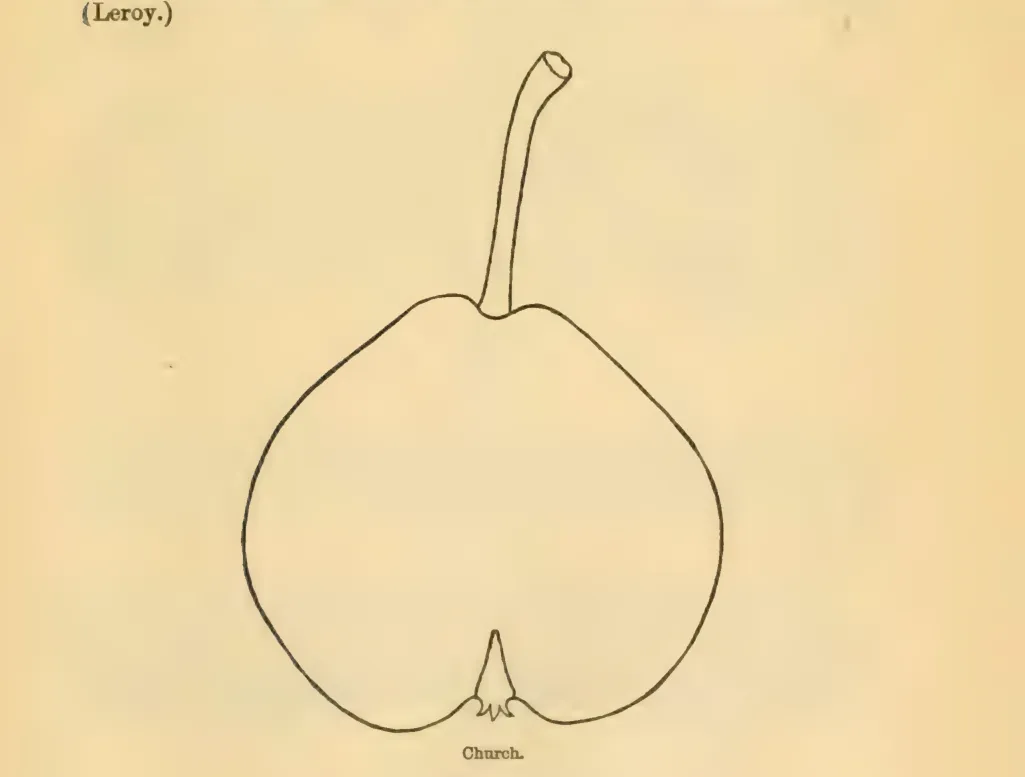
Origin & History
The Church pear originated at New Rochelle, New York, on land belonging to Trinity Church, hence its name. However, according to Hedrick, Dr. Brinckle believed it to be a seedling raised by an old Huguenot settler, and that the original tree still existed on the premises of L. P. Miller, and was presumed to be nearly [number missing in source] years old. In 1859, Dr. Brinckle and Prince and Ferris expressed the opinion that it was identical with Plait's Bergamot, and Mr. Colt thought the Clark pear of Hartford was also the same.
Tree
The tree is vigorous (Thomas) with a somewhat spreading habit of growth. It is uniformly productive, and the fruit is unvarying in its quality. Young wood dull yellow or brown (Downing).
Fruit
Size: Medium, though Downing describes it as rather below medium size.
Form: Sources disagree on shape. Downing describes it as generally depressed, somewhat angular. Hedrick calls it globular-oblate, irregular. Thomas describes it as roundish oblate, with a very short neck, irregular. Elliott, in contrast, describes it as obovate acute pyriform.
Stem: Rather long and stout at its insertion (Downing, Thomas). Thomas notes it is scarcely sunk. Elliott describes the stem simply as medium.
Cavity: Small, surrounded by russet (Downing). Thomas describes the stalk as scarcely sunk, suggesting a minimal cavity.
Calyx: Small and closed.
Basin: Broad and rather shallow. Thomas adds that it is slightly furrowed. Elliott describes the basin simply as medium.
Skin: Green, becoming yellow at maturity, with minute dots (Hedrick, Thomas). Elliott describes the skin as yellowish green, spotted and marbled with russet.
Flesh & Flavor: White (Downing), fine-grained, very buttery, juicy, melting, with an exceedingly rich, sweet, and highly perfumed flavor. Rated "very good" by Downing and "first" by Hedrick. Elliott describes the flesh as buttery, juicy, sweet, and aromatic. Thomas characterizes the flavor as "very sweet, rich, and excellent."
Core & Seeds: Core small (Downing). Not otherwise described.
Season
Ripens slowly and continues in use all of September (Downing). Thomas concurs, saying it ripens through September. Hedrick gives September. Elliott, in contrast, gives the season as July and August.
Uses
Not described in source.
Subtypes & Variants
Not described in source.
Book Sources
Described in 4 period pomological works
View original book sources (4)
— A.J. Downing, The Fruits and Fruit Trees of America (1900)Church.
Church. Clarke?
This really good Pear originated on land belonging to the Trinity Church, at New Rochelle, N. Y.; hence its name. The habit of the Church Pear is somewhat spreading in its growth, uniformly productive, and the fruit unvarying in its quality. Young wood dull yellow, or brown.
Fruit rather below medium size, generally depressed, somewhat angular. Stalk rather long, stout at its insertion, in a small cavity surrounded by russet. Calyx small and closed, in a broad, rather shallow basin. Skin green, becoming yellow at maturity. Flesh white, very buttery, juicy, melting, with an exceedingly rich, sweet, and highly perfumed flavor. Very good. Core small. Ripens slowly, and continues in use all of September.
— U.P. Hedrick, The Pears of New York (1921)Church.
- Mag. Hort. 23:112, fig. 5. 1857. 2. Downing Fr. Trees Am. 19. 1869. Vanilla. 3. Watson Am. Home Card. 376, fig. 235. 1860.
Reported by Downing to have originated on land belonging to Trinity Church at New Rochelle, N. Y., hence its name; but Dr. Brinckle, in the second reference, says that it was believed to be a seedling raised by an old Huguenot settler, and that the original tree still existed on the premises of L. P. Miller, and was presumed to be nearly years old. In 1859 Dr. Brinckle and Prince and Ferris expressed the opinion that it was identical with Plait's Bergamot and Mr. Colt thought the Clark pear of Hartford was also the same.
Fruit medium, globular-oblate, irregular, green becoming yellow at maturity, with minute dots; flesh fine, very buttery, melting, with a very rich, sweet and highly perfumed flavor; first; Sept.
— F.R. Elliott, The Western Fruit Book (1865)Church. From New Rochelle, N. Y. Medium, obovate acute pyriform, yellowish green, spotted and marbled with russet; stem, medium ; calyx, closed; basin, medium ; flesh, buttery, juicy, sweet, aromatic. July, August.
— John J. Thomas, The American Fruit Culturist (1903)Church. Size medium, roundish oblate, with a very short neck, irregular; yellow, with minute dots; stalk rather long and stout, scarcely sunk; basin broad and shallow, slightly furrowed; flesh fine, very buttery, melting, with a very sweet, rich, and excellent flavor. Ripens through September. Tree vigorous and spreading, uniformly productive, and fruit unvarying in good quality. New Rochelle, N. Y. Fig. 720.