Coit's Beurré
Pear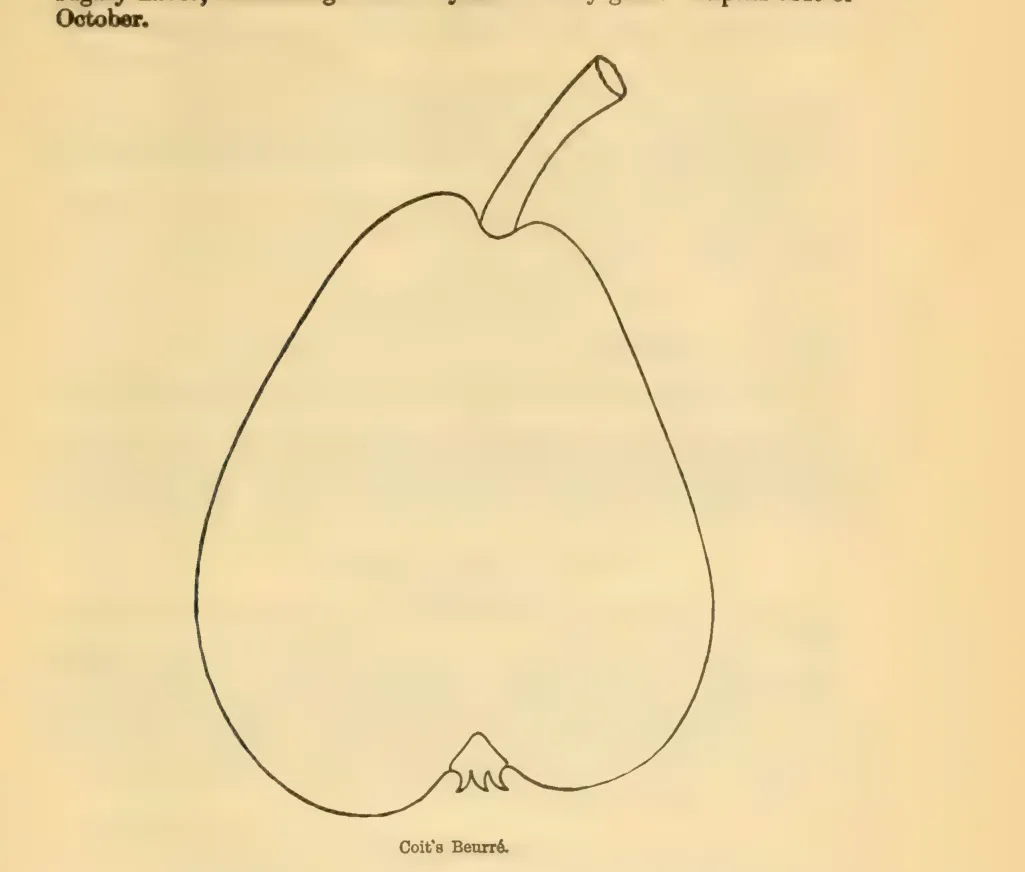
Coit's Beurré
Origin / History
Raised by Colonel Coit of Euclid, Ohio, near Cleveland (Elliott; Hedrick). Elliott records first eating the fruit in 1846, when his initial favorable notes were made, with further observations written September 25, 1853. Hedrick cites prior published references in The Horticulturist 19:110, figs. 1, 2 (1864) and Downing's Fruit Trees of America, p. 722, fig. (1869).
Tree
Hardy, vigorous, upright, and spreading in form, with dark brown shoots. An early and good bearer on the pear root (Elliott).
Fruit
Size: Above medium (Elliott); medium (Thomas; Hedrick). Elliott notes his drawing was made from a specimen pulled in August and is below an average size.
Form: Obtuse pyriform, slightly angular (Elliott); obovate pyriform (Thomas); obovate inclining to pyriform (Hedrick).
Stem: Rather short (Elliott). Not described in the other sources.
Cavity: Shallow, with unequal projections (Elliott).
Calyx: With segments nearly erect, surrounded by depressed crescent-shaped furrows (Elliott).
Basin: Shallow (Elliott).
Skin: Rich brown russet, mostly overspreading a yellow ground, with a brownish red cheek in the sun (Elliott); yellow with some russet, crimson, dotted (Thomas); yellow, deeply covered with russet, covered with dots which become crimson on the exposed side, cheek often crimson (Hedrick).
Flesh / Flavor: Yellowish white, melting, buttery, juicy, sweet, vinous (Elliott); granular, buttery, rich, vinous (Thomas); buttery, juicy, spicy, melting, rich, vinous (Hedrick); sugary flavor, resembling White Doyenné (Downing). Quality rated "very good" (Downing; Hedrick); Elliott judges it "worthy a place in all collections."
Core / Seeds: Core small; seeds blackish (Elliott).
Season
Last September and October (Elliott); September and October (Hedrick); September (Thomas); ripens first of October (Downing).
Uses
Not described in source.
Subtypes / Variants
Not described in source.
Other
Downing's entry is illustrated with a figure of Coit's Beurré; Hedrick cites accompanying figures in both The Horticulturist (1864) and Downing (1869); Elliott's account is based on a drawing made from an August-picked specimen.
Book Sources
Described in 4 period pomological works
- Hedrick, The Pears of New York (1921) — listed as Coit Beurré
- Downing, Fruits and Fruit Trees of America (1900)
- Thomas, The American Fruit Culturist (1903)
- Elliott, The Western Fruit Book (1865) — listed as Beurre Coit
View original book sources (4)
— F.R. Elliott, The Western Fruit Book (1865)Beurre Coit.
A new variety, raised by Col. Coit, of Euclid, O. We first ate of it in 1846, when we made our notes in its favor. Since that we have seen it several times, and as we write this, September 25, 1853, have the fruit before us. It is worthy a place in all collections. The tree is hardy, vigorous, upright, spreading in form, dark brown shoots, and early good bearer on the pear root. Our drawing was made from a specimen pulled in August, and is below an average size.
Fruit, above medium, obtuse pyriform, slightly angular ; color, rich brown russet, mostly overspreading a yellow ground, with a brownish red cheek in sun ; stem, rather short ; cavity, shallow, with unequal projections ; calyx, with segments nearly erect, surrounded by depressed crescent-shaped furrows in a shallow basin ; core, small ; seeds, blackish ; flesh, yellowish white, melting, buttery, juicy, sweet vinous. Last Sept. and Oct.
— A.J. Downing, The Fruits and Fruit Trees of America (1900)sugary flavor, resembling white Doyenné. Very good. Ripens first of October.
[Illustration: Coit's Beurré]
— John J. Thomas, The American Fruit Culturist (1903)Coit's Beurré. Medium, obovate pyriform, yellow with some russet, crimson, dotted; granular; buttery, rich, vinous. September.
— U.P. Hedrick, The Pears of New York (1921)Coit Beurré.
i. Horticulturist 19:110, figs. 1, 2. 1864. 2. Downing Fr. Trees Am. 722, fig. 1869.
Raised by Colonel Coit, near Cleveland, O. Fruit medium, obovate inclining to pyriform, yellow, deeply covered with russet, covered with dots which become crimson on exposed side, cheek often crimson; flesh buttery, juicy, spicy, melting, rich, vinous; very good; Sept. and Oct.