Collamer
Apple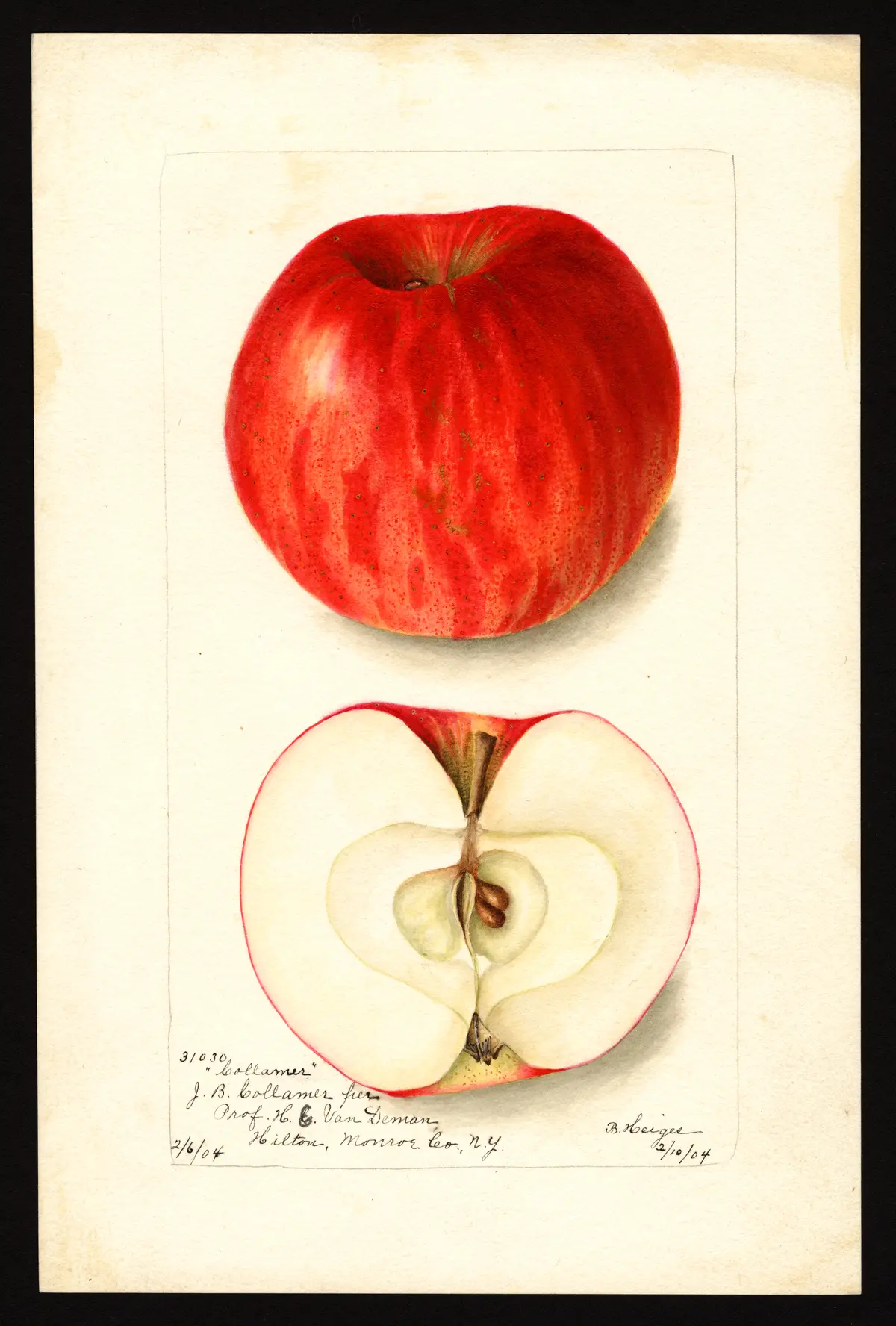
USDA Pomological Watercolor Collection
Collamer
Origin/History
Collamer is a sport of Twenty Ounce, originating in Hilton, New York, in the orchard of J. B. Collamer. The two sources differ on the date: Beach (1905) states that Mr. Collamer began propagating the variety about 1900, while Hedrick (1922) places the origin of the variety at about 1895. The variety is also known as Collamer Twenty Ounce.
Tree
The bark of the young twigs is more distinctly tinged with red than those of the parent variety, Twenty Ounce (Beach). Both sources refer the reader to the Twenty Ounce description for a full technical account of the tree.
Fruit
General: Collamer is more regular in shape than Twenty Ounce and, if ribbed at all, is less distinctly ribbed.
Skin: The defining characteristic distinguishing Collamer from Twenty Ounce is its coloration. Collamer is less mottled and striped than Twenty Ounce, but more completely covered with red; the red often extends in an unbroken blush over a considerable portion of the fruit. In the Twenty Ounce, an unbroken blush of this kind is seldom or never seen — the red appears instead as mottling or heavy stripes and splashes (Beach). The brighter, more solid red color makes the fruit more attractive than Twenty Ounce (Beach; Hedrick).
Size, form, stem, cavity, calyx, basin, flesh, core, seeds: Both sources refer the reader to the Twenty Ounce description for these technical details.
Season
Not described in source.
Uses
Considered more valuable as a commercial apple than Twenty Ounce by virtue of its more attractive coloring. Beach notes it is worthy of consideration for commercial planting where an apple of the Twenty Ounce type is desired.
Subtypes/Variants
Not described in source.
Book Sources
Described in 2 period pomological works
View original book sources (2)
— S.A. Beach, The Apples of New York, Vol. 2 (1905)COLLAMER.
The Collamer or Collamer Twenty Ounce is a sport of the Twenty Ounce, from which it differs in being more highly colored. As compared with Twenty Ounce, it is less mottled and striped but more completely covered with red, which often extends in an unbroken blush over a considerable portion of the fruit. In the Twenty Ounce this is seldom or never seen, but the red is mottled or appears in heavy stripes and splashes. So far as we have been able to determine, Collamer is more regular in shape and, if ribbed at all, is less distinctly ribbed than Twenty Ounce. The tree differs from Twenty Ounce in that the bark of the young twigs is more distinctly tinged with red. The fruit being more attractive than Twenty Ounce, Collamer is worthy of consideration for commercial planting where an apple of the Twenty Ounce type is desired. Except in the points of difference above noted, Collamer appears to be identical with Twenty Ounce, and the reader is referred to the description of that variety for a technical account of the tree and fruit.
Historical. This variety originated as a sport of the Twenty Ounce tree in the orchard of J. B. Collamer, Hilton, N. Y. Mr. Collamer began propagating it about 1900.
— U.P. Hedrick, Cyclopedia of Hardy Fruits (1922)COLLAMER.
This variety is a sport of the well-known Twenty Ounce, from which it differs in bearing fruits more solidly covered with red, more regular in shape, and less ribbed. The brighter color of Collamer makes it a more valuable commercial apple than Twenty Ounce. The variety originated at Hilton, New York, in the orchard of J. B. Collamer, about 1895. For a technical account of fruit and tree, the reader is referred to Twenty Ounce.