Colmar d'Aremberg Pear
Pear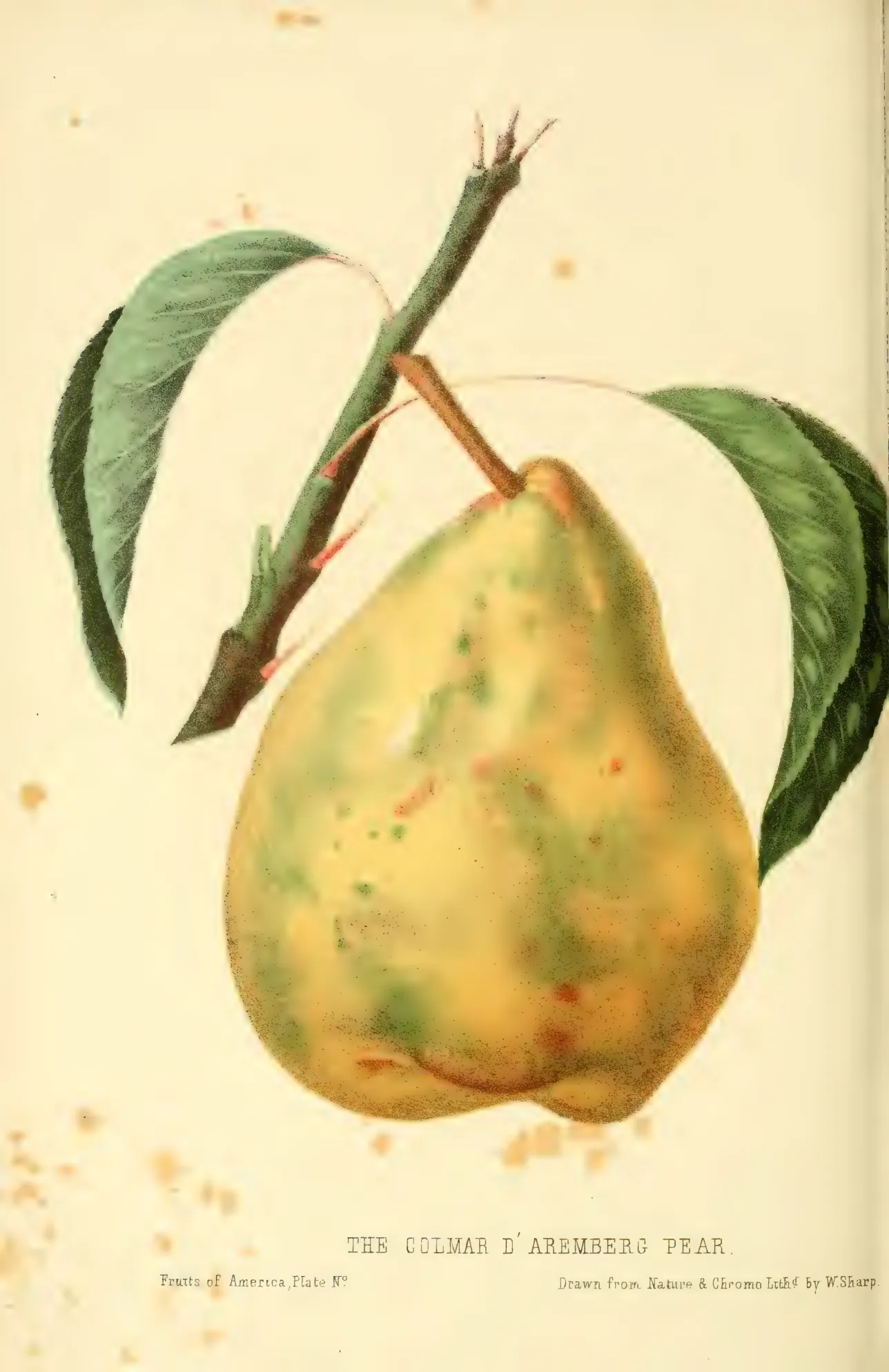
Colmar d'Aremberg Pear
Origin and History
The Colmar d'Aremberg is attributed to Van Mons as an origin source. M. Bivort includes it in his Album de Pomologie under the name Kartoffel, noting that information about the variety was communicated by M. Millot of Nancy. According to Millot's account, the variety originally came from Van Mons without a name, marked only as No. 224, which corresponds in Van Mons' printed 1825 catalogue to the Kartoffel birne. Despite having been called one of Van Mons' seedlings, the name suggests a German origin. It was introduced to American collections in 1845 and first fruited in 1847.
The reputation of the Colmar d'Aremberg does not appear to be fully established. Its character is variable—sometimes excellent, and again of only medium quality. More experience is needed to test its real merits fully. However, when observed under various conditions of soil, locality, and exposure, it proves itself a variety well worthy of cultivation.
Tree
The Colmar d'Aremberg is a distinct growing tree, very erect and upright in habit, making but few lateral shoots. Those shoots that do develop are very strong and vigorous, and the whole tree is studded with numerous short stocky spurs. The tree is moderately vigorous overall, branching off at an acute angle. Annual shoots are very stout, with downy ends. The tree succeeds very well on quince stock, though it requires good cultivation to produce large specimens.
Wood and Buds
The wood is yellowish brown, stout, and short-jointed, dotted with numerous small roundish russet specks. Old wood is grayish olive in color. Buds are small, short, and flattened, with little divergence from the twig. Flower-buds are medium size, ovate, angular, and pointed, with a dark shining brown color little shaded with gray.
Leaves
Leaves are large and narrow oval in form, tapering to a fine point. They are thick, with a deep glossy green color, flat surface, and coarsely and deeply serrated margins. Petioles are medium length, about one and one-quarter inches long, and stout.
Flowers
Flowers are small. Petals are small, roundish ovate, and cupped. Flower clusters are compact.
Fruit
The fruit is very large, approximately four and one-half inches long and three and one-half inches in diameter. Form is obtusely pyramidal with an uneven surface, largest about the middle, rounding off gradually to the crown and tapering to the stem, near which it is slightly contracted on one side.
The skin is fair and slightly rough, pale green in color, becoming yellowish when mature. It is traced and netted with russet around the crown and stem, and is thickly covered with conspicuous reddish russet specks.
The stem is medium length, about one inch long, stout, and slightly swollen at the base. It is obliquely inserted in a slight cavity with a high projection on one side.
The eye is medium size and open, sunk very deeply in a large funnel-shaped, somewhat angular basin. The segments of the calyx are very short and rounded.
The flesh is yellowish white, fine-grained, melting, half buttery, and juicy. The flavor is rich, sugary, perfumed, and excellent. The core is large. Seeds are large, broad, and dark brown in color.
Identification Note
When well grown and properly ripened, the Colmar d'Aremberg approaches the Passe Colmar so closely that experienced judges have been known to mistake one for the other. It is of the largest size, nearly equal to the Duchess of Angouleme, often weighing eighteen or twenty ounces.
Season and Uses
The fruit ripens in November and December. It is a variety well worthy of cultivation.
Book Sources
Described in 1 period pomological work
View original book sources (1)
— C.M. Hovey, The Fruits of America (1852)THE COLMAR D'AREMBERG PEAR.
Colmar d'Aremberg. Magazine of Horticulture, vol xiv. p. 110. Kartoffel, Album de Pomologie, vol. i.
The Colmar d'Aremberg is one of the few pears whose reputation does not seem to be fully established. Its character appears to be variable; sometimes excellent, and again of only medium quality; and more experience is wanting to test its real merits. So far, however, as we have had an opportunity of seeing it under various conditions of soil, locality and exposure, we consider it a variety well worthy of cultivation. It is of the largest size, nearly equal to the Duchess of Angouleme, often weighing eighteen or twenty ounces, and when well grown, and properly ripened, so nearly approaches a Passe Colmar, that we have known good judges to mistake it for that fine pear.
The origin of the Colmar d'Aremberg is attributed to Van Mons. M. Bivort, who figures it in his Album under the name of Kartoffel, remarks that his information in regard to the variety was communicated by M. Millot of Nancy, who states that it originally came from Van Mons without name, marked No. 224, which corresponds, in his printed Catalogue of 1825, to the Kartoffel birne: hence, he observes, it has been called one of his seedlings, notwithstanding its name indicates a German origin. It was introduced to our American Collections in 1845, and first fruited, we believe, in 1847.
The Colmar d'Aremberg is a distinct growing tree: very erect and upright in its habit, making but few lateral shoots, and those very strong and vigorous; the whole being studded with numerous short stocky spurs. It succeeds very well upon the quince, requiring good cultivation to produce large specimens.
Tree. — Moderately vigorous, upright and erect in habit, branching off at an acute angle: annual shoots, very stout, downy at the ends.
Wood. — Yellowish brown, dotted with numerous small roundish russet specks, stout, and short-jointed; old wood, grayish olive; buds, small, short, flattened, little diverging: Flower-buds, medium size, ovate, angular, pointed, dark shining brown, little shaded with gray.
Leaves. — Large, narrow oval, tapering to the point, thick, deep glossy green, flat, coarsely and deeply serrated; petioles, medium length, about one and a quarter inches long, stout.
Flowers. — Small; petals small, roundish ovate, cupped; clusters, compact.
Fruit. — Very large, about four and a half inches long, and three and a half in diameter: Form, obtusely pyramidal, with an uneven surface, largest about the middle, rounding off to the crown, and tapering to the stem, near which it is little contracted on one side: Skin, fair, slightly rough, pale green, becoming yellowish when mature, traced and netted with russet around the crown and stem, and thickly covered with conspicuous, reddish russet specks: Stem, medium length, about an inch long, stout, slightly swollen at the base, and obliquely inserted in a slight cavity, with a high projection on one side: Eye, medium size, open, and very deeply sunk in a large funnel-shaped, somewhat angular basin; segments of the calyx very short, and rounded: Flesh, yellowish white, fine, melting, half buttery, and juicy: Flavor, rich, sugary, perfumed, and excellent: Core, large: Seeds, large, broad, dark brown.
Ripe in November and December.