Colvert
Apple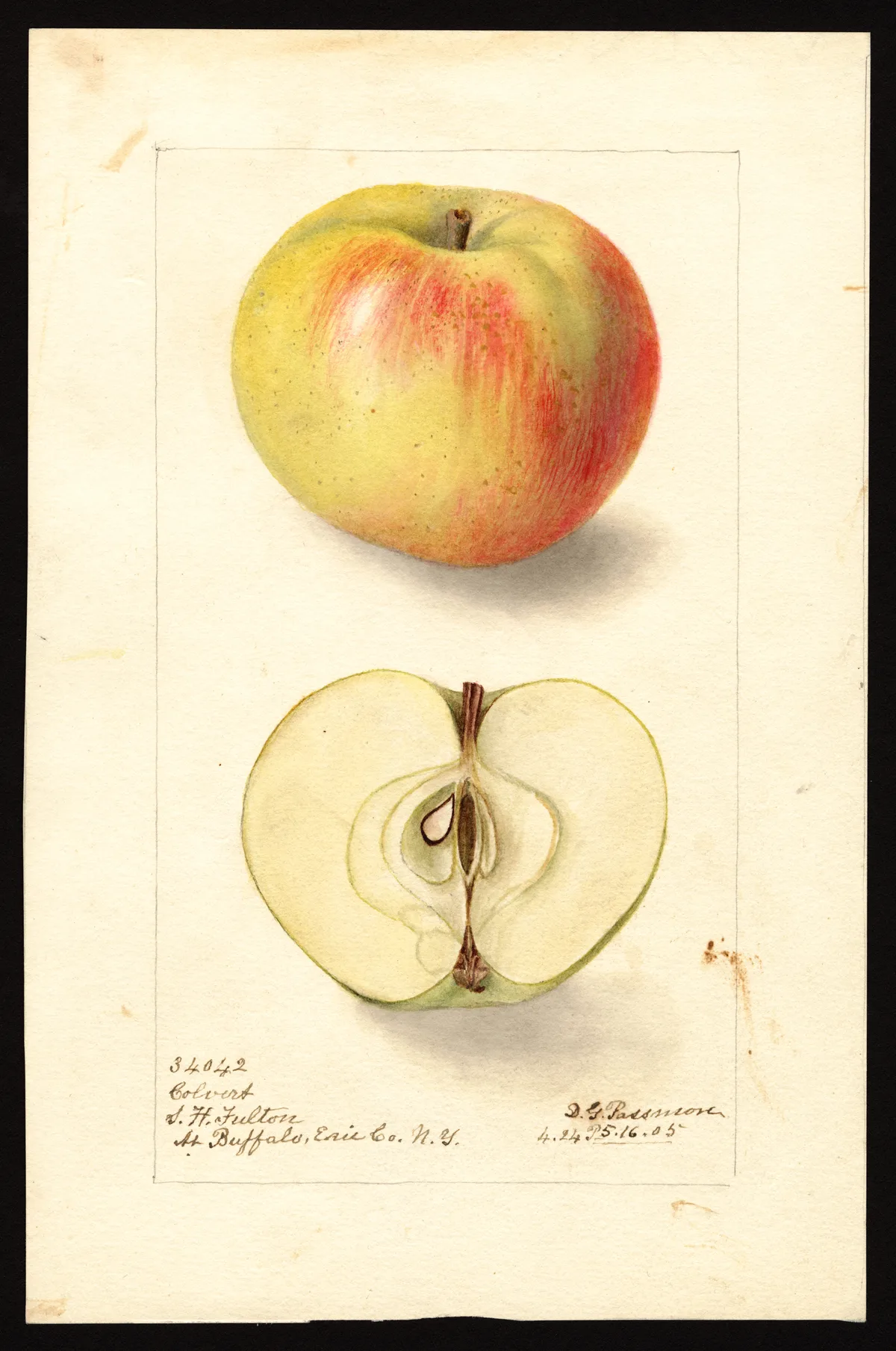
USDA Pomological Watercolor Collection
Origin & History
An old variety of uncertain origin. It has long been known and pretty widely disseminated but is not much grown in New York. Even in those localities where it is best known the trees of this variety constitute less than one per cent of the orchards (Beach). Valued mainly for cooking (Downing). Thomas notes it succeeds well in the Northwest.
Tree
Medium size to large, moderately vigorous to vigorous. Downing describes it as "a strong grower, and an enormous bearer." Branches long, medium stout, curved, crooked. Form upright spreading or roundish, open. Twigs above medium to long, usually nearly straight, moderately stout; internodes medium. Bark rather dark brownish-red, shaded with olive-green, lightly streaked with scarf-skin; pubescent. Lenticels scattering, medium, oblong, raised. Buds medium to large, broad, prominent, very plump, obtuse, free, pubescent. Leaves medium in size, broad. The tree is generally hardy, healthy and an excellent cropper, and generally succeeds well on any good apple land (Beach).
Fruit
Size: Large, fairly uniform in size.
Form: Oblate to oblate conic, obscurely ribbed, irregular and with sides sometimes unequal (Beach). Warder describes it as roundish-oblate, slightly conic, regular, often unequal. Thomas simply notes oblate.
Stem: Short, rather thick (Beach). Medium (Warder).
Cavity: Acute to slightly acuminate, medium to nearly deep, medium in width to sometimes broad, usually very heavily russeted, sometimes compressed and frequently lipped (Beach). Warder describes it as rather deep, acute, brown.
Calyx: Medium, closed or slightly open; lobes short, narrow, acuminate (Beach). Eye medium (Warder).
Basin: Abrupt, medium in depth, narrow, slightly furrowed (Beach). Warder describes it as deep, abrupt, regular, folded.
Skin: Very thick, rather tough, rather dull greenish-yellow, sometimes partly washed with red and striped and splashed with carmine. Dots inconspicuous, small, usually submerged; a few scattering ones are large and russet. Prevailing color greenish-yellow, not particularly attractive (Beach). Warder describes the surface as smooth, yellowish-green, mixed, striped, light red, with dots scattered, distinct, white. Downing describes it as greenish yellow, striped and shaded with dull red in sun. Beach notes the fruit is smooth and showy and fairly attractive for market despite the prevailing color being not particularly attractive, and that it ripens about with Twenty Ounce but is inferior to that variety in size, color, and quality. It needs to be picked early to prevent loss from dropping.
Calyx Tube: Broadly conical to funnel-shape. Stamens median to basal (Beach).
Flesh & Flavor: Beach describes the flesh as tinged with yellow, firm, nearly coarse, crisp, moderately tender, juicy, subacid, good. Warder describes it as white, breaking, fine-grained, juicy, with flavor sub-acid and quality "scarcely good." Downing describes it as greenish white, tender, brisk subacid, rating it "Good." Thomas rates quality as moderate.
Core & Seeds: Core axile, small; cells closed or partly open. Carpels broad-cordate, emarginate, tufted. Seeds large to above medium, wide, rather long, plump, acute; frequently they are abortive (Beach). Warder describes the core as round, flattened, slightly open, meeting the eye, with seeds numerous, long, pointed, imperfect.
Season
October to November (Warder, Downing). Beach extends the season to October through January or February, noting it is not a good keeper and is not much in demand among buyers, though it sometimes sells pretty well.
Uses
Market chiefly (Warder). Culinary (Thomas, Downing). Beach notes it is more productive than Twenty Ounce but not as good a seller.
Subtypes & Variants
Not described in source.
Other
Beach provides references: 1. Warder, 1867:427. 2. Downing, 1869:131. 3. Am. Pom. Soc. Cat., 1875:6. 4. Thomas, 1885:506. 5. Lyon, Mich. Hort. Soc. Rpt., 1890:290. 6. Bailey, An. Hort., 1892:237. 7. Powell and Fulton, U. S. B. P. I. Bul., 48:39. 1903.
The Encyclopedia of Practical Horticulture (Lowther, 1914) contains no prose description; the variety appears only in a variety-characteristic table:
Description absent; variety present in variety-characteristic table.
Colvert............ L rob yr G b a 3* 2* ......
Book Sources
Described in 5 period pomological works
Nursery Catalog Sources
Found in 8 catalogs (1886–1909) from Alabama, Illinois, Maryland, Massachusetts, New Jersey, Pennsylvania
- Huntsville Wholesale Nurseries (Jessie S. Moss , Proprietor; W.F. Heikes, Manager), Huntsville , Alabama — 1886
- William H. Moon Co. , Morrisville, Bucks County , Pennsylvania — 1890
- Rogers Nursery Co. , Moorestown , New Jersey — 1893
- Reading Nursery , Jacob W. Manning, Proprietor, Reading , Massachusetts — 1898
- Brown Brothers Co. , Continental Nurseries, Rochester, NY (also operated from Toronto, Canada) — 1899
- Brown Brothers Co. , Continental Nurseries, Rochester, NY (also operated from Toronto, Canada) — 1901
- Phoenix Nursery Company (W. E. Rossney , President; Sidney Tuttle, Vice-President), Bloomington , Illinois — 1904
- Wm. J. Corse (successor to Robert Sinclair / Sinclair Nurseries) , Baltimore , Maryland — 1909
View original book sources (5)
— John A. Warder, American Pomology: Apples (1867)Colvert.
Fruit large, roundish-oblate, slightly conic, regular, often unequal ; Surface smooth, yellowish-green, mixed, striped, light red ; Dots scattered, distinct, white.
Basin deep, abrupt, regular, folded ; Eye medium.
Cavity rather deep, acute, brown ; Stem medium.
Core round, flattened, slightly open, meeting the eye ; Seeds numerous, long, pointed, imperfect ; Flesh white, breaking, fine-grained, juicy ; Flavor sub-acid; Quality scarcely good ; Use, market chiefly ; Season October, November.
— A.J. Downing, The Fruits and Fruit Trees of America (1900)Colvert.
Prussian.
An old variety, of uncertain origin, valued mainly for cooking.
Tree a strong grower, and an enormous bearer.
Fruit large, oblate, inclining to conic, greenish yellow, striped and shaded with dull red in sun. Flesh greenish white, tender, brisk subacid. Good. October, November.
— S.A. Beach, The Apples of New York, Vol. 2 (1905)COLVERT.
REFERENCES. 1. Warder, 1867:427. 2. Downing, 1869:131. 3. Am. Pom. Soc. Cat., 1875:6. 4. Thomas, 1885:506. 5. Lyon, Mich. Hort. Soc. Rpt., 1890:290. 6. Bailey, An. Hort., 1892:237. 7. Powell and Fulton, U. S. B. P. I. Bul., 48:39. 1903.
SYNONYMS. Colvert (1, 2, 3, 4, 5, 6, 7). Prussian (2).
Ripens about with Twenty Ounce. It is inferior to that variety in size, color and quality, and is not as good a seller, but is more productive. The fruit is large, uniform in size, yellowish-green shaded and lightly striped with pinkish-red on the sunny side, smooth, showy and fairly attractive. It needs to be picked early to prevent loss from dropping. It is not a good keeper and is not much in demand among buyers, but sometimes it sells pretty well.
The tree is generally hardy, healthy and an excellent cropper. It generally succeeds well on any good apple land.
Historical. Origin uncertain (2). It has long been known and pretty widely disseminated but it is not much grown in New York. Even in those localities where it is best known the trees of this variety constitute less than one per cent of the orchards.
TREE.
Tree medium size to large, moderately vigorous to vigorous; branches long, medium stout, curved, crooked. Form upright spreading or roundish, open. Twigs above medium to long, usually nearly straight, moderately stout; internodes medium. Bark rather dark brownish-red, shaded with olive-green, lightly streaked with scarf-skin; pubescent. Lenticels scattering, medium, oblong, raised. Buds medium to large, broad, prominent, very plump, obtuse, free, pubescent. Leaves medium in size, broad.
FRUIT.
Fruit averages large, fairly uniform in size but rather variable in shape. Form oblate to oblate conic, obscurely ribbed, irregular and with sides sometimes unequal. Stem short, rather thick. Cavity acute to slightly acuminate, medium to nearly deep, medium in width to sometimes broad, usually very heavily russeted, sometimes compressed and frequently lipped. Calyx medium, closed or slightly open; lobes short, narrow, acuminate. Basin abrupt, medium in depth, narrow, slightly furrowed.
Skin very thick, rather tough, rather dull greenish-yellow, sometimes partly washed with red and striped and splashed with carmine. Dots inconspicuous, small, usually submerged; a few scattering ones are large and russet. Prevailing color greenish-yellow, not particularly attractive.
Calyx tube broadly conical to funnel-shape. Stamens median to basal.
Core axile, small; cells closed or partly open. Carpels broad-cordate, emarginate, tufted. Seeds large to above medium, wide, rather long, plump, acute; frequently they are abortive.
Flesh tinged with yellow, firm, nearly coarse, crisp, moderately tender, juicy, subacid, good.
Season October to January or February.
— Granville Lowther (ed.), Encyclopedia of Practical Horticulture (1914)Colvert............ L rob yr G b a 3* 2* ......
— John J. Thomas, The American Fruit Culturist (1903)Colvert. Large, oblate, striped; sub-acid, quality moderate—culinary. Autumn. Succeeds well Northwest.