Conference
Pear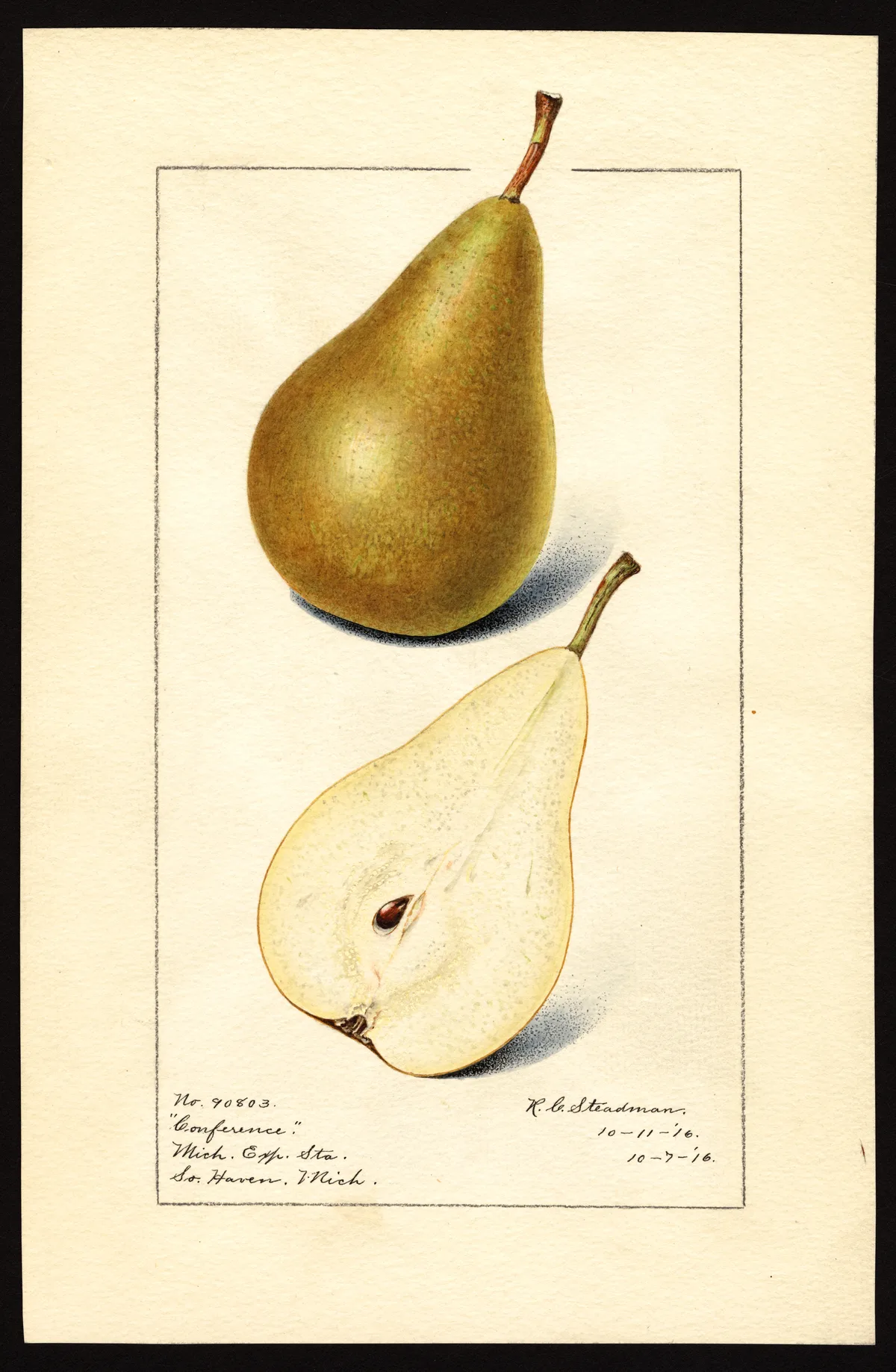
USDA Pomological Watercolor Collection
Conference Pear
Origin and History
Named after the National (British) Pear Conference of 1885. Originated by Rivers, the English pomologist, and introduced in 1894. It is now grown in enormous quantities in England for market purposes and is said to be one of the most regular cropping varieties.
Tree
Moderate grower, very productive.
Fruit
Size: Medium to above medium.
Form: Slightly long-gourd-shaped, even.
Skin: Smooth, shining green, dotted with russet.
Stem: Long and woody.
Calyx: Open, set in a shallow basin.
Flesh: Pale yellow with a slight pinkish tinge, melting, very juicy, sweet, flavor rated good.
Core and Seeds: Not described in source.
Season
October and November.
Uses
Not described in source.
Subtypes or Variants
Not described in source.
Other
Not described in source.
Book Sources
Described in 1 period pomological work
Nursery Catalog Sources
Found in 5 catalogs (1897–1917) from England
- Kelway & Son , Langport, Somerset , England — 1897
- James Veitch & Sons , Ltd., Royal Exotic Nursery, Chelsea, London (also Coombe Wood, Langley, and Feltham) , England — 1911
- Thomas Rivers & Son , Sawbridgeworth, Hertfordshire , England — 1913
- George Bunyard & Co. , Royal Nurseries, Maidstone, Kent , England — 1914
- George Bunyard & Co. , Royal Nurseries, Maidstone, Kent , England — 1917
View original book sources (1)
— U.P. Hedrick, The Pears of New York (1921)Conference. 1. Nicholson Dict. Gard. 3:51. 1900. 2. Garden 62:367, fig. 1902. 3. Bunyard Handb. Hardy Fr. 166. 1920.
Named after the National (British) Pear Conference of 1885. Originated by Rivers, the English pomologist, and introduced in 1894. It is now grown in enormous quantities in England for market purposes and is said to be one of the most regular cropping varieties. Tree a moderate grower, very productive. Fruit medium to above, slightly long-gourd-shaped, even, smooth, shining green, dotted with russet; stem long, woody; calyx open in a shallow basin; flesh pale yellow, slight pinkish tinge, melting, very juicy, sweet, good; Oct. and Nov.