Cooper's Market
Apple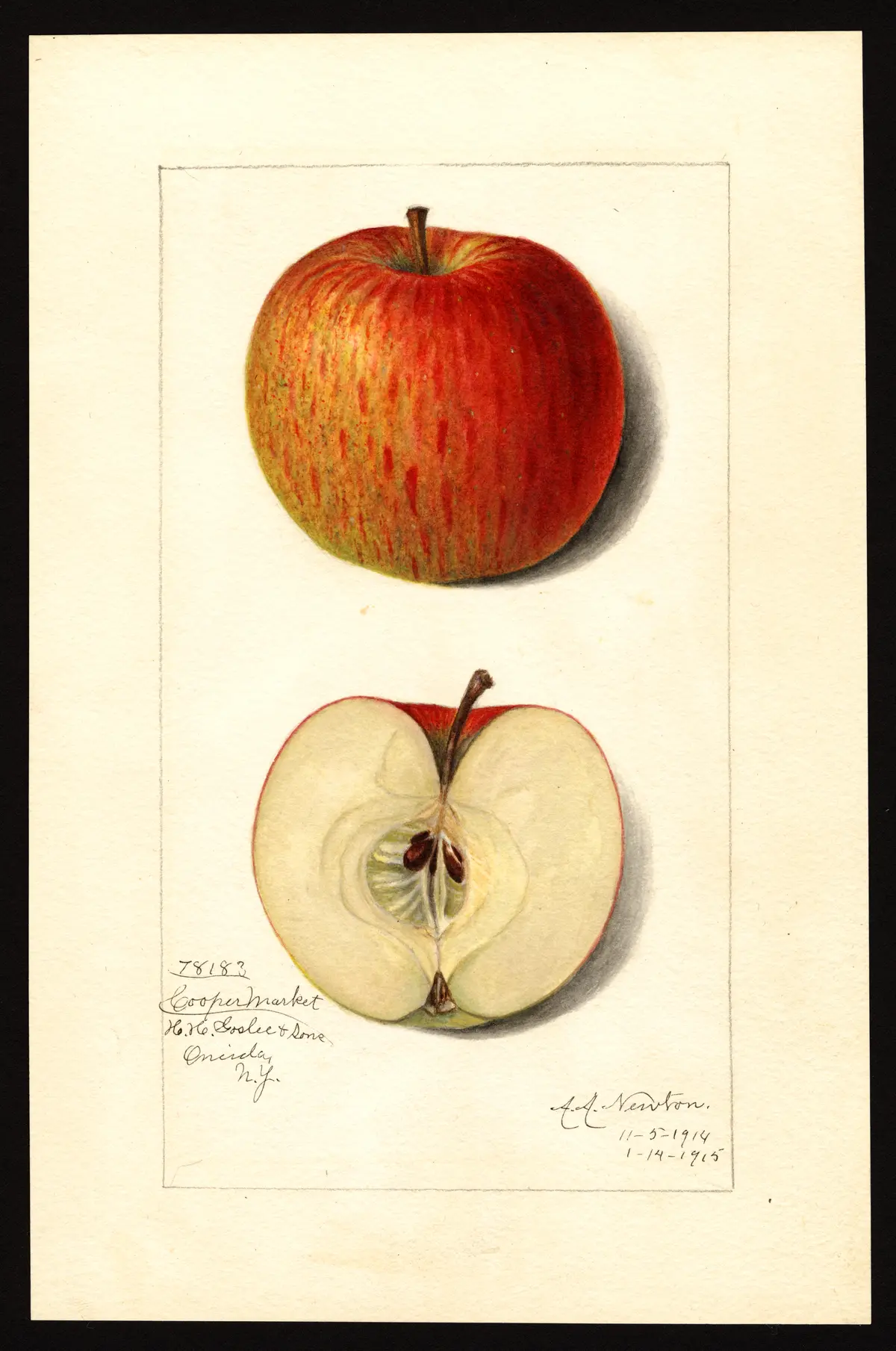
USDA Pomological Watercolor Collection
Cooper's Market
Origin / History
Now believed to be of Pennsylvania origin and identical with the Redling of Coxe and others (Beach). First described in 1804 (Hedrick). For nearly a century Cooper's Market was a standard commercial apple in northern regions, valued for its capacity to keep, attractive color and form in the fruit, and vigor, hardiness, healthfulness, and productiveness in the trees. By 1922 the variety was passing from cultivation because the apples are small and their quality is poor (Hedrick). Valuable for market in New Jersey (Downing); profitable, although not of highest quality, in New Jersey (Thomas, 1903).
Beach notes that the fact that "Cooper's Red" is a synonym for Etowah has led some to confuse that variety with Cooper's Market, but the two are quite distinct.
Tree
Tree hardy, moderately vigorous to vigorous, upright in form, with long, slender, rather drooping lateral branches; very productive, one of the most reliable croppers, and not slow in coming into bearing. It bears such heavy crops that it requires more than ordinary attention in pruning to keep the fruit uniformly of marketable size. The fruit hangs to the tree remarkably well. A late keeper.
Twigs: below medium to above medium in caliber, rather slender, nearly straight; internodes short to medium.
Bark: dull, dark brownish-red with considerable olive-green in some specimens, uniformly overlaid with a moderately heavy scarf-skin, heavily pubescent.
Lenticels: moderately conspicuous, slightly raised, numerous, usually large but varying to small, roundish or elliptical.
Buds: small, almost sunk in the bark, obtuse, rather pubescent; scales sometimes divided.
Fruit
Size: Sources vary. Warder, Downing, Elliott, Thomas (1903), and Lowther give medium. Budd-Hansen give small to medium. Beach gives medium or below, sometimes nearly large, and notes the variety is often somewhat deficient in size. Hedrick gives medium or large.
Form: Sources describe the form variously. Warder, Elliott, and Thomas (1903) give oblong-conic / oblong conical. Downing gives oblate conic. Budd-Hansen give round oblate conic. Lowther codes the form as "re" (round). Beach gives roundish ovate varying to roundish conic, flattened at the base and often narrowing sharply towards the apex, pretty symmetrical. Hedrick gives round-ovate to round-conic, flattened at the base and often narrowing sharply towards the apex, symmetrical.
Stem / Stalk: Warder, Downing, Elliott, Thomas (1903), and Budd-Hansen give short (Budd-Hansen: short to medium). Beach gives medium to long, slender. Hedrick gives long, slender.
Cavity: deep, narrow; acute to acuminate (Beach) / acuminate (Hedrick); sometimes slightly furrowed; often russeted.
Calyx: closed; small, pubescent (Beach, Hedrick).
Basin: small; often oblique, shallow, narrow, obtuse to abrupt, somewhat furrowed, wrinkled (Beach); shallow, slightly irregular (Budd-Hansen); small, often oblique, shallow, narrow, obtuse, furrowed, wrinkled (Hedrick).
Skin: tough, smooth, glossy; ground color yellowish / greenish-yellow / greenish yellow, shaded, mottled, and blushed with red (Budd-Hansen: heavily shaded with purplish red), conspicuously splashed and striped with crimson / bright carmine, and partly covered with a light bloom (Beach, Hedrick). In fall the color is rather dull but in ordinary storage it improves noticeably as the season advances, becoming bright red with a yellowish-green background (Beach). The variety is esteemed for holding a bright color late in the season; it improves in color in the package when held in common storage, but does not show as great improvement of this kind in cold storage (Beach). Lowther codes the color as "yv". Color: yellowish-green/greenish-yellow base with red shading and crimson/bright carmine striping is the consensus.
Dots: Budd-Hansen give few. Beach and Hedrick describe them as whitish or white with a russet point, numerous and small towards the cavity, scattering, large and often irregular towards the basin.
Calyx tube: small, short, cone-shape (Beach, Hedrick).
Stamens: median to nearly marginal (Beach); median (Hedrick).
Core: distant, truncate, abaxile, medium; cells closed or open, often part of them unsymmetrical; core lines slightly clasping (Beach) / clasping (Hedrick). Budd-Hansen give core medium, somewhat open.
Carpels: roundish, slightly emarginate, somewhat tufted (Beach); round, emarginate, tufted (Hedrick).
Seeds: numerous, dark, plump, acute; medium to short (Beach) / short (Hedrick).
Flesh: white (Warder, Downing, Elliott, Thomas 1903, Budd-Hansen); whitish tinged with yellow (Beach); yellow (Hedrick). Tender; very firm and a little coarse, moderately tender, juicy (Beach); very firm, coarse, tender, juicy (Hedrick). Flavor brisk subacid (sub-acid).
Quality: good (Downing, Budd-Hansen, Lowther). Beach rates the flesh fair to good, noting that although not of high quality it is fairly good when compared with other very late keeping varieties; he describes the variety overall as attractive in color and form but not of high quality. Hedrick rates fair to good.
Season
December to May (Warder, Downing, Elliott, Budd-Hansen). Through winter (Thomas, 1903); winter (Lowther). January to June (Beach, Hedrick). It may be held very late in common storage. Grown to a limited extent in commercial orchards; desirable for supplying the general trade after the Baldwin season has closed (Beach).
Uses
Market (Lowther). Especially esteemed for its keeping qualities (Beach). Grown commercially, particularly in New Jersey.
Subtypes / Variants
Not described in source.
Other
Lowther's tabular data: reported from 2 stations in the Northern Division and 2 stations in the Central Division (both reported in more than one division); no stations reported in the Southern Division. Wickson (1891) and other western references cited by Beach indicate the variety reached Pacific Coast horticultural literature by the late nineteenth century.
Book Sources
Described in 8 period pomological works
- Beach, The Apples of New York Vol. 1 (1905) — listed as Cooper Market
- Hedrick, Cyclopedia of Hardy Fruits (1922) — listed as COOPER MARKET
- Warder, American Pomology: Apples (1867)
- Downing, Fruits and Fruit Trees of America (1900)
- Elliott, The Western Fruit Book (1865)
- Budd & Hansen, Systematic Pomology (1914) — listed as Cooper Market
- Lowther (ed.), Encyclopedia of Practical Horticulture (1914) — listed as Cooper Market
- Thomas, The American Fruit Culturist (1903) — listed as Cooper's Red
Nursery Catalog Sources
Found in 14 catalogs (1889–1921) from California, Illinois, Oregon, Washington
- California Nursery Co. , Niles , California — 1889
- Milwaukie-Canby Nurseries , Canby, OR (and Milwaukie, OR) — 1893
- Sherwood Hall Nursery Co. , Timothy Hopkins (Menlo Park Nurseries), San Francisco / Menlo Park , California — 1893
- Multnomah Nurseries , Russellville , Oregon — 1894
- Central Experimental Farm , Dominion Department of Agriculture, Agassiz, British Columbia (under test; Bulletin No. 3, Second Series) — 1900
- Washington Nursery Co. , Toppenish , Washington — 1901
- Benjamin Buckman (personal inventory) , Farmingdale , Illinois — 1901
- The Dalles Nurseries , The Dalles , Oregon — 1906
- Washington Nursery Company , Toppenish , Washington — 1909
- Pacific Nursery Company , Portland , Oregon — 1912
- Washington Nursery Company , Toppenish , Washington — 1912
- Benjamin Buckman (personal inventory) , Farmingdale , Illinois — 1913
- Union Nurseries , J.B. Weaver & Sons, Union , Oregon — 1915
- Benedict Nursery Co. , Portland , Oregon — 1921
View original book sources (8)
— John A. Warder, American Pomology: Apples (1867)Cooper's Market.
COOPER'S REDLING.
"Fruit medium, oblong-conic; Skin yellowish, shaded with red, and striped with crimson; Stem short, cavity deep, narrow; Calyx closed, basin small; Flesh white, tender, with a brisk sub-acid flavor; December to May." — (Downing.)
— A.J. Downing, The Fruits and Fruit Trees of America (1900)Cooper's Market.
Cooper's Redling. Bigley. Redling.
Tree hardy, vigorous, upright, with long slender branches, very productive and a late keeper. Valuable for market in New Jersey.
Fruit medium, oblate conic, yellowish, shaded with red and striped with crimson. Stalk short. Cavity deep, narrow. Calyx closed. Basin small. Flesh white, tender, with a brisk subacid flavor. Good. December to May.
— S.A. Beach, The Apples of New York, Vol. 1 (1905)COOPER MARKET.
REFERENCES. 1. Mease, Willichs Dom. Encyc., 1804. (cited by 15). 2. M'Mahon, Amer. Gard. Cal., 1806. (cited by 13). 3. Coxe, 1817:137. fig. 4. Horticulturist, 9:291. 1854. col. pl. 5. Downing, 1857:130. 6. Mag. Hort., 25:53. 1859. 7. Am. Pom. Soc. Cat., 1862. 8. Warder, 1867:513. 9. Barry, 1883:344. 10. Thomas, 1885:232. 11. Lyon, Mich. Hort. Soc. Rpt., 1890:290. 12. Wickson, 1891:247. 13. Bailey, An. Hort., 1892:237. 14. Can. Hort., 16:33. 1893. 15. Ragan, Am. Pom. Soc. Rpt., 1901:49. 16. Waugh, Vt. Sta. An. Rpt., 14:291. 1901. 17. Budd-Hansen, 1903:67. 18. Thomas, 1903:325. 19. Beach and Clark, N. Y. Sta. Bul., 248:115. 1904.
SYNONYMS. COOPER'S MARKET (4, 5, 8, 9, 12, 13). Cooper's Market (10, 18). COOPER'S RED (10). COOPER'S RED incorrectly (18). COOPER'S REDLING (6). Cooper's Redling (5, 8, 10). Etowah, incorrectly (18). REDLING (1, 2, 3). Redling (9).
Attractive in color and form but not of high quality, often somewhat deficient in size. Especially esteemed for its keeping qualities and for holding a bright color late in the season. Grown to a limited extent in commercial orchards. Desirable for supplying the general trade after the Baldwin season has closed. It may be held very late in common storage. It improves in color in the package when held in common storage, but does not show as great improvement of this kind in cold storage (19).
The tree is hardy, one of the most reliable croppers, and not slow in coming into bearing. In fact, it bears such heavy crops that it requires more than ordinary attention in pruning to make the fruit uniformly of marketable size. The fruit hangs to the tree remarkably well.
Evidently the fact that Cooper's Red is a synonym for Etowah has led some to confuse that variety with Cooper Market (18). The two are quite distinct.
Historical. This is now believed to be of Pennsylvania origin and identical with the Redling of Coxe and others (1, 2, 3, 15).
Tree.
Tree moderately vigorous to vigorous; lateral branches long, slender and rather drooping. Form upright. Twigs below medium to above, rather slender, nearly straight; internodes short to medium. Bark dull, dark brownish-red with considerable olive-green in some specimens, uniformly overlaid with a moderately heavy scarf-skin, heavily pubescent. Lenticels moderately conspicuous, slightly raised, numerous, usually large but varying to small, roundish or elliptical. Buds small, almost sunk in the bark, obtuse, rather pubescent. Scales sometimes divided.
Fruit.
Fruit medium or below, sometimes nearly large. Form roundish ovate varying to roundish conic, flattened at the base and often narrowing sharply towards the apex, pretty symmetrical. Stem medium to long, slender. Cavity acute to acuminate, deep, rather narrow, sometimes slightly furrowed, often russeted. Calyx small, closed, pubescent. Basin small, often oblique, shallow, narrow, obtuse to abrupt, somewhat furrowed, wrinkled. Skin tough, smooth, glossy, greenish-yellow, mottled and blushed with red, conspicuously splashed and striped with bright carmine and partly covered with a light bloom. Dots whitish or with russet point, numerous and small towards the cavity, scattering, large and often irregular towards the basin. In fall the color is rather dull but in ordinary storage it improves noticeably as the season advances, becoming bright red with a yellowish-green background. Calyx tube small, short, cone-shape. Stamens median to nearly marginal. Core distant, truncate, abaxile, medium; cells closed or open; often part of them are unsymmetrical; core lines slightly clasping. Carpels roundish, slightly emarginate, somewhat tufted. Seeds numerous, dark, medium to short, plump, acute. Flesh whitish tinged with yellow, very firm, a little coarse, moderately tender, juicy, brisk subacid, fair to good. Although not of high quality it is fairly good when compared with other very late keeping varieties. Season January to June.
— Granville Lowther (ed.), Encyclopedia of Practical Horticulture (1914)Cooper Market. Size: medium. Form: 're'. Color: 'yv'. Quality: good. Use: market. Season: winter. Northern Division: 2 stations (reported in more than one division). Central Division: 2 stations (reported in more than one division). Southern Division: no stations reported.
— F.R. Elliott, The Western Fruit Book (1865)Cooper's Market. Cooper's Redling.
Tree, vigorous, upright, with long slender branches. Productive, and a late keeper.
Fruit, medium, oblong conic; skin, yellowish, shaded with red, and striped with crimson; stem, short; cavity, deep, narrow; calyx, closed; basin, small; flesh, white, tender, with a brisk, sub-acid flavor. December to May. (Downing.)
— John J. Thomas, The American Fruit Culturist (1903)Cooper's Red. (Cooper's Market.) Size medium, oblong conical; shaded and striped with red on yellow; stalk short, cavity deep, narrow; basin small; flesh white, tender, with a brisk sub-acid flavor. Through winter. Shoots long, slender. Profitable, although not of highest quality, New Jersey.
— J.L. Budd & N.E. Hansen, American Horticultural Manual, Part II: Systematic Pomology (1914)Cooper Market.—Tree vigorous, upright, with long slender branches; very productive.
Fruit small to medium, round oblate conic; surface greenish yellow, heavily shaded with purplish red and striped with crimson; dots few; cavity deep, narrow; stem short to medium; basin small, shallow, slightly irregular; calyx closed. Core medium, somewhat open; flesh white, tender, brisk subacid, good. December to May.
— U.P. Hedrick, Cyclopedia of Hardy Fruits (1922)COOPER MARKET. Cooper's Red. For nearly a century Cooper Market was a standard commercial apple in northern regions. Its chief merits are capacity to keep, attractive color and form in the fruit, and vigor, hardiness, healthfulness, and productiveness in the trees. The variety is now passing from cultivation because the apples are small and their quality is poor. The variety is thought to have originated in Pennsylvania. It was first described in 1804.
Tree vigorous, upright, lateral branches long, slender and drooping. Fruit medium or large, round-ovate to round-conic, flattened at the base and often narrowing sharply towards the apex, symmetrical; stem long, slender; cavity acuminate, deep, narrow, sometimes furrowed, often russeted; calyx small, closed, pubescent; basin small, often oblique, shallow, narrow, obtuse, furrowed, wrinkled; skin tough, smooth, glossy, greenish-yellow, mottled and blushed with red, conspicuously splashed and striped with bright carmine and covered with light bloom; dots white or with a russet point, numerous and small towards the cavity, scattering, large and irregular towards the basin; calyx-tube small, short, cone-shape; stamens median; core distant, truncate, abaxile, medium; cells closed or open, often unsymmetrical; core-lines clasping; carpels round, emarginate, tufted; seeds numerous, dark, short, plump, acute; flesh yellow, very firm, coarse, tender, juicy, brisk subacid; fair to good; January to June.