Cooper's Russeting
Apple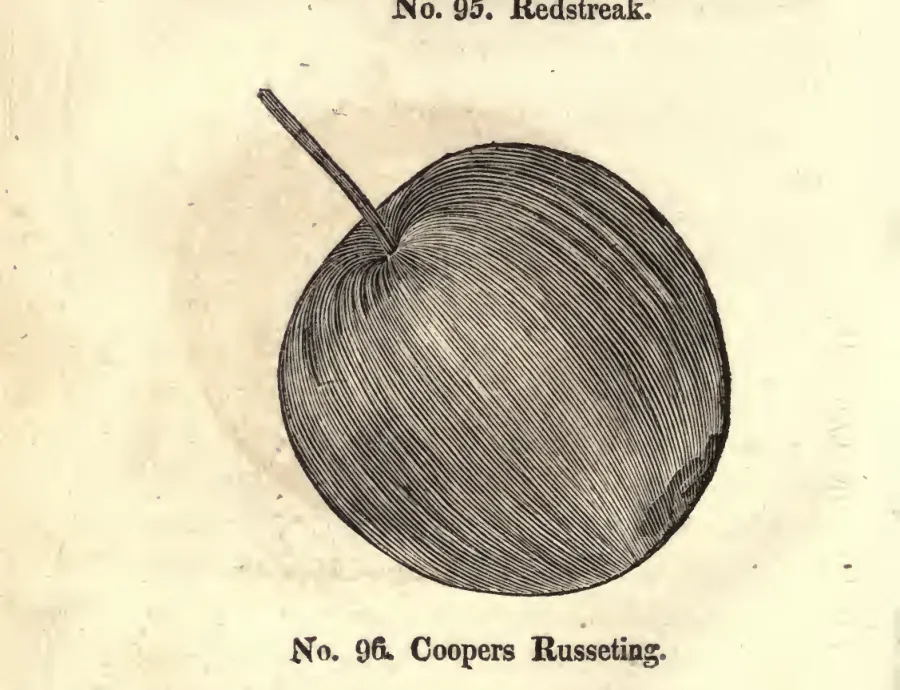
Origin/History
Cooper's Russeting originated in Gloucester County, New Jersey. According to Coxe (1817), it was first propagated from an ancient tree in the possession of Mr. Joseph Cooper of Gloucester County, who supposed it to be of Indian origin; strong doubts were entertained of that fact. Downing (1900) confirms the Gloucester County, New Jersey origin.
Tree
The tree is small and irregular in growth, with branches shooting in every direction. The wood is brittle and apt to be broken from the weight of fruit; this fault may be remedied in a great degree by pruning the lateral shoots and promoting the growth of the perpendicular shoots. The tree suits light, rich soils, in which it grows vigorously and bears abundantly. (Coxe)
Downing describes the tree as irregular in form, a healthy grower, and an abundant bearer.
Fruit
Size: Small.
Form: Oblong, conical, diminishing towards the crown. (Coxe; confirmed by Downing.)
Stem: Singularly long and thin. (Coxe)
Cavity: Not described in source.
Calyx: Not described in source.
Basin: Not described in source.
Skin: Pale yellow, mixed with russet. (Both sources agree.)
Flesh/Flavor: Dry, rich, and sweet. (Both sources agree.)
Core/Seeds: Not described in source.
Season
The fruit hangs until about the first of November and keeps well through the winter (Coxe). Downing gives the season as October to December.
Uses
An economical kitchen apple requiring but little sugar. (Coxe; Downing notes it as valuable for cooking.)
Highly regarded for cider. The cider is thought by Coxe to be the strongest in the country. When first made it is of a syrupy consistency and continues so through the winter; it is sometimes difficult to fine. When properly managed, it is a most exquisitely flavoured and vinous liquor. The must is uncommonly heavy, weighing twenty-four penny-weight in the pint heavier than water. (Coxe)
Subtypes/Variants
Not described in source.
Other
Not described in source.
Book Sources
Described in 2 period pomological works
View original book sources (2)
— William Coxe, A View of the Cultivation of Fruit Trees (1817)NO. 96. COOPERS RUSSETING.
This apple was first propagated from an ancient tree in the possession of Mr. Joseph Cooper of Gloucester county, New-Jersey, who supposed it to be of Indian origin; of this fact, strong doubts are entertained. The apple is small, of a pale yellow colour, mixed with russet; the form is oblong, diminishing towards the crown; the stem is singularly long and thin; the flesh is dry, rich, and sweet: the fruit hangs till about the first of November, it keeps well through the winter, and is an economical kitchen apple, requiring but little sugar. The cider is thought to be the strongest in our country: it is, when first made, of a sirupy consistence, continues so through the winter, and is sometimes difficult to fine; it is when properly managed, a most exquisitely flavoured and vinous liquor; the must is uncommonly heavy, weighing twenty-four penny-weight in the pint heavier than water: the tree is of small and irregular growth, the branches shoot in every direction, and the wood being brittle, is apt to be broken from the weight of fruit: this fault may be remedied in a great degree, by pruning the lateral, and promoting the growth of the perpendicular shoots. The tree suits light rich soils, in which it grows vigorously, and bears abundantly.
— A.J. Downing, The Fruits and Fruit Trees of America (1900)Cooper's Russeting.
Originated in Gloucester Co., N. J. Tree irregular in form, healthy grower, abundant bearer.
Fruit small, oblong, conical, pale yellow mixed with russet. Flesh rich, sweet, dry. Valuable for cooking or for cider. October to December.