Cornell
Apple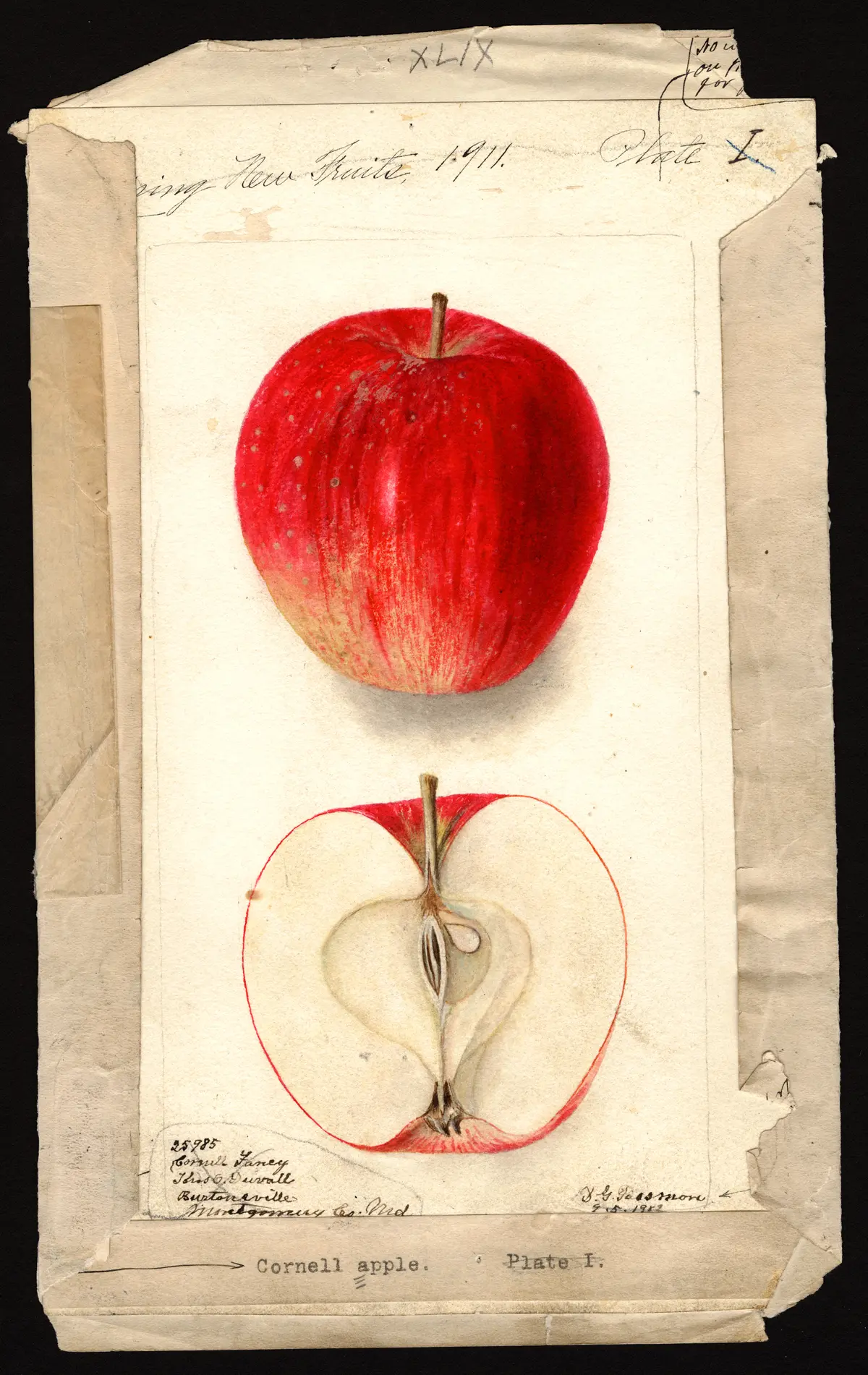
USDA Pomological Watercolor Collection
Cornell
Origin and History
Cornell originated in Pennsylvania (Downing, 1857). It was listed in the American Pomological Society Catalogue in 1862 and was known to the pomological literature through the latter half of the nineteenth century, but remained little known in New York at the time of Beach's writing (1905). The variety was sometimes sold or listed under the name Cornell Fancy.
Tree
The tree sometimes lacks vigor and productiveness (Beach, citing Farrand, Mich. Sta. Bul., 1903).
Fruit
Size and Form: Above medium to large, uniform in size, somewhat variable in shape. Form roundish conic to oblate conic, often quite strongly ribbed, irregular; sides usually unequal.
Stem: Medium to rather long and slender.
Cavity: Moderately deep to deep, moderately wide, often compressed, sometimes lipped, sometimes russeted, with the russet extending beyond the cavity.
Calyx: Below medium to rather large, closed or slightly open; lobes sometimes separated at the base, often upright, moderately acute. Calyx tube rather large, rather short, conical. Stamens median.
Basin: Deep, wide, rather abrupt, strongly furrowed, slightly wrinkled.
Skin: Moderately thick, tough, smooth, clear pale waxen yellow, partly overspread with thin attractive pinkish-red, often quite regularly splashed and striped with bright carmine. Dots conspicuous, variable, often large, irregular, russet or areolar with russet center, varying to small, light colored and submerged. Prevailing effect: handsome red striped over clear yellow.
Flesh and Flavor: Tinged with yellow, firm, moderately coarse, crisp, moderately tender, juicy, agreeable, mild subacid, aromatic, rich, sprightly; rated very good for dessert. Flesh is often affected with "Baldwin Spot."
Core and Seeds: Core below medium, variable, nearly axile to decidedly abaxile; cells variable, open or closed; core lines meeting or slightly clasping. Carpels broadly ovate, slightly emarginate, sometimes tufted. Seeds numerous, rather large, dark brown, rather narrow, long, plump, acute to acuminate, sometimes tufted.
Season
Early September to November.
Uses
Agreeable for dessert.
Note on the Lowther (1914) source: The Encyclopedia of Practical Horticulture entry consists entirely of a coded table row (M ob yr G b a 2* 6* 2*) without an accompanying key in the provided text. The interpretable codes are consistent with Beach: M = medium size, ob = oblate(-conic) form, yr = yellow-red color. The numeric ratings (2*, 6*, 2*) likely represent quality scores on the publication's rating scale but cannot be precisely decoded without the key. No details from this source contradict Beach.
Book Sources
Described in 2 period pomological works
View original book sources (2)
— S.A. Beach, The Apples of New York, Vol. 2 (1905)CORNELL.
REFERENCES. 1. Downing, 1857:131. 2. Am. Pom. Soc. Cat., 1862. 3. Warder, 1867:716. 4. Thomas, 1875:200. 5. Barry, 1883:337. 6. Lyon, Mich. Hort. Soc. Rpt., 1890:290. 7. Bailey, An. Hort., 1892:237. 8. Van Deman, Rural N. Y., 61:671. 1902. fig. 9. Farrand, Mich. Sta. Bul., 205:44. 1903. 10. Budd-Hansen, 1903:67.
SYNONYMS. CORNELL (6, 8, 9). CORNELL FANCY (1, 2, 3, 4, 5, 7). Cornell Fancy (8). CORNELL Fancy (10). Cornell's Favourite (1).
Fruit usually of good medium size, sometimes large, waxen yellow and red, agreeable for dessert, in season from early September to November. The tree sometimes lacks vigor and productiveness (9).
Historical. Origin Pennsylvania (1). It is but little known in New York.
FRUIT.
Fruit above medium to large, uniform in size, somewhat variable in shape. Form roundish conic to oblate conic, often quite strongly ribbed, irregular; sides usually unequal. Stem medium to rather long and slender. Cavity moderately deep to deep, moderately wide, often compressed, sometimes lipped, sometimes russeted, with the russet extending beyond the cavity. Calyx below medium to rather large, closed or slightly open; lobes sometimes separated at the base, often upright, moderately acute. Basin deep, wide, rather abrupt, strongly furrowed, slightly wrinkled. Skin moderately thick, tough, smooth, clear pale waxen yellow, partly overspread with thin attractive pinkish-red, often quite regularly splashed and striped with bright carmine. Dots conspicuous, variable, often large, irregular, russet or areolar with russet center, varying to small, light colored and submerged. Prevailing effect handsome red striped over clear yellow.
Calyx tube rather large, rather short, conical. Stamens median.
Core below medium, variable, nearly axile to decidedly abaxile; cells variable, open or closed; core lines meeting or slightly clasping. Carpels broadly ovate, slightly emarginate, sometimes tufted. Seeds numerous, rather large, dark brown, rather narrow, long, plump, acute to acuminate, sometimes tufted.
Flesh tinged with yellow, often affected with "Baldwin Spot," firm, moderately coarse, crisp, moderately tender, juicy, agreeable, mild subacid, aromatic, rich, sprightly, very good.
Season early September to November.
— Granville Lowther (ed.), Encyclopedia of Practical Horticulture (1914)Cornell........ M ob yr G b a 2* 6* 2*