Cornell
Apple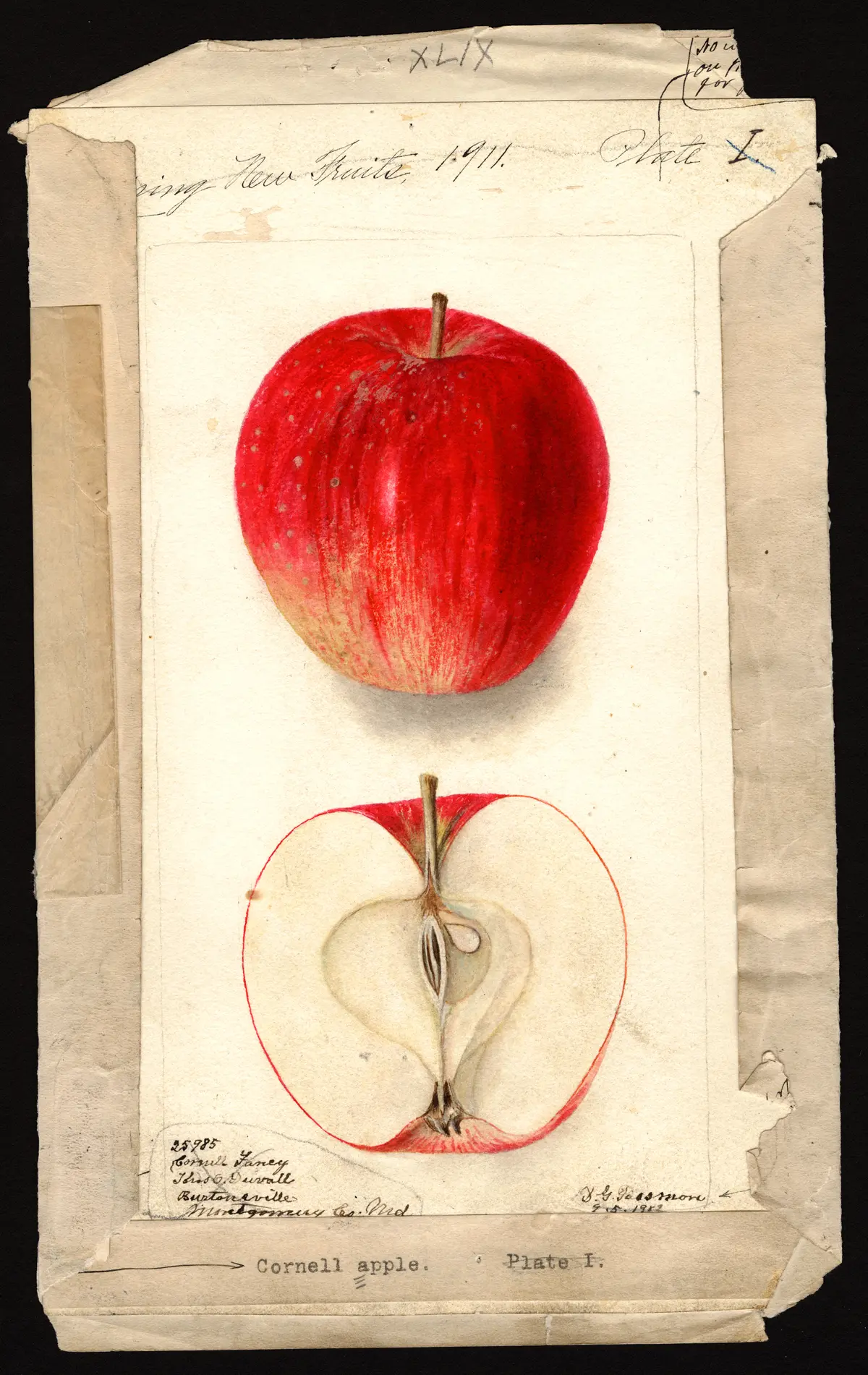
USDA Pomological Watercolor Collection
Cornell
Origin/History
Cornell originated in Pennsylvania (Downing; Elliott; Beach; Budd-Hansen), and was originated and valued in central Pennsylvania (Thomas; Budd-Hansen describes it as "A valuable September variety in Central Pennsylvania"). Beach notes that "It is but little known in New York." Beach's reference list traces the variety through pomological literature from Downing (1857) through Budd-Hansen (1903), with appearances in the American Pomological Society Catalogue (1862), Warder (1867), Thomas (1875), Barry (1883), Lyon's Michigan Horticultural Society Report (1890), Bailey's Annals of Horticulture (1892), Van Deman in Rural New Yorker (1902, with figure), and Farrand's Michigan Station Bulletin 205 (1903).
Tree
Tree vigorous and productive (Elliott; Downing; Budd-Hansen). Beach notes, citing Farrand's Michigan Station Bulletin, that "The tree sometimes lacks vigor and productiveness."
Fruit
Size: Sources differ. Elliott, Downing, Thomas, and Budd-Hansen describe the fruit as medium. Beach describes it as "usually of good medium size, sometimes large," and in the detailed FRUIT section as "above medium to large, uniform in size, somewhat variable in shape." Lowther describes it as medium-sized.
Form: Elliott, Downing, Thomas, and Budd-Hansen describe the form as oblong conical. Beach describes the form as "roundish conic to oblate conic, often quite strongly ribbed, irregular; sides usually unequal." Lowther describes the form as oblate.
Stem/Stalk: Stalk of medium length (Elliott; Downing; Thomas; Budd-Hansen). Beach: "Stem medium to rather long and slender."
Cavity: Rather large (Elliott; Downing; Thomas — "cavity large"; Budd-Hansen). Beach: "moderately deep to deep, moderately wide, often compressed, sometimes lipped, sometimes russeted, with the russet extending beyond the cavity."
Calyx: Closed, abrupt, corrugated (Elliott; Downing; Budd-Hansen describes calyx as closed). Beach: "below medium to rather large, closed or slightly open; lobes sometimes separated at the base, often upright, moderately acute." Calyx tube rather large, rather short, conical (Beach). Stamens median (Beach).
Basin: Thomas: "basin abrupt, furrowed." Budd-Hansen: "basin abrupt, corrugated." Beach: "deep, wide, rather abrupt, strongly furrowed, slightly wrinkled."
Skin: Waxen yellow, shaded and splashed with crimson (Elliott; Downing; Budd-Hansen: "surface waxen, yellow, shaded and splashed with crimson"). Thomas: "shaded and splashed red on yellow." Lowther: yellow-red skin. Beach gives the most detailed account: "moderately thick, tough, smooth, clear pale waxen yellow, partly overspread with thin attractive pinkish-red, often quite regularly splashed and striped with bright carmine. Dots conspicuous, variable, often large, irregular, russet or areolar with russet center, varying to small, light colored and submerged. Prevailing effect handsome red striped over clear yellow."
Flesh/Flavor: White, tender, crisp, juicy, with a pleasant subacid flavor (Elliott; Downing; Thomas — "flesh white, tender, with a pleasant sub-acid flavor"; Budd-Hansen — "flesh white, tender, crisp, juicy with a pleasant subacid flavor, very good"). Downing rates it "Very good." Beach: "Flesh tinged with yellow, often affected with 'Baldwin Spot,' firm, moderately coarse, crisp, moderately tender, juicy, agreeable, mild subacid, aromatic, rich, sprightly, very good." Beach also describes the fruit overall as "agreeable for dessert." Lowther: "Quality is good."
Core/Seeds: Core medium or large (Downing; Budd-Hansen: "Core medium to large"). Beach: "Core below medium, variable, nearly axile to decidedly abaxile; cells variable, open or closed; core lines meeting or slightly clasping. Carpels broadly ovate, slightly emarginate, sometimes tufted. Seeds numerous, rather large, dark brown, rather narrow, long, plump, acute to acuminate, sometimes tufted."
Season
September (Elliott; Thomas; Budd-Hansen — "A valuable September variety"). Beach: "in season from early September to November." Lowther: "Season is early autumn."
Uses
Beach notes it is "agreeable for dessert." Lowther: "Its use is both kitchen and market."
Subtypes/Variants
Not described in source.
Other
Lowther reports geographic distribution at the time of publication: "It is reported by 2 stations in the Northern Division, 6 stations in the Central Division, and 2 stations in the Southern Division; the asterisk on each division count indicates the variety is reported as adapted to more than one division."
Book Sources
Described in 6 period pomological works
- Beach, The Apples of New York Vol. 2 (1905)
- Downing, Fruits and Fruit Trees of America (1900)
- Elliott, The Western Fruit Book (1865)
- Lowther (ed.), Encyclopedia of Practical Horticulture (1914)
- Thomas, The American Fruit Culturist (1903)
- Budd & Hansen, Systematic Pomology (1914) — listed as Cornell Fancy
Nursery Catalog Sources
Found in 4 catalogs (1900–1912) from Illinois, Washington
- Central Experimental Farm , Dominion Department of Agriculture, Agassiz, British Columbia (under test; Bulletin No. 3, Second Series) — 1900
- Benjamin Buckman (personal inventory) , Farmingdale , Illinois — 1901
- Benjamin Buckman (personal inventory) , Farmingdale , Illinois — 1901 — listed as Cornell Fancy
- Vineland Nurseries Company , Clarkston , Washington — 1912
View original book sources (6)
— F.R. Elliott, The Western Fruit Book (1865)Cornell's Fancy. Cornell's Favorite. From Pennsylvania. Tree, vigorous and productive. Fruit, medium, oblong conical; skin, waxen yellow, shaded and splashed with crimson, stalk, of medium length; cavity, rather large; calyx, closed, abrupt, corrugated: flesh, white, tender, crisp, juicy, with a pleasant, sub-acid flavor. September. (Downing.)
— A.J. Downing, The Fruits and Fruit Trees of America (1900)Cornell's Favorite.
From Pennsylvania. Tree vigorous and productive.
Fruit medium, oblong, conical. Color waxen yellow, shaded and splashed with crimson. Stalk of medium length. Cavity rather large. Calyx closed, abrupt, corrugated. Flesh white, tender, crisp, juicy, with a pleasant subacid flavor. Core medium or large. Very good.
— John J. Thomas, The American Fruit Culturist (1903)Cornell. (Cornell's Fancy.) Medium, oblong conic; shaded and splashed red on yellow; stalk medium, cavity large; basin abrupt, furrowed; flesh white, tender, with a pleasant sub-acid flavor. September. Originated and valued in central Pennsylvania.
— S.A. Beach, The Apples of New York, Vol. 2 (1905)CORNELL.
REFERENCES. 1. Downing, 1857:131. 2. Am. Pom. Soc. Cat., 1862. 3. Warder, 1867:716. 4. Thomas, 1875:200. 5. Barry, 1883:337. 6. Lyon, Mich. Hort. Soc. Rpt., 1890:290. 7. Bailey, An. Hort., 1892:237. 8. Van Deman, Rural N. Y., 61:671. 1902. fig. 9. Farrand, Mich. Sta. Bul., 205:44. 1903. 10. Budd-Hansen, 1903:67.
SYNONYMS. CORNELL (6, 8, 9). CORNELL FANCY (1, 2, 3, 4, 5, 7). Cornell Fancy (8). CORNELL Fancy (10). Cornell's Favourite (1).
Fruit usually of good medium size, sometimes large, waxen yellow and red, agreeable for dessert, in season from early September to November. The tree sometimes lacks vigor and productiveness (9).
Historical. Origin Pennsylvania (1). It is but little known in New York.
FRUIT.
Fruit above medium to large, uniform in size, somewhat variable in shape. Form roundish conic to oblate conic, often quite strongly ribbed, irregular; sides usually unequal. Stem medium to rather long and slender. Cavity moderately deep to deep, moderately wide, often compressed, sometimes lipped, sometimes russeted, with the russet extending beyond the cavity. Calyx below medium to rather large, closed or slightly open; lobes sometimes separated at the base, often upright, moderately acute. Basin deep, wide, rather abrupt, strongly furrowed, slightly wrinkled. Skin moderately thick, tough, smooth, clear pale waxen yellow, partly overspread with thin attractive pinkish-red, often quite regularly splashed and striped with bright carmine. Dots conspicuous, variable, often large, irregular, russet or areolar with russet center, varying to small, light colored and submerged. Prevailing effect handsome red striped over clear yellow.
Calyx tube rather large, rather short, conical. Stamens median.
Core below medium, variable, nearly axile to decidedly abaxile; cells variable, open or closed; core lines meeting or slightly clasping. Carpels broadly ovate, slightly emarginate, sometimes tufted. Seeds numerous, rather large, dark brown, rather narrow, long, plump, acute to acuminate, sometimes tufted.
Flesh tinged with yellow, often affected with "Baldwin Spot," firm, moderately coarse, crisp, moderately tender, juicy, agreeable, mild subacid, aromatic, rich, sprightly, very good.
Season early September to November.
— J.L. Budd & N.E. Hansen, American Horticultural Manual, Part II: Systematic Pomology (1914)Cornell Fancy.—Origin, Pennsylvania; tree vigorous and productive. A valuable September variety in Central Pennsylvania.
Fruit medium, oblong, conical; surface waxen, yellow, shaded and splashed with crimson; cavity rather large; stem medium; basin abrupt, corrugated; calyx closed. Core medium to large; flesh white, tender, crisp, juicy with a pleasant subacid flavor, very good.
— Granville Lowther (ed.), Encyclopedia of Practical Horticulture (1914)Cornell is a medium-sized apple of oblate form with yellow-red skin. Quality is good. Its use is both kitchen and market. Season is early autumn. It is reported by 2 stations in the Northern Division, 6 stations in the Central Division, and 2 stations in the Southern Division; the asterisk on each division count indicates the variety is reported as adapted to more than one division.